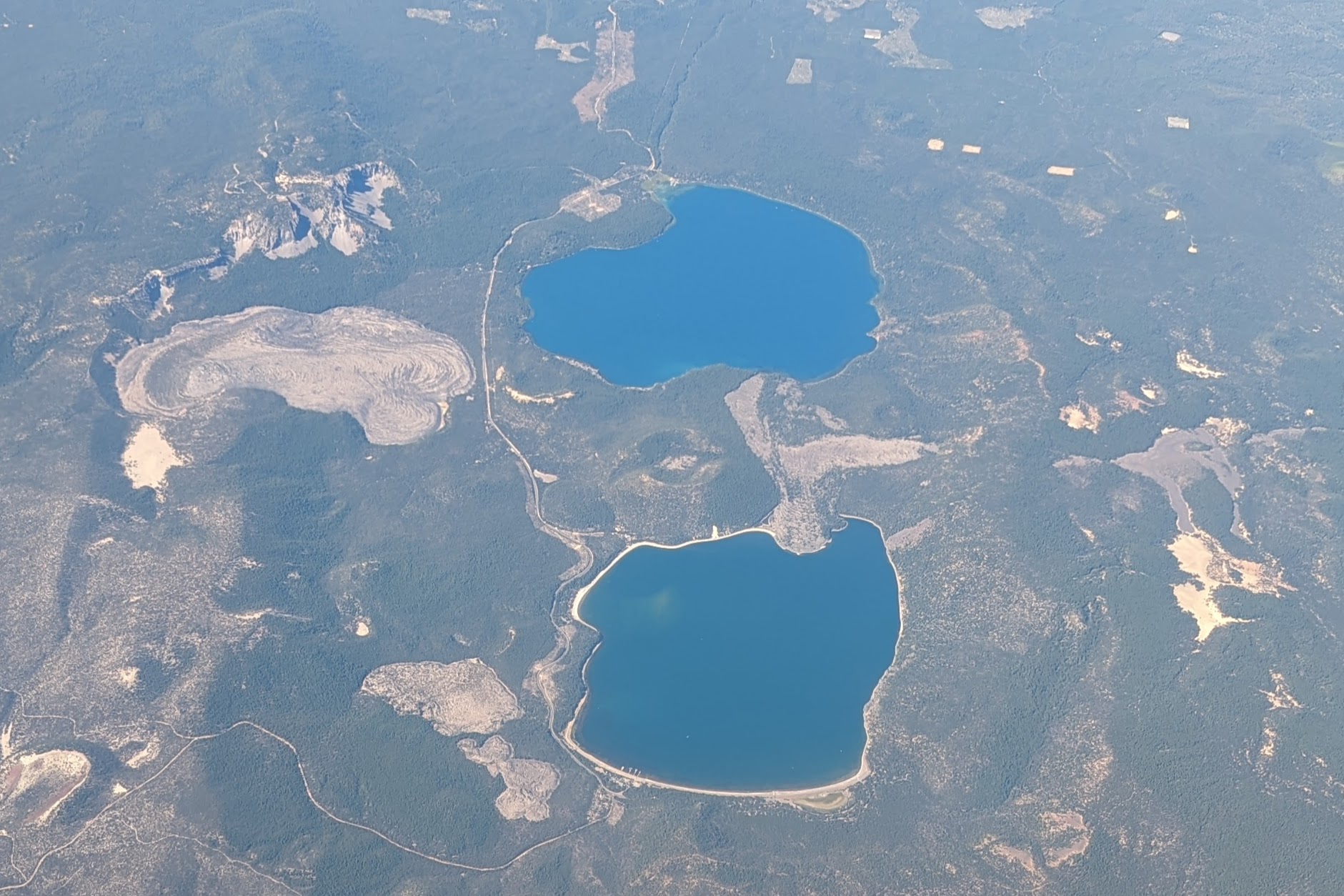
Newberry Volcano
Before Neil Armstrong set foot on lunar soil, he walked across the black obsidian flows of central Oregon. NASA geologists chose this unlikely training ground in 1964 because Newberry Volcano offered something no other site could match: a complete catalog of volcanic features in one sprawling landscape. The lava tubes, cinder cones, pumice fields, and obsidian flows that would help Apollo crews identify lunar geology remain exactly where the astronauts studied them, scattered across the flanks of the largest volcano in the entire Cascade Arc.
A Mountain Hiding as a Mountain Range
Newberry Volcano does not look like a volcano. Rising south of Bend, Oregon, its massive shield spreads so wide that early settlers mistook it for an entire mountain range. The numbers explain the confusion: the volcano stretches nearly 40 miles from north to south, spans 20 miles east to west, and contains more than 400 individual vents, more than any other volcano in the contiguous United States. At its summit, Paulina Peak reaches 7,984 feet, but the peak represents just one point on a broad caldera rim that cradles two alpine lakes. The volcano's last eruption, just 1,300 years ago, left behind the Big Obsidian Flow, a glittering black field of volcanic glass that still looks freshly cooled.
Fire Beneath the Water
Twin lakes fill the heart of Newberry's caldera. Paulina Lake stretches across 1,530 acres with depths reaching 250 feet, while East Lake covers 1,050 acres beside it. A narrow isthmus of rhyolite lava separates them, with the Central Pumice cone rising between. Hot springs bubble along both lakeshores, reminders that the volcano merely sleeps. The USGS rates Newberry as having a 'very high' threat level, monitoring it with seismometers and GPS instruments that detect even subtle swelling from underground magma movement. Researchers count 10 to 15 small earthquakes here each year. The presence of all that water makes any future eruption potentially more explosive, as magma meeting lake water could generate violent steam eruptions and fast-moving lahars capable of reaching the La Pine valley within 30 minutes.
Obsidian Highway
For more than 10,000 years, Native American peoples harvested obsidian from Newberry's caldera. This volcanic glass, sharper than surgical steel when fractured correctly, traveled along trade networks stretching from the Pacific Coast to the Great Plains. Archaeologists excavating near Paulina Lake in 1992 discovered a housing structure with central hearth dated to 11,000 years ago, evidence of communities that returned to this rich quarry generation after generation despite periodic eruptions that must have disrupted their lives. The first European to reach the crater, trapper Peter Skene Ogden, arrived in 1826. The volcano's namesake, surgeon and geologist John Strong Newberry, explored central Oregon in 1855 but ironically never visited the volcano that would bear his name.
Training Ground for the Moon
In October 1964 and July 1966, NASA brought Apollo astronauts to Newberry to study volcanic geology. The varied terrain offered perfect proxies for lunar landscapes: cinder cones, pumice deposits, lava tubes, and obsidian flows all within hiking distance. Neil Armstrong, Buzz Aldrin, Alan Bean, Edgar Mitchell, James Irwin, and Charlie Duke walked these same trails before their historic missions. Today, the Lava River Cave, Oregon's longest continuous lava tube at over a mile in length, remains the most popular attraction within the Newberry National Volcanic Monument. The Lava Cast Forest, where a 6,000-year-old eruption molded standing trees into hollow stone pillars, preserves another piece of the geological puzzle that helped put humans on the Moon.
Living Landscape
Despite its volcanic drama, Newberry supports rich ecosystems. Oregon's largest ponderosa pine grows here, along with forests of lodgepole, whitebark, and jack pine. Wildlife ranges from burrowing owls and kangaroo rats in the dry lowlands to Roosevelt elk and American pika on the forested slopes. The monument's 11 kipukas, islands of older forest surrounded by younger lava flows, preserve habitats largely untouched by human disturbance. Each year, 250,000 visitors come to fish for trout, bike the crater rim, or simply stand at the edge of the Big Obsidian Flow and contemplate the restless fire that shaped this landscape and may yet reshape it again.
From the Air
Newberry Volcano is located at 43.69N, 121.25W, approximately 20 miles south of Bend, Oregon. Best viewed from 8,000-10,000 feet AGL to appreciate the massive caldera containing Paulina Lake and East Lake. The distinctive dark Big Obsidian Flow is visible on the caldera's south flank. Paulina Peak (7,984 ft) marks the caldera rim's highest point. Nearby airports: KBDN (Bend Municipal) 20nm north, KRDM (Redmond Municipal) 30nm north. Expect mountain wave turbulence in westerly winds. The area lies within the Deschutes National Forest.