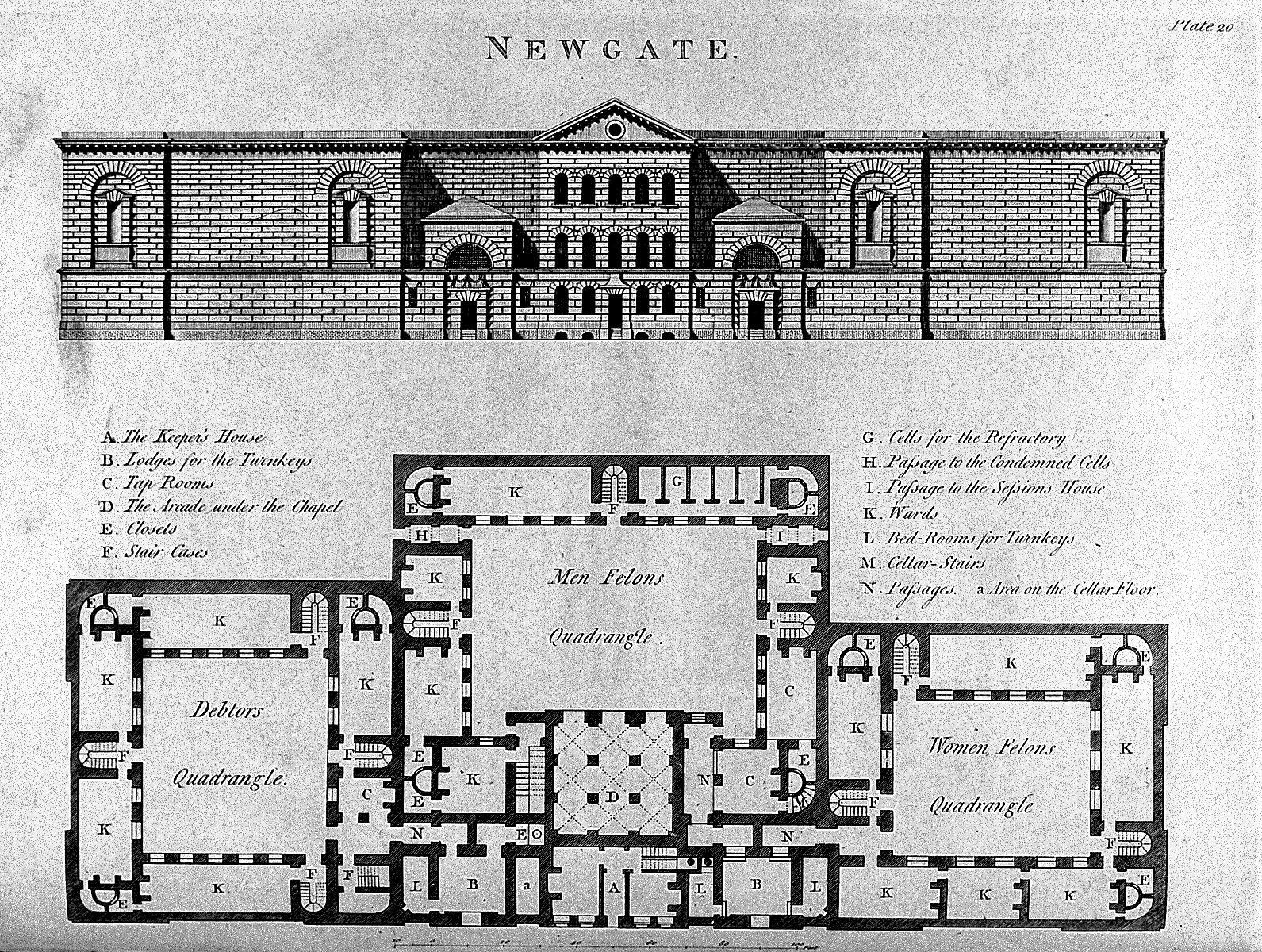
Newgate Prison
The spot where the Old Bailey now stands was, for seven centuries, the most feared address in London. Newgate Prison occupied the site from 1188 to 1902, growing from a gatehouse lockup into a vast institution that processed thieves, murderers, debtors, political prisoners, and the merely unfortunate through its filthy corridors. Its name became a byword for suffering. When Londoners said "Newgate," they did not mean a building. They meant a condition.
A Gate Becomes a Hell
Newgate began as one of the gates in London's Roman wall, converted into a prison in the 12th century as part of Henry II's legal reforms requiring places to hold the accused while royal judges determined their fate. By the medieval period, it was already appalling. Prisoners with money could buy better cells, food, and even temporary release. Those without funds were crammed into underground dungeons where disease, particularly gaol fever, a form of typhus, killed inmates and occasionally spread into the courtrooms next door, killing judges and jurors. The prison was rebuilt or repaired after nearly every crisis London threw at it: the Peasants' Revolt of 1381, the Great Fire of 1666, and the Gordon Riots of 1780, when a mob burned it to the ground and freed 300 prisoners.
The Theatre of Execution
In the late 18th century, public hangings were moved to Newgate from the gallows at Tyburn, two miles to the west. A portable scaffold was erected in the street outside the prison on execution mornings, and crowds gathered in their thousands to watch. The scene was part carnival, part horror. Street vendors sold food and drink, spectators rented windows in surrounding buildings for a better view, and pickpockets worked the crowd with the efficiency of professionals who knew exactly when everyone's attention would be elsewhere. Charles Dickens attended a hanging at Newgate in 1849 and was so revolted by the crowd's behavior that he campaigned publicly for an end to public executions. His efforts contributed to the Capital Punishment Amendment Act of 1868, which moved hangings behind the prison walls, but executions at Newgate continued privately until 1902.
Reform and the Prison's Twilight
The prison that visitors saw in its final century was the version rebuilt by George Dance the Younger in 1782, a severe neoclassical structure deliberately designed with windowless walls to convey the grimness of incarceration to passersby. The reformer Elizabeth Fry began visiting Newgate's female prisoners in 1813 and was horrified to find women and children crammed together in conditions she described as worse than anything she had imagined. Her advocacy for separate accommodation, education, and basic dignity for women prisoners helped launch the modern prison reform movement. By the late 19th century, Newgate was obsolete, its cells too cramped, its infrastructure too old, and its reputation too stained to serve any reforming purpose. The last prisoners were transferred out in 1902.
What Stands in Its Place
Demolition began in 1904, and by 1907 the Central Criminal Court, universally known as the Old Bailey, had risen on the site. The connection between the court and the prison was not new; criminal courtrooms had been attached to Newgate in various forms for centuries, and the name "Old Bailey" originally referred to the street running alongside the prison wall. Today, the bronze figure of Lady Justice atop the Old Bailey dome stands roughly where Newgate's execution scaffold once drew its crowds. Nothing of the prison itself survives above ground. But the name persists in the culture, shorthand for a certain kind of institutional cruelty that London once considered ordinary. Daniel Defoe, Ben Jonson, and Giacomo Casanova all spent time inside its walls. For more than seven hundred years, if London wanted to make someone disappear, it sent them to Newgate.
From the Air
Located at 51.515N, 0.102W at the corner of Newgate Street and Old Bailey in the City of London. The site is now occupied by the Central Criminal Court (Old Bailey), identifiable by its distinctive dome topped with the gold statue of Lady Justice. Nearest airports: EGLC (London City, 5nm E), EGLL (Heathrow, 14nm W). Best viewed at 2,000-3,000 ft AGL.