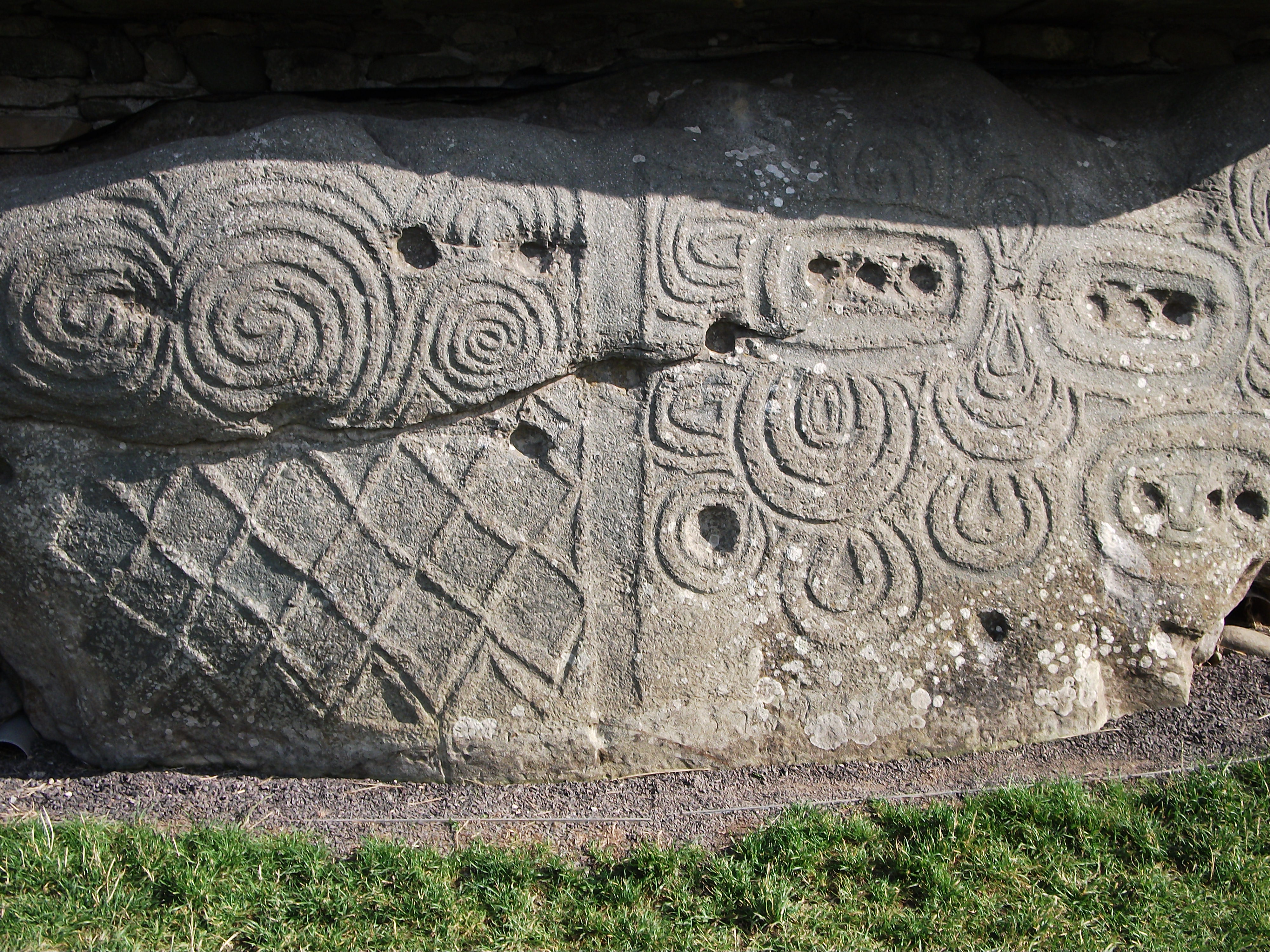
Newgrange
Every year on the morning of the winter solstice, sunlight enters a narrow opening above the entrance of Newgrange and travels seventeen meters down a stone passage to illuminate the chamber at its heart. This alignment has held for over five thousand years. Built around 3200 BC in County Meath, Newgrange predates Stonehenge by roughly a thousand years and the Great Pyramid of Giza by six centuries. It is not merely old. It is a feat of Neolithic engineering that modern architects still study with admiration.
Constructed from Distant Mountains
Newgrange is a circular mound roughly 85 meters in diameter and 13 meters high, covering an area of about one acre. Its facade is made of white quartz cobblestones that gleam in even weak Irish light, interspersed with rounded granite boulders. The quartz was hauled from the Wicklow Mountains, some 80 kilometers to the south; other materials came from the Mourne Mountains to the north. Ninety-seven kerbstones ring the base, many carved with the spirals, lozenges, and concentric arcs of megalithic art. The entrance stone, with its famous triple spiral, is one of the most recognized pieces of prehistoric art in Europe. Inside, the passage leads to a cruciform chamber roofed by a corbelled vault that has remained waterproof for five millennia.
The Roofbox and the Solstice
The feature that distinguishes Newgrange from other passage tombs is the roofbox: a carefully constructed opening above the main entrance, separate from the passage itself. For about seventeen minutes around sunrise on the winter solstice, light enters through this slot, travels the full length of the passage, and illuminates the back wall of the chamber. The precision required to achieve this alignment -- accounting for the slope of the passage, the angle of the hillside, and the specific arc of the midwinter sun at this latitude -- suggests a sophisticated understanding of astronomy. Today, a lottery determines which of the roughly thirty thousand annual applicants will witness the event in person. On a clear morning, the effect is extraordinary: a blade of golden light slowly widening across a floor that has waited in darkness since the previous winter.
Layers of Meaning, Layers of Time
Burnt and unburnt human bones were found in the chamber, along with possible grave goods, suggesting Newgrange served as a tomb. But its use almost certainly extended beyond burial. The scale of construction -- estimated at three hundred workers over twenty years -- implies a site of communal and ceremonial importance. After its initial period of use, roughly a thousand years, Newgrange fell into disuse and was gradually covered by soil and vegetation. The surrounding area continued to attract human activity. Beaker pottery fragments suggest visits during the Bronze Age. Roman coins and gold artifacts found nearby indicate contact with the Roman world between the first and fourth centuries AD. In medieval Irish mythology, Newgrange appears as the dwelling place of the god Dagda and later his son Aengus.
Rediscovery and Restoration
Newgrange was 'rediscovered' in 1699 when laborers quarrying stone removed material from the mound's surface, revealing the passage entrance. Antiquarians began visiting almost immediately. The site was excavated and substantially reconstructed between 1962 and 1975 under archaeologist Michael J. O'Kelly, who confirmed the solstice alignment in 1967. O'Kelly's reconstruction of the white quartz facade remains controversial among archaeologists -- some believe the quartz originally formed a plaza in front of the mound rather than a vertical wall. Today, Newgrange is part of the Bru na Boinne UNESCO World Heritage Site, along with the nearby passage tombs of Knowth and Dowth. The visitor center on the south bank of the River Boyne manages access, with shuttle buses ferrying visitors to a monument that has drawn people to this bend in the river for longer than recorded history.
From the Air
Newgrange sits at 53.69N, 6.48W on a ridge overlooking the River Boyne in County Meath. The large white-faced mound is visible from altitude in clear conditions, particularly striking against the green farmland of the Boyne Valley. Look for it approximately 8 km west of Drogheda. Nearest airports: Dublin Airport (EIDW) about 30 nm south, Gormanston (EIME) about 15 nm southeast. Best viewed below 3,000 ft AGL.