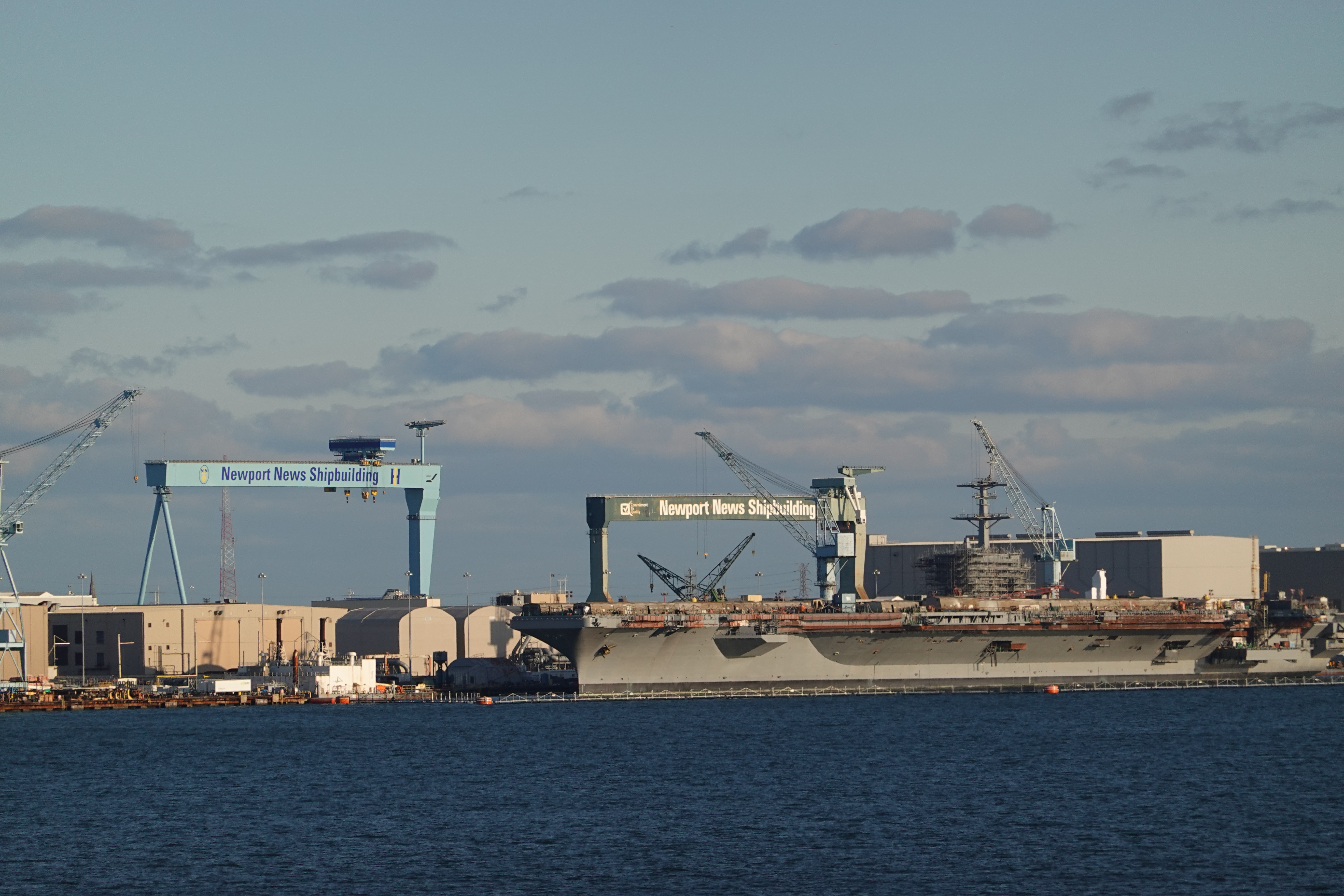
Newport News Shipbuilding
Its first ship was a tugboat named Dorothy, delivered in 1891. Today, Newport News Shipbuilding is the only facility on Earth that designs, builds, and refuels the nuclear-powered aircraft carriers of the United States Navy. That trajectory, from a modest tug to the most powerful warships ever constructed, tracks the arc of American naval power itself. Founded as the Chesapeake Dry Dock and Construction Company in 1886, the shipyard stretches along the waterfront of Newport News, Virginia, its cranes visible for miles along the James River, a permanent fixture of the Hampton Roads skyline.
Coal, Rails, and a Dreamer's Ambition
The shipyard exists because of one man's refusal to stop building. Collis P. Huntington, the industrialist who helped complete the transcontinental railroad, funded the Chesapeake and Ohio Railroad from Richmond to the Ohio River in the early 1870s. That rail line soon carried bituminous coal from the isolated fields along the New River and Kanawha River in West Virginia. In 1881, the Peninsula Extension pushed the C&O down the Virginia Peninsula to a new coal pier on Hampton Roads near the small community of Newport News Point. But Huntington wanted more than a coal terminal. In 1886, he built a shipyard to repair the ships servicing this transportation hub. By 1897, just six years after delivering Dorothy, Newport News Shipbuilding had built three warships for the U.S. Navy.
Presidents, Torpedoes, and Two World Wars
The shipyard's early leaders were inseparable from the city they helped create. Walter A. Post, one of the builders of the C&O Railway's terminals, became the first mayor of Newport News when it achieved independent city status in 1896, and later served as shipyard president. His successor, Albert Lloyd Hopkins, died in May 1915 aboard the Lusitania, torpedoed by a German U-boat off the Irish coast. Homer Lenoir Ferguson then took the helm and guided the company through both world wars, co-founding the nearby Mariners' Museum with Archer Huntington along the way. Between 1907 and 1923, Newport News built six of the Navy's 22 dreadnoughts, and seven of the 16 battleships in President Theodore Roosevelt's Great White Fleet had been constructed in its yards. The yard delivered 25 destroyers between 1918 and 1920 alone.
The Nuclear Age on the Waterfront
The post-war decades brought transformations that matched the scale of the vessels being built. In 1954, Newport News partnered with Westinghouse and the Navy to develop a prototype nuclear reactor for carrier propulsion. The yard launched its first nuclear-powered submarine in 1959 and designed the USS Enterprise in 1960. In the 1970s, the yard launched two of the largest tankers ever built in the Western Hemisphere and constructed liquefied natural gas carriers exceeding 390,000 deadweight tons, the largest ever built in America. The shipyard also built the passenger liner SS United States, which set a transatlantic speed record that still stands. Since 1999, the yard has focused exclusively on warships for the Navy, performing the four-year refueling and complex overhaul work that keeps the Nimitz-class carriers operational.
A Company Town Reinvented
When World War I demanded rapid expansion, Newport News lacked the housing for thousands of new workers. The federal government built Hilton Village just northwest of the shipyard in 1918, one of the first planned communities in America. Planners consulted the wives of shipyard workers, and 14 house plans emerged for 500 English-village-style homes. After the war, Henry Huntington acquired the village and facilitated sales to shipyard employees. Three streets were named for former shipyard presidents: Post, Hopkins, and Ferguson. The company itself changed hands multiple times, merging with Tenneco in 1968, spinning off in 1996, being acquired by Northrop Grumman for $2.6 billion in 2001, and finally emerging in 2011 as a division of Huntington Ingalls Industries, the largest military shipbuilder in America.
From the Air
Located at 36.992N, 76.445W along the James River waterfront in Newport News, Virginia. The shipyard's massive dry docks, gantry cranes, and aircraft carriers under construction or overhaul are unmistakable from the air. Look for the enormous gray hulls of Nimitz-class and Ford-class carriers berthed along the waterfront. Nearest airport: Newport News/Williamsburg International (KPHF) approximately 6nm northwest. Norfolk International (KORF) approximately 15nm southeast across Hampton Roads. The yard is directly adjacent to the James River Bridge approach. Best viewed at 3,000-5,000 feet AGL. Caution: restricted airspace may apply near active naval facilities.