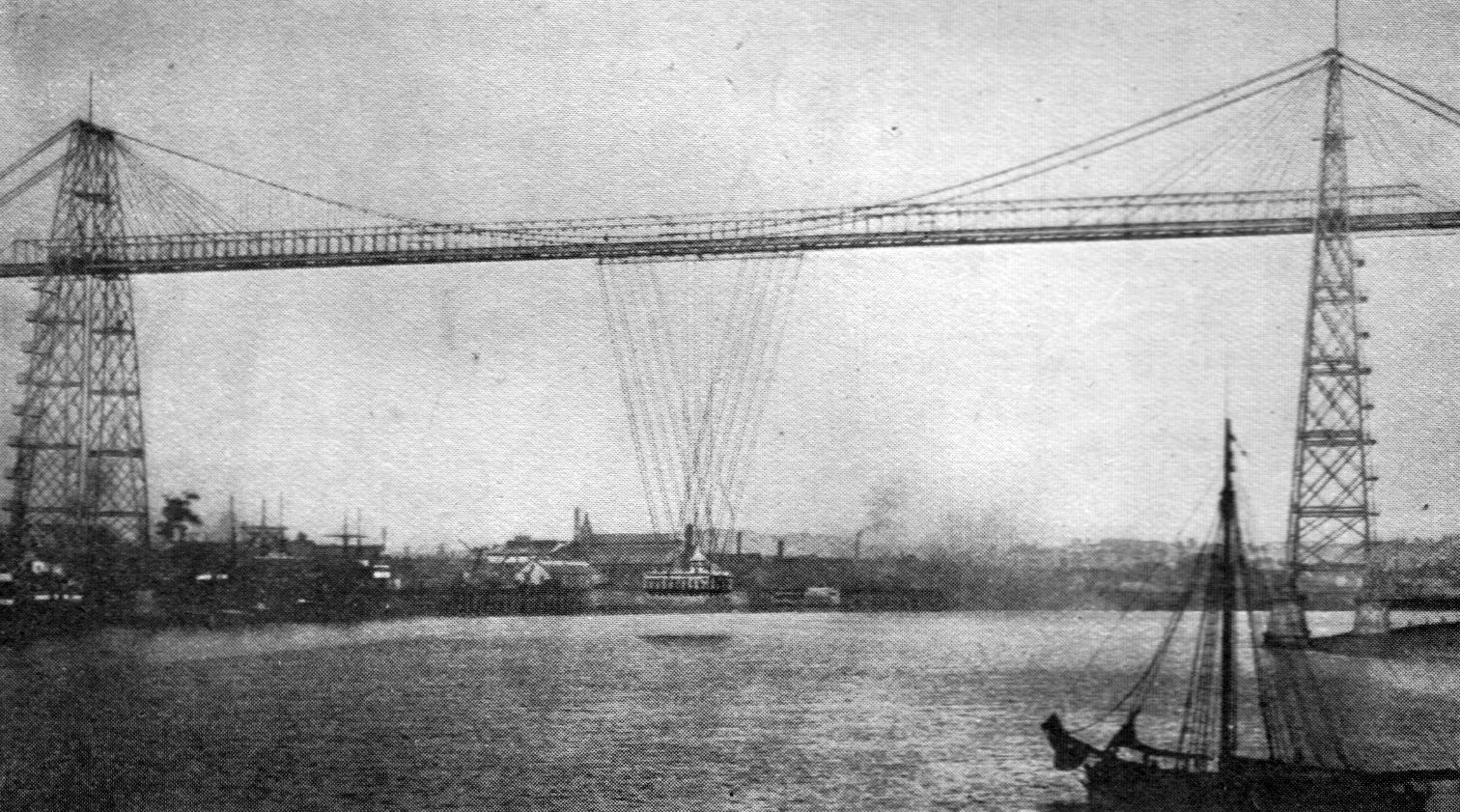
Newport Transporter Bridge
It does not look like a bridge. It looks like two Eiffel Towers joined at the top by a steel lattice beam, with a tiny gondola dangling from cables far below. That is essentially what the Newport Transporter Bridge is: a structure so unusual that only a few dozen were ever built worldwide, and fewer than ten survive in operation. The one spanning the River Usk in Newport, designed by French engineer Ferdinand Arnodin and opened in 1906, is the oldest and largest of the three historic transporter bridges remaining in Britain. It is also the only one still working.
An Ingenious Problem, Solved
The challenge that produced this improbable structure was entirely practical. Newport needed a crossing a few miles south of the city centre, but the river banks at that point were so low that a conventional bridge would have required impossibly long approach ramps to allow ships to pass underneath. A ferry could not operate at low tide. The river was too narrow for a swing bridge or a drawbridge. Arnodin's solution was to build high and hang low: two towers rising 73.6 metres, connected by a boom far above the waterline, from which a suspended gondola ferries people and vehicles across. Electric motors drive the gondola at three metres per second, a steady, gliding crossing that feels nothing like any other bridge in the world.
A Century of Near-Death Experiences
The bridge has survived by the narrowest of margins, repeatedly. It was shut down in 1985 due to wear and tear, and only a three-million-pound refurbishment brought it back in 1995. Service was suspended again in December 2008, with a two-million-pound repair bill looming. Grants from the Welsh Government, Newport City Council, and Cadw funded another restoration, and the bridge reopened in July 2010, only to close again in February 2011 for further operational problems. Each closure has sparked the same anxious question in Newport: will this be the time it does not come back? Each time, so far, the answer has been the same. The bridge endures because the city refuses to let it go.
Newport's Rocky and Other Stories
The bridge has accumulated stories the way old structures do. The 1959 film Tiger Bay used it as a backdrop, though the film was set in Cardiff, giving audiences the wrong impression about which city owned this marvel. Boxer David Pearce, the undefeated Welsh and British Heavyweight Champion from 1983 to 1985, used to run up the bridge steps as part of his training, and a painting of him hangs in the visitor centre. The bridge was the centrepiece of Newport's millennium celebrations in 2000, fireworks arcing from its length, and its centenary in 2006 was marked by the Crow Point Festival. Visitors can climb the towers and walk across the upper deck, seventy metres above the Usk, for a view that makes the city's industrial past and post-industrial present equally visible.
Last of Its Kind
When the Tees Transporter Bridge at Middlesbrough closed on safety grounds in 2019, Newport's bridge became the last operational transporter bridge in Britain. Its Cadw listing describes it as 'the oldest and largest of the three historic transporter bridges which remain in Britain, and also the largest of eight such bridges which remain worldwide.' That rarity gives it a significance beyond local pride. The transporter bridge was a brief, brilliant chapter in engineering history, a solution so elegant and so specific to its circumstances that the world built a handful and then moved on. Newport's bridge is a working reminder that ingenuity sometimes produces things too beautiful to be merely functional, and that the most interesting answers often come from the most awkward questions.
From the Air
Located at 51.57N, 2.99W, spanning the River Usk in Newport, South Wales. The bridge's distinctive twin-tower structure with its high-level boom is unmistakable from the air. Cardiff Airport (EGFF) lies 15 miles to the southwest; Bristol Airport (EGGD) is 20 miles east. Best viewed at 1,500-2,500 feet for the full structural profile.