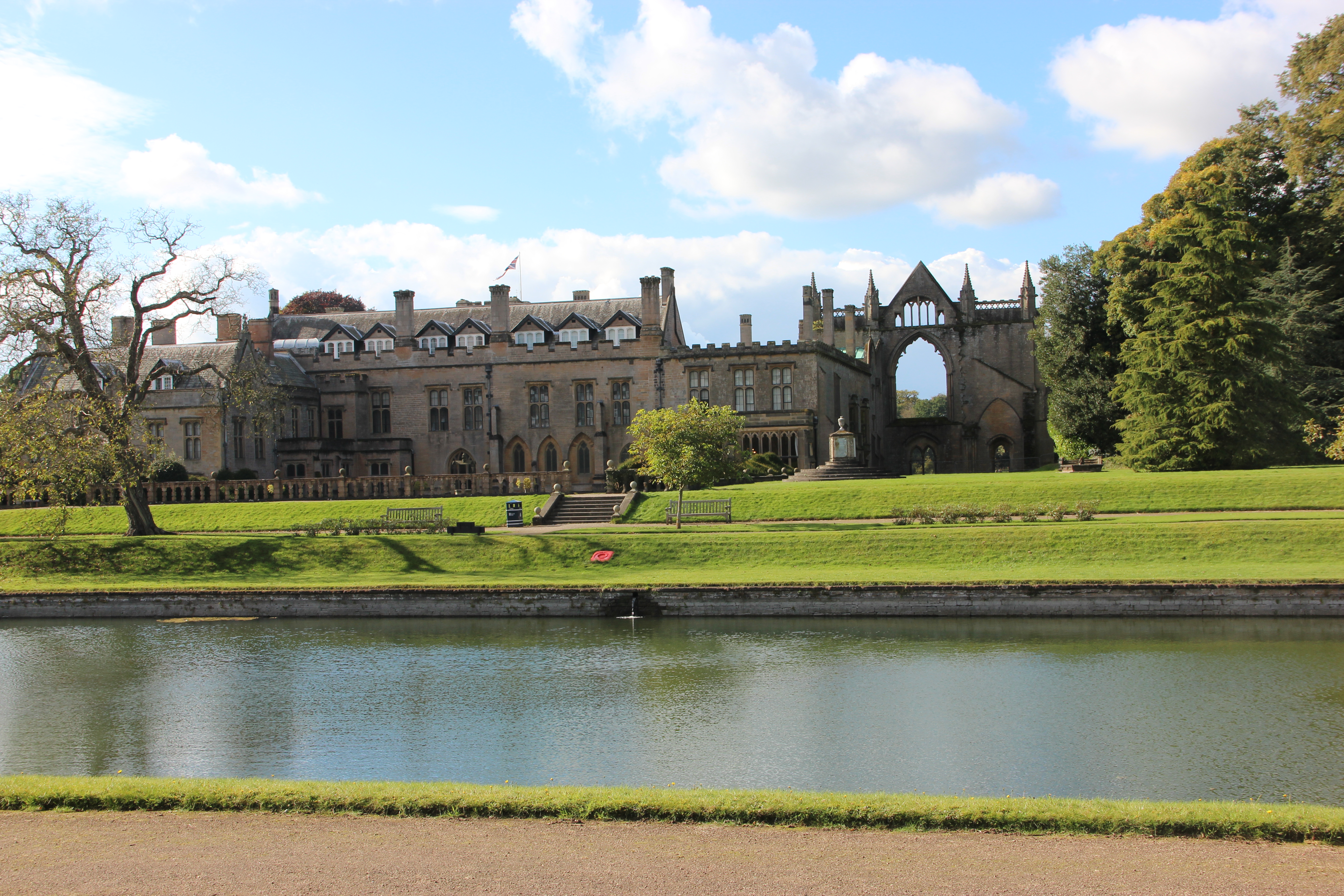
Newstead Abbey
The dog's monument is larger than the master's. In the grounds of Newstead Abbey, a substantial stone memorial marks the grave of Boatswain, a Newfoundland who died of rabies in 1808. The epitaph inscribed above it -- "near this Spot are deposited the Remains of one who possessed Beauty without Vanity, Strength without Insolence" -- became one of the most quoted passages attributed to Lord Byron, though his friend John Hobhouse actually wrote it. Byron wanted to be buried alongside Boatswain. He never was. But the gesture captures everything about this place: grandiose, romantic, slightly absurd, and haunted by the gap between what the Byrons aspired to and what they could afford.
A King's Penance
Newstead was never actually an abbey. It was a priory -- the priory of St. Mary of Newstead, a house of Augustinian Canons founded around 1170 by Henry II. The king established it as one of many penances following the murder of Thomas Becket, the archbishop whose martyrdom haunted Henry for the rest of his reign. The priory was rebuilt and extended in the late 13th century, with further additions in the 15th century including a Great Hall and Prior's Lodgings. For nearly four centuries the canons lived and prayed here in the Nottinghamshire countryside, until Henry VIII's Dissolution of the Monasteries swept through in 1539-40. Sir John Byron of Colwick received the property from the Crown on 26 May 1540 and began converting it into a country house, preserving the medieval shell while adding domestic rooms within and around it.
The Wicked Lord and the Boy Poet
The Byron family's relationship with Newstead reads like a Gothic novel. The 4th Baron landscaped the gardens beautifully and assembled a celebrated art collection, but his son, the 5th Baron -- William, known to later generations as "the Wicked Lord" -- spent the estate into ruin. As a young man, William built Gothic follies and staged mock naval battles on the lake. When his heir eloped with a cousin instead of marrying a wealthy heiress, the old baron's finances collapsed entirely. He stripped the house of its art, furniture, and even its trees to raise cash. He outlived all four of his children and his only grandson, who was killed by cannon fire in Corsica in 1794. When the 5th Baron died in 1798, the title and the ruined estate passed to his ten-year-old great-nephew, George Gordon Byron -- the future poet.
Byron's Romantic Ruin
The young Lord Byron was awed by Newstead but could not afford it. Income from the estate had fallen to just 800 pounds a year, and the buildings needed extensive repairs. "Thro' thy battlements, Newstead, the hollow winds whistle," he wrote. "Thou, the hall of my fathers, art gone to decay." He tried repeatedly to sell the place. An auction in 1812 failed to reach a satisfactory price. A buyer offered 140,000 pounds, then paid only 5,000 of the deposit before the deal collapsed. Byron accused the man of robbing the wine cellar. Desperate for money, the poet proposed marriage to the heiress Anne Isabella Milbanke -- a decision that would end in one of the most scandalous separations of the 19th century. Only in 1818, during his exile in Italy, did Byron finally sell Newstead to Thomas Wildman, a former schoolmate from Harrow who was heir to Jamaican plantations, for 94,500 pounds.
From Livingstone to the National Trust
Wildman poured money into restoring Newstead, and the architect John Shaw Sr. designed new additions. When Wildman's widow sold the estate in 1861, the buyer was William Frederick Webb, an African explorer whose guests included David Livingstone. The property passed through Webb's descendants until his grandson sold it to the philanthropist Sir Julien Cahn, who presented it to Nottingham Corporation in 1931. Today the abbey is a museum housing Byron memorabilia, owned by Nottingham City Council but on the heritage at risk register due to water ingress at the roofs. The grounds remain open -- gardens, lake, and the medieval facade that inspired a poet who could never quite afford to live there. Boatswain's monument still stands, weathered but solid, larger than any memorial to the humans who passed through this place and moved on.
From the Air
Newstead Abbey lies at 53.08°N, 1.19°W in Nottinghamshire, set within parkland north of Nottingham. The medieval ruins and lake are visible from lower altitudes. East Midlands Airport (EGNX) is approximately 15nm to the southwest. Sherwood Forest lies to the north. The abbey's grounds cover a substantial area of green parkland amid surrounding farmland.