Nezu Museum
Step through the entrance and the city vanishes. A long corridor of bamboo-slatted walls and dark stone narrows toward daylight, and by the time you emerge into the museum's interior, the boutiques and fashion houses of Omotesando feel like another country. This is exactly what architect Kengo Kuma intended when he redesigned the Nezu Museum in 2009 -- a threshold experience, a passage from the frenetic to the contemplative. The building itself is barely visible from the street, hidden behind a towering bamboo hedge, its low-slung roof of woven reeds hovering just above the garden canopy. Inside waits one of Tokyo's finest private art collections, gathered by a man they once called the King of Railways.
The Railroad King's Eye
Nezu Kaichiro was born in 1860 in Yamanashi Prefecture and moved to Tokyo in 1897, where he made his fortune through stock investments before becoming president of Tobu Railway in 1905. He grew the company into one of the largest private rail operators in the Kanto region, earning the nickname that would follow him through history. But Kaichiro's real passion was collecting. Unlike most Meiji-era industrialists who focused on a single genre, he gathered works across an extraordinary range -- paintings, calligraphy, sculpture, metalwork, ceramics, lacquerware, bamboo craft, textiles, armor, and archaeological artifacts. His devotion to the tea ceremony deepened his acquisitive instinct, and his bold, sometimes reckless approach to buying became almost legendary among dealers. When he died in January 1940, his son established a foundation to preserve the collection, and the museum opened to the public in 1941.
Surviving the Flames
The timing was precarious. Japan was already at war, and by 1945, American bombers were systematically destroying Tokyo. The Nezu estate in Minami-Aoyama was hit during the devastating firebombing raids of May 1945 -- the original buildings burned to the ground. But the collection survived. It had been evacuated from central Tokyo and hidden away, a common practice among Japan's museum custodians who understood what was coming. Exhibitions resumed as early as 1946, amid the rubble and reconstruction of a shattered city. For decades the museum operated from rebuilt structures on the same grounds, maintaining a quiet, almost reclusive presence in an increasingly fashionable neighborhood. The large-scale renovation that closed the museum from 2006 to 2009 gave it the Kengo Kuma building it occupies today -- a structure that feels simultaneously brand new and centuries old.
Irises in Gold
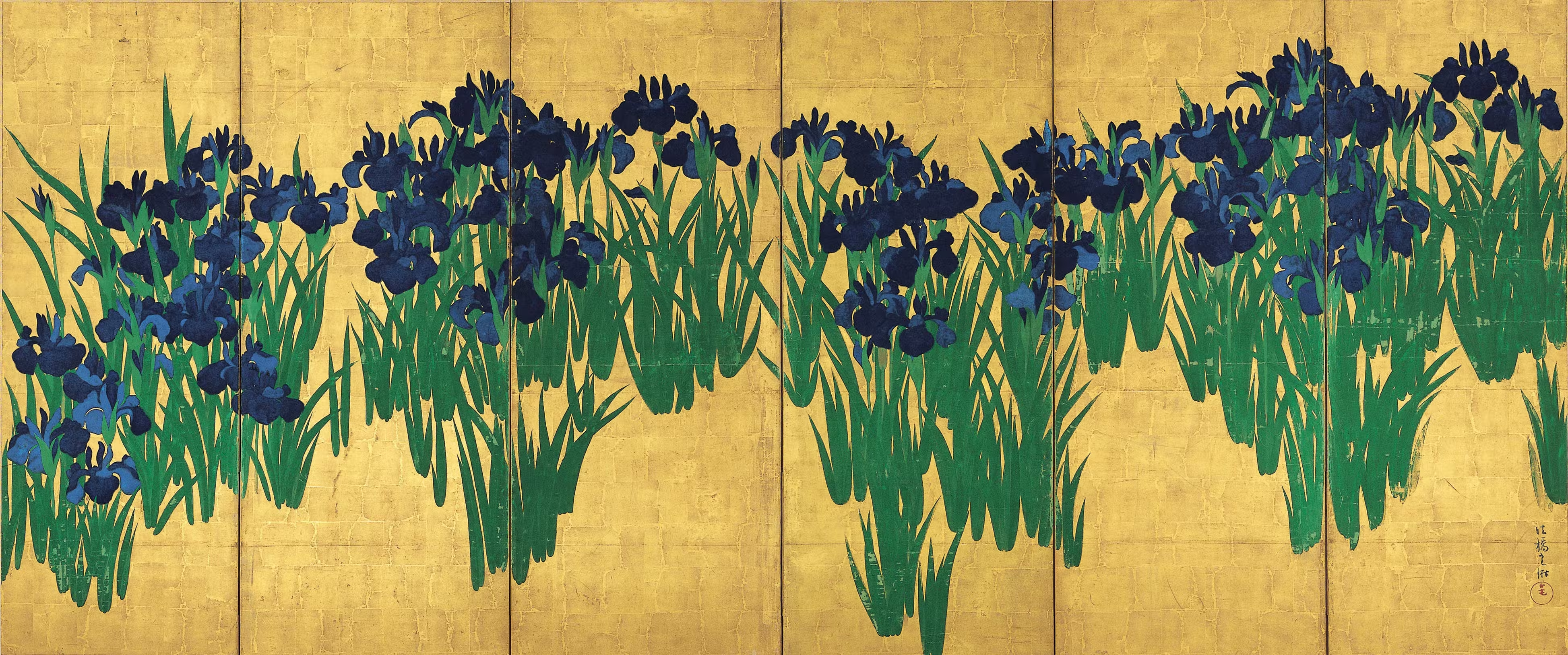
The museum holds more than 7,400 cultural objects, seven designated as National Treasures and 88 as Important Cultural Properties. But one work stands above them all. Ogata Korin's Irises is a pair of six-panel folding screens painted in the early eighteenth century -- deep purple iris blossoms floating against brilliant gold leaf, the brushwork confident and decorative in the Rinpa style that Korin helped define. The museum considers it the centerpiece of its entire collection. Kaichiro himself acquired it in 1914, and even before the museum existed, he hosted exhibitions and tea ceremonies to share it with guests. Today, Irises appears only briefly each year during a special exhibition from April to May, timed to coincide with the blooming of real irises planted in the museum's Japanese garden. The effect is deliberate: art and nature mirroring each other, inside and outside dissolving. The collection also includes 1,200 Japanese sword fittings from Meiji-era industrialist Mitsumura Toshimo's holdings, as well as Chinese bronzes from the Shang and Zhou dynasties.
The Garden That Completes It
The Nezu Museum's garden is not an afterthought -- it is half the experience. Spread across a sloping hillside behind the museum building, the traditional Japanese garden contains stone lanterns, moss-covered pathways, teahouses, and a pond fed by a small stream. The canopy of old-growth trees is dense enough to block the surrounding apartment towers from view entirely. A cafe overlooking the garden serves yuzu tea, an experience that the travel guidebook Soul of Tokyo singled out in 2019 as one of the thirty best things to do in the city. Visitors who come only for the art often find themselves spending more time on the garden paths than in the galleries, sitting on weathered benches, watching koi drift in the dark water, listening to the sound of nothing in particular. In a city of fourteen million people, the silence is the rarest treasure the museum holds.
From the Air
Located at 35.662N, 139.717E in the Minami-Aoyama district of Minato ward, central Tokyo. From the air, the museum is identifiable by its distinctive low dark roof and the surprisingly large patch of green garden canopy amid the dense urban grid, situated between Omotesando and Roppongi. Nearest airports: Tokyo Haneda (RJTT) approximately 9 nm south-southwest, Narita International (RJAA) approximately 37 nm east. Best viewed at 2,000-3,000 feet AGL. The garden canopy provides a clear visual contrast against surrounding rooftops.