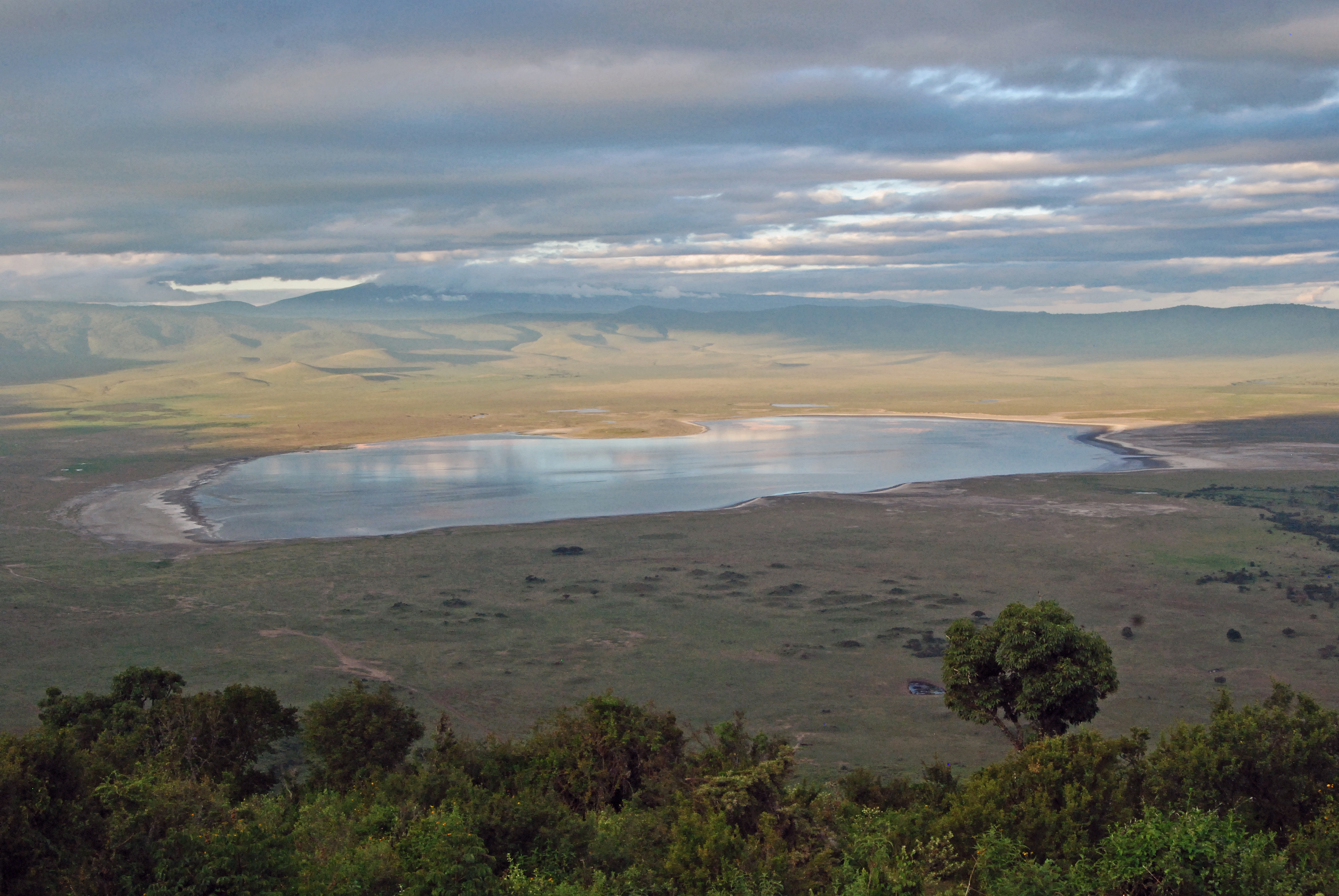
Ngorongoro Conservation Area
Three million years ago, a massive volcano collapsed inward on itself. The result is not technically a crater at all but a caldera -- a volcanic depression 21 kilometers across, with walls rising 600 meters above a floor of savanna, forest, and soda lake. Inside this natural amphitheater in northern Tanzania, roughly 25,000 large animals live year-round, hemmed in by jungle-clad slopes they rarely bother to climb. Ngorongoro is not just one of the best wildlife-viewing sites in Africa. It is also a UNESCO World Heritage Site, a Maasai homeland, and the backyard of Olduvai Gorge, where fossils nearly two million years old helped rewrite the story of human evolution.
The Caldera That Became a Kingdom
The numbers describe Ngorongoro but do not quite capture it. One hundred square miles of savanna encircled by a mountainous ring covered in dense forest. The rim sits at roughly 2,200 meters above sea level -- high enough that mornings are cold and mist clings to the descent road. The floor, 600 meters below, can bake under the afternoon sun when the wind dies. Lions here live at the highest density of any place on Earth. Herds of wildebeest and zebra graze alongside buffalo and Grant's gazelle. Black rhinoceros, critically endangered elsewhere, survive under special protection within the caldera -- this is one of the best places in East Africa to see them. Flamingos crowd Lake Magadi, the shallow soda lake at the crater's center. Hyenas patrol the grasslands. Cheetahs hunt in the open. Leopards inhabit the forested rim but are seldom spotted below. It is an ecosystem that functions like a walled garden, complete and self-sustaining.
Cradle of Humanity
Ngorongoro's significance extends far deeper than its wildlife. Within the broader conservation area lies Olduvai Gorge, where Louis and Mary Leakey spent decades excavating some of the most important hominin fossils ever found. Their discoveries -- including Homo habilis and early stone tools dating back nearly two million years -- transformed scientific understanding of human evolution. The gorge earned the region its nickname: the Cradle of Humanity. Nearby Laetoli preserves fossilized footprints left by Australopithecus afarensis 3.6 million years ago, the oldest direct evidence of upright walking by human ancestors. The Ngorongoro Conservation Area thus contains both the animals that define Africa's present and the fossils that illuminate humanity's deepest past. Few places on Earth compress so much of life's story into a single landscape.
The Maasai Question
Unlike the neighboring Serengeti, which was designated a strict national park, Ngorongoro was declared a conservation area in 1959 specifically to allow the Maasai to continue their traditional pastoralist way of life alongside the wildlife. It was an experiment in coexistence -- and a compromise that has never been entirely comfortable. The Maasai have lived as semi-nomadic herders in these highlands for centuries, their cattle grazing the same grasslands as the wildebeest. UNESCO recognized the area in 1979 for both its natural and cultural significance. But balancing conservation priorities with Maasai livelihoods remains an ongoing tension. Restrictions on cultivation and settlement have tightened over the decades. What began as an acknowledgment that people belonged in the landscape has at times drifted toward something more ambiguous. Ngorongoro remains one of the few protected areas in Africa where Indigenous communities and megafauna officially share the same land.
Descending into the Bowl
Most visitors arrive from Arusha, the safari hub of northern Tanzania, on organized tours that combine Ngorongoro with the Serengeti. The descent into the caldera happens on narrow, steep roads that are one-way -- down in the morning, up in the afternoon -- and only 4x4 vehicles are permitted. The shift in temperature is immediate: from the chilly, windswept rim to the warming floor below. Game drives last a few hours before the midday heat drives animals into the shade and tourists to their packed lunches at designated picnic sites. Lodges perched on the crater rim offer sunrise views straight down into the caldera, where, at first light, the movement of animals across the grasslands looks less like nature and more like choreography. The highland setting means Ngorongoro is cooler than most Tanzanian destinations -- nights on the rim require warm layers, and the rainy season from mid-November through mid-May can make the access roads treacherous.
From the Air
Located at 3.21S, 35.46E in the Ngorongoro Crater Highlands of northern Tanzania. From altitude, the caldera is unmistakable -- a near-perfect circular depression roughly 21 km in diameter, its forested walls contrasting sharply with the flat savanna floor. Lake Magadi is visible as a pale patch at the center. The rim elevation is approximately 2,200 meters ASL. Ngorongoro is part of a chain of three craters; Empakai and Olmoti are visible nearby to the northeast. Nearest major airport is Kilimanjaro International Airport (HTKJ), approximately 180 km to the east. Lake Manyara Airstrip (HTMLA) is closer. The Serengeti plains stretch to the west.