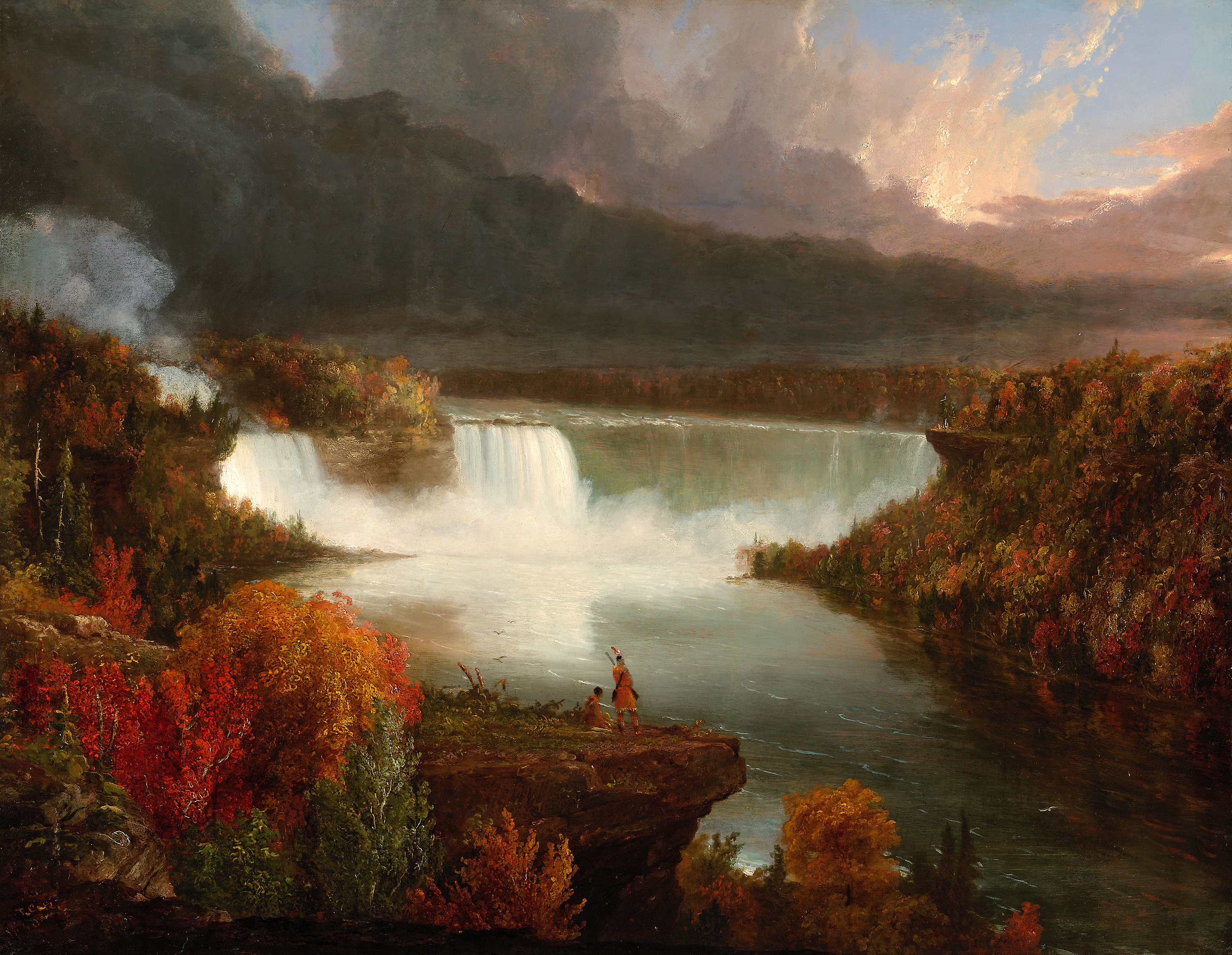
Niagara Falls
The numbers stagger: six million cubic feet of water per minute, a combined width of 3,950 feet, a vertical drop of 167 feet at Horseshoe Falls. Niagara is not the highest waterfall, nor even the widest, but it is the most powerful in North America and among the most voluminous on Earth. The falls straddle the border between Ontario, Canada, and New York State, creating twin cities that bear their name and an international tourist industry that has drawn honeymooners, daredevils, and day-trippers since the 1800s. The Canadian Horseshoe Falls captures most of the spectacle; the American Falls and smaller Bridal Veil Falls complete the trio. Below them, the Niagara River continues through a gorge carved over 12,000 years as the falls have slowly retreated upstream from their origin at Lake Ontario. Tacky tourist attractions crowd the surrounding streets, but the falls themselves remain genuinely sublime.
Geological Engine
Niagara Falls exists because of the last Ice Age and the peculiar geology beneath the Great Lakes region. When glaciers retreated roughly 12,500 years ago, they left behind a landscape of interconnected lakes. Water from Lake Erie began draining through the Niagara River to Lake Ontario, but a cap of hard dolomite rock resisted erosion while softer layers below eroded away. The result was a waterfall that has been eating its way upstream ever since, retreating at an average rate of about three feet per year. The falls began at the Niagara Escarpment near present-day Queenston-Lewiston, seven miles downstream from their current position. At current rates, they would reach Lake Erie in approximately 50,000 years - though human water diversion has slowed the retreat considerably.
Two Sides of the Border
The international boundary runs through the middle of Horseshoe Falls, but geography favors Canada. The Canadian side offers direct, head-on views of both the Horseshoe and American Falls, while the American side provides close-up encounters but less panoramic perspective. The Canadian city has embraced tourism completely: Clifton Hill's neon attractions, the Skylon Tower, casinos, wax museums, and haunted houses create an atmosphere some find charming and others find excessive. The American side offers more parkland and a more subdued atmosphere, including the historic state park that predates most other American parks. Both sides offer the essential experience: Maid of the Mist boat tours (now called Hornblower on the Canadian side) that approach the base of Horseshoe Falls, soaking passengers in spray as millions of gallons per second thunder overhead.
Daredevils and Disasters
Niagara has attracted thrill-seekers since Annie Edson Taylor became the first person to survive going over Horseshoe Falls in a barrel in 1901. She was 63 years old. Others followed: some survived, many didn't. Tightrope walkers crossed the gorge starting with Jean-François Gravelet (Blondin) in 1859, who repeated the feat while blindfolded, pushing a wheelbarrow, and carrying his manager on his back. In 1960, a seven-year-old boy survived an accidental plunge over Horseshoe Falls wearing only a life jacket. All stunts are now illegal, prosecuted vigorously by both countries, yet people continue to attempt them. The falls have also frozen spectacularly - in 1848, ice blocked the river upstream, reducing the falls to a trickle; in extreme winters, ice bridges form below the falls, though these are now off-limits after a collapse killed three people in 1912.
Power and Preservation
The same force that draws tourists also generates electricity. Hydroelectric development began in 1881 and expanded dramatically through the twentieth century. Today, diversions send roughly half the river's flow through tunnels to power stations downstream, with international treaties governing water allocation. The falls themselves are literally turned down at night and in winter when tourist crowds thin - flow is reduced to increase power generation. A 1969 engineering project temporarily dammed the American Falls entirely to study erosion, revealing a massive talus slope of fallen rock at the base. Proposals to remove the talus were rejected; instead, both nations committed to maintaining the falls' natural appearance while continuing to harvest their power. Queen Victoria Park on the Canadian side and the New York State Reservation on the American side protect the immediate surroundings.
Visiting the Falls
Niagara functions as a day trip from Toronto (75 miles) or Buffalo (17 miles), though overnight stays allow experiencing the falls illuminated at night, when colored lights play across the cascades. The Canadian side offers more commercial infrastructure; the American side offers a more authentic park experience. Crossing the border is straightforward on the Rainbow Bridge or Whirlpool Bridge, though wait times vary. The Maid of the Mist / Hornblower boat tours operate from both sides and remain the signature experience - cheap ponchos barely protect against the wall of spray at the base of Horseshoe Falls. Journey Behind the Falls (Canadian) and Cave of the Winds (American) offer tunnel-accessed viewing platforms. Beyond the falls, the Niagara River's whitewater, the Shaw Festival at Niagara-on-the-Lake, and the Niagara Peninsula wineries extend the region's appeal far beyond the single spectacular attraction.
From the Air
Located at 43.08°N, 79.07°W on the US-Canada border between Lake Erie and Lake Ontario. The falls are visible from cruising altitude as a distinctive break in the Niagara River with a prominent mist plume, especially noticeable in cooler weather. Horseshoe Falls (Canadian) forms a curved line; the smaller American Falls and Bridal Veil Falls are visible to the east. The Niagara Gorge extends downstream toward Queenston-Lewiston. Buffalo Niagara International Airport (BUF) lies 25km southeast; Toronto Pearson (YYZ) is 130km northwest. The Rainbow Bridge international crossing is visible just downstream of the falls.