Niagara Falls Daredevil History
Niagara Falls has been killing and immortalizing daredevils for nearly two centuries. The falls' combination of height (167 feet at the American Falls, 188 feet at Horseshoe Falls), volume (3,160 tons per second), and visibility has made them irresistible to those who seek fame through danger. The first stunter, Sam Patch, jumped into the pool below in 1829 and survived (he died later attempting a different waterfall). Blondin crossed on a tightrope in 1859, stopping to cook an omelet midway. Annie Edson Taylor became the first person to go over in a barrel in 1901 - a 63-year-old schoolteacher seeking fortune. Since then, dozens have gone over; roughly half have survived. The falls don't care. They keep falling, and people keep testing themselves against them.
The Tightrope Walkers
The first Niagara daredevils crossed above the falls, not over them. Jean François Gravelet, known as 'Blondin,' made the first tightrope crossing in 1859 - 1,100 feet across the gorge below the falls, 160 feet above the water. He crossed repeatedly that summer, adding variations: blindfolded, in a sack, pushing a wheelbarrow, carrying his manager on his back, and stopping to cook and eat an omelet on a portable stove midway. Maria Spelterini became the first woman to cross in 1876, with variations including blindfolded, with baskets on her feet, and with her ankles and wrists manacled. The tightrope era established Niagara as a stage for performance.
The First Over the Falls
Annie Edson Taylor was 63 years old, a widowed schoolteacher facing poverty, when she decided to go over Niagara Falls in a barrel. On October 24, 1901, she became the first person to survive the plunge. Her barrel was custom-built of oak and iron, fitted with a mattress and straps. She emerged bruised but alive, saying afterward, 'No one ought ever do that again.' She hoped for fame and fortune; she achieved the former but not the latter, dying in poverty 20 years later. Her success inspired others - Bobby Leach went over in a steel barrel in 1911 and survived (he died later slipping on an orange peel).
The Survivors
Since Taylor, approximately 15 people have intentionally gone over Niagara Falls in some kind of contraption. Roughly half survived. The survivors include: Karel Soucek (1984, barrel), Steven Trotter (1985, barrel wrapped in inner tubes), Dave Munday (1985 and 1993, barrel - he did it twice), and Kirk Jones (2003, no protection - the first to survive unprotected, and the only one until his fatal second attempt in 2017). What works: reinforced barrels with padding and oxygen supplies, going over the Horseshoe Falls (deeper pool, less rocky), and extraordinary luck. What doesn't: inadequate protection, poor timing, and ordinary luck.
The Deaths
For every survivor, there's a casualty. Charles Stephens brought a weighted barrel that inverted on impact in 1920; only his arm was recovered. George Stathakis survived the plunge in 1930 but his barrel got trapped behind the falls and he suffocated. Red Hill Jr.'s 'contraption' of inner tubes disintegrated in 1951. Jesse Sharp went over in a kayak in 1990, planning to paddle the rapids below; he was never found. Kirk Jones, having survived unprotected in 2003, returned in 2017 in an inflatable ball and died. The falls have claimed dozens of unintentional victims as well - suicides, accidents, and the simply unlucky who slipped at the wrong moment.
Visiting Niagara Falls
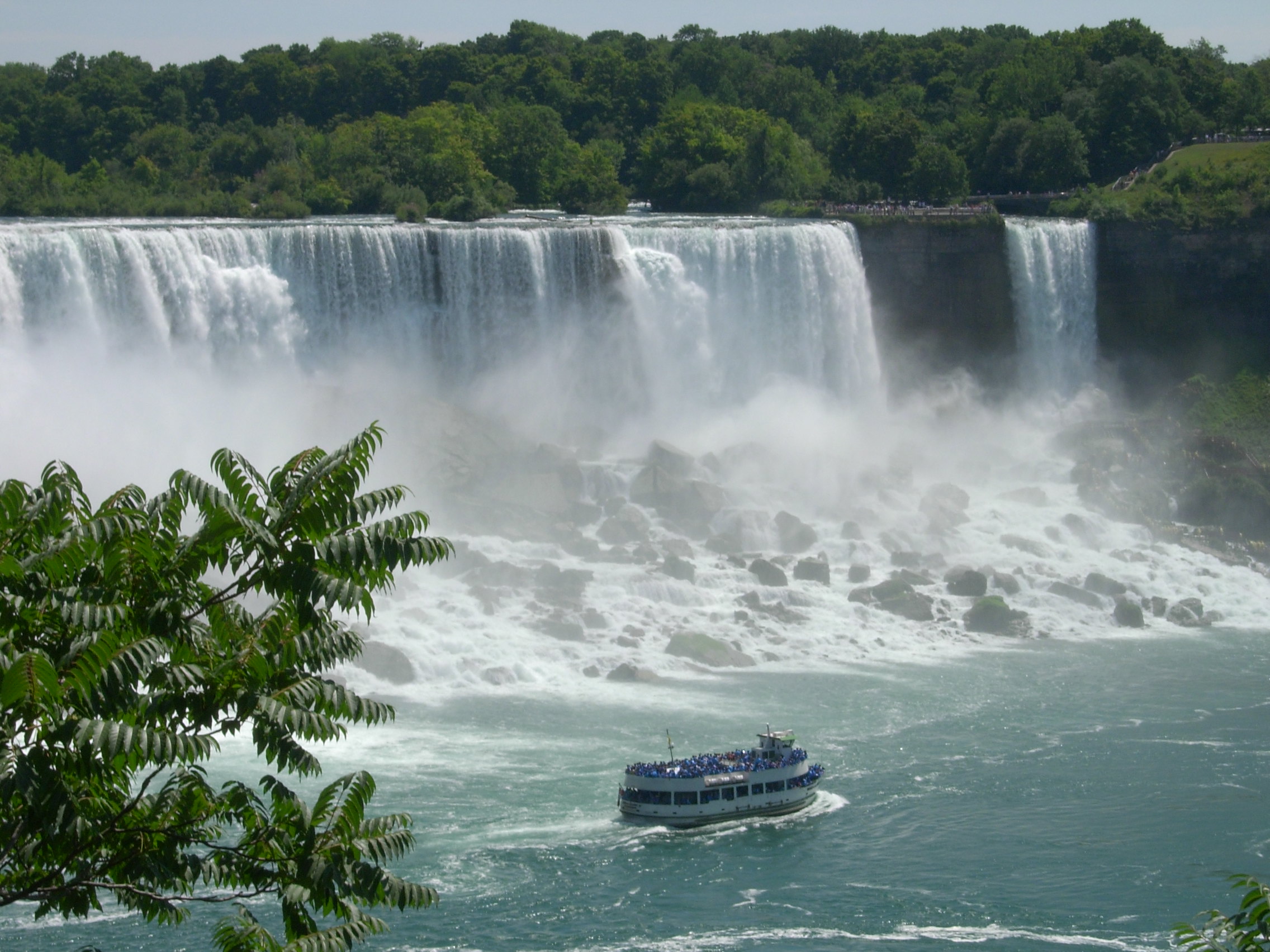
Niagara Falls straddles the U.S.-Canada border. The American side (Niagara Falls State Park, New York) and Canadian side (Niagara Parks, Ontario) both offer viewing areas, boat tours, and interpretive displays. The Maid of the Mist boat tour (American) and Hornblower Niagara Cruises (Canadian) approach the base of the falls. Cave of the Winds on the American side allows visitors to stand near the base of the American Falls. The Daredevil Museum at the Niagara Falls State Park Visitor Center displays barrels and tells the stories. Going over the falls is illegal on both sides and results in fines - if you survive. Buffalo Niagara International Airport is 30 minutes from the American falls; Toronto Pearson is 90 minutes from the Canadian side.
From the Air
Located at 43.08°N, 79.07°W on the U.S.-Canada border between New York and Ontario. From altitude, Niagara Falls is unmistakable - the Niagara River flowing from Lake Erie toward Lake Ontario, suddenly dropping over the escarpment in a massive plume of mist. The Horseshoe Falls (Canadian) is the larger curved falls; the American Falls and Bridal Veil Falls are on the U.S. side, separated by Goat Island. The cities of Niagara Falls, NY and Niagara Falls, ON flank both sides. Rainbow Bridge connects the countries. The mist plume is visible from commercial flight altitude in good conditions. The falls process the outflow of four Great Lakes - over 750,000 gallons per second.