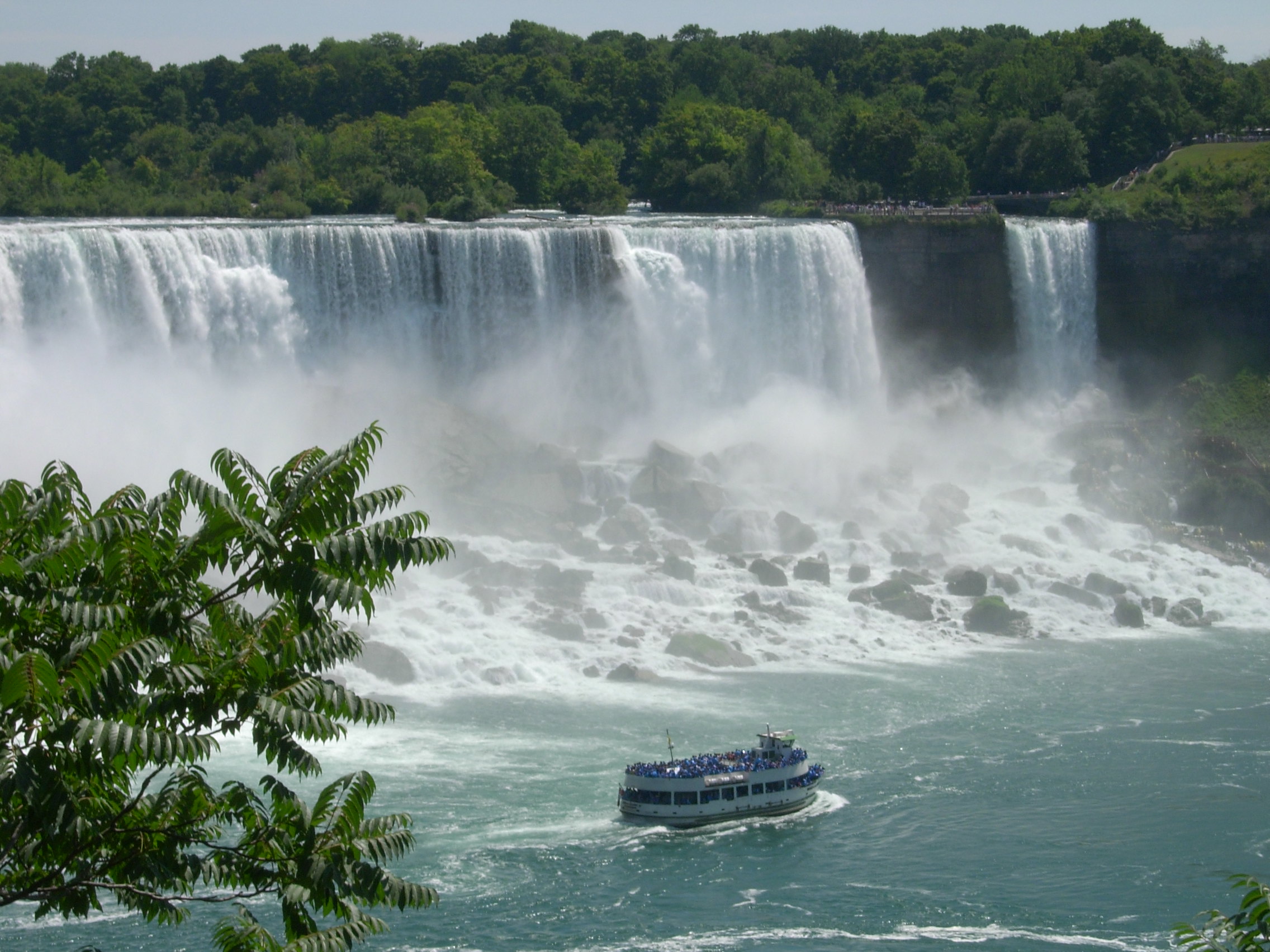
Niagara Falls: The Honeymoon Capital of the World
Niagara Falls has been America's favorite natural spectacle since railroads made it accessible in the 1830s. The falls were the continent's first mass tourist destination - before national parks existed, before the automobile, there was Niagara. Honeymooners came from the beginning, establishing a tradition that continues 200 years later. The falls became synonymous with romantic beginnings; the honeymoon suite and heart-shaped bathtub are Niagara clichés. But Niagara is also daredevils and death, barrel rides and tightrope walks, the endless human desire to conquer what should simply be admired. The falls survive all of it - six million cubic feet of water per minute, thundering into the gorge, indifferent to the souvenir shops and the lovers and the fools.
The Falls
Niagara is actually three waterfalls: Horseshoe Falls (the largest, straddling the U.S.-Canadian border), American Falls, and Bridal Veil Falls (both on the American side). Combined, they carry more water than any other waterfall in North America - roughly 750,000 U.S. gallons per second. The falls formed roughly 12,000 years ago as glaciers retreated, leaving the Great Lakes to drain over the Niagara Escarpment. Erosion has moved the falls seven miles upstream from their original location; they continue retreating at roughly a foot per year, eventually destined to drain Lake Erie entirely. The spectacle is temporary - on geological timescales.
The Tourism
The falls became a tourist destination almost immediately after European contact. By the 1830s, railroads delivered thousands of visitors annually. Hotels, viewing platforms, and attractions multiplied. The 'Maid of the Mist' boat tour began in 1846 and continues today. The tourist infrastructure grew until it threatened the falls themselves - industrial development, power generation, and commercial encroachment degraded the experience. Public outcry led to the creation of parks on both sides: Niagara Reservation (America's first state park) in 1885, Queen Victoria Park on the Canadian side. The parks preserve the immediate surroundings; the cities behind them remain aggressively commercial.
The Daredevils
Going over Niagara Falls is illegal, dangerous, and irresistible to certain personalities. The first person to survive was Annie Edson Taylor, a 63-year-old schoolteacher who went over in a barrel in 1901, hoping for fame and fortune. She achieved neither - and started a tradition of stunts that continues. Some survived; many died. Barrels, rubber balls, jet skis, and tightropes have all been used. In 2012, Nik Wallenda walked a tightrope across the gorge, the first sanctioned crossing in decades. The stunts are pointless, the deaths are tragic, and the impulse reveals something about human psychology that the falls themselves illuminate perfectly: some forces are simply too powerful to resist.
The Honeymoon
Jerome Bonaparte (Napoleon's brother) allegedly brought his bride to Niagara in 1803, starting the honeymoon tradition. By the 1940s, Niagara received 90% of American honeymooners. The appeal was practical - accessible, dramatic, romantic - and self-reinforcing: couples went because couples had always gone. The tradition has declined but persists. Modern Niagara Falls offers honeymoon packages, heart-shaped hot tubs, and romance-branded everything. The schmaltz is thick. But behind the kitsch, the falls remain genuinely moving - watching that much water fall that far, feeling the mist and the thunder, sharing the experience with someone you love. The cliché became a cliché because it works.
Visiting Niagara Falls
Niagara Falls straddles the U.S.-Canadian border; both sides offer views and attractions. The Canadian side (Niagara Falls, Ontario) is generally considered to offer better views of Horseshoe Falls, plus casinos, observation towers, and commercial attractions. The American side (Niagara Falls, New York) offers access to Cave of the Winds and Goat Island between the falls. Border crossing requires passports. The Maid of the Mist operates from both sides. Buffalo, NY has the nearest major American airport; Toronto is roughly 80 miles from the Canadian side. Peak season is summer; winter offers frozen mist and ice formations. The experience is best at night when the falls are illuminated and the crowds thin.
From the Air
Located at 43.08°N, 79.07°W on the Niagara River between Lake Erie and Lake Ontario. From altitude, Niagara Falls is visible as a distinctive break in the river, the gorge cutting through the landscape below the falls. The mist plume is often visible from aircraft, rising from where water meets rock. Horseshoe Falls is the semicircular break; the American falls are the straight drop adjacent. The cities on both sides are visible - urban development crowding to the river's edge. Lake Erie lies to the south; Lake Ontario to the north. The falls are a tiny feature on a large landscape, yet generate more tourism than natural wonders far larger.