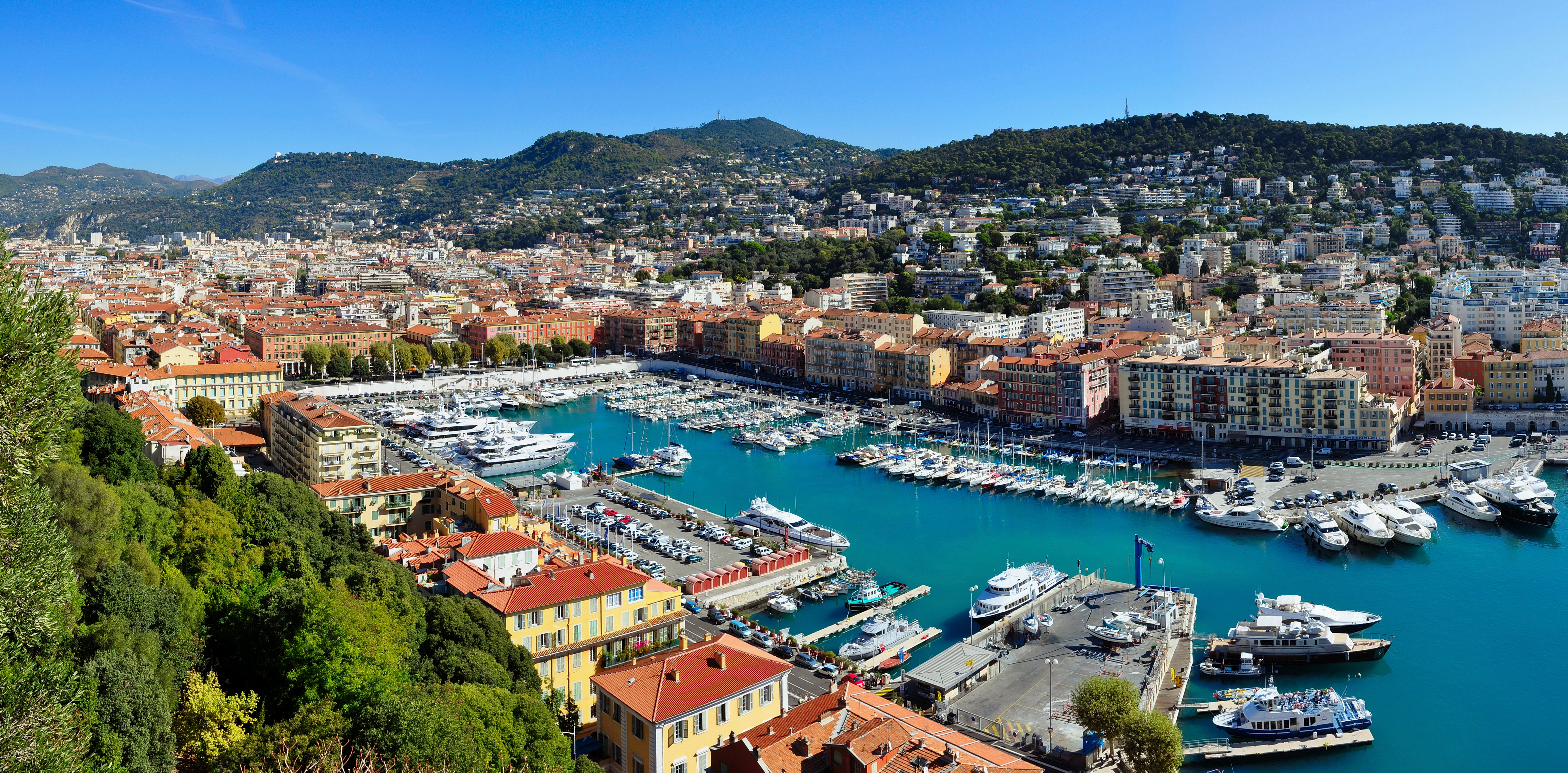
Nice
Nice was invented by the British. The aristocrats who fled English winters in the 19th century built the Promenade des Anglais along the waterfront, creating a resort that would define Mediterranean tourism. The light that drew them - clear, golden, Mediterranean - also drew artists: Matisse spent his last decades here, Chagall settled nearby, the Riviera became an artists' colony that produced work as distinctive as the landscape that inspired it. Nice had been Italian until 1860, when Sardinia ceded it to France in exchange for help in Italian unification; the Old Town, with its narrow lanes and ochre facades, still feels more Genoa than Marseille. Today Nice holds 340,000 people, France's fifth-largest city, a place that has learned to monetize its climate and light, where tourism is industry and leisure is serious business.
The Promenade
The Promenade des Anglais stretches seven kilometers along the Baie des Anges, from the airport to the old port. The name recalls the English colonists who funded its original construction in 1820; the current version, widened and paved, carries joggers and cyclists and tourists photographing the view. The beach below is pebbles rather than sand - a disappointment to some, a distinctive feature to others.
The promenade was the site of terrorist attack in July 2016, when a truck drove through Bastille Day crowds, killing 86 people. The memorial that marks the tragedy shares the waterfront with the hotels and cafes that have since reopened. Nice absorbed the horror and continued; the promenade fills each evening as it has for two centuries, the activity itself a kind of defiance.
The Vieille Ville
The Old Town huddles at the base of Castle Hill, its narrow lanes a maze of market stalls and restaurants. The baroque architecture is Italian, the language on shop signs French, the food a mixture - socca (chickpea pancake), pissaladiere (onion tart), salade nicoise - that reflects the cross-border heritage. The Cours Saleya hosts a daily flower and produce market that has operated for centuries.
The neighborhood survived the development that transformed the rest of Nice because its streets were too narrow for cars and too charming to destroy. What was poverty became picturesque; the residents who remained through the lean years now live in real estate worth fortunes. The Old Town offers tourists what they came for - narrow lanes, ochre facades, meals in squares where fountains splash - without revealing how recently that charm was threatened by neglect.
The Artists' Light
Henri Matisse moved to Nice in 1917 and never really left, spending nearly four decades producing work that the Musee Matisse now displays. Marc Chagall settled in nearby Saint-Paul-de-Vence; the Musee National Marc Chagall holds his biblical paintings. The Riviera light that drew these masters - the clarity, the color, the way shadows fall at Mediterranean angles - shaped a visual tradition that continues to attract artists.
The museums that honor these artists anchor a cultural tourism that supplements beach tourism. The Musee d'Art Moderne et d'Art Contemporain, the Villa Massena, the Hotel Negresco with its collection of Salon paintings - Nice offers culture for visitors who want more than sun. The light that Matisse painted remains the same; the city has built institutions to justify staying indoors to see it captured.
The Carnival
The Carnival of Nice runs for two weeks before Lent, the second-largest carnival in the world after Rio. The flower battles - floats covered in flowers throwing blooms to crowds - are distinctively Nicois, less samba and more parade, the festivities structured rather than spontaneous. The carnival draws 1.2 million visitors, filling hotels and restaurants during what would otherwise be dead season.
The carnival is industry as much as celebration. The floats cost hundreds of thousands of euros; the planning takes a year; the economic impact sustains the city's tourism infrastructure through winter. The party that seems spontaneous is actually manufactured, the joy commodified - but the flowers are real, the crowds are genuine, and the spectacle delivers what it promises.
The New Nice
Nice has transformed in recent decades from faded resort to dynamic city. The tram system opened in 2007, connecting neighborhoods that cars had made unreachable. The eco-valley of the Plaine du Var promises sustainable development to balance tourism. The city competes for tech companies and startups, trying to diversify an economy dangerously dependent on visitors.
The transformation is incomplete. Nice remains expensive and seasonal, its economy vulnerable to terrorism and pandemic and anything else that discourages travel. The elderly residents who settled here for retirement are joined by remote workers who can live anywhere and chose somewhere warm. Nice's future depends on remaining desirable, which depends on factors - climate, light, beauty - that the city can preserve but cannot create.
From the Air
Nice (43.70N, 7.27E) lies on the Mediterranean coast, bounded by the Alps to the north. Nice Cote d'Azur Airport (LFMN/NCE) is located 6km west of the city center with two runways built on reclaimed land extending into the sea: 04L/22R (2,960m) and 04R/22L (2,570m). The Promenade des Anglais is visible along the waterfront. The Old Town clusters at the base of Castle Hill. The Baie des Anges curves to the west. The Alps rise steeply north of the city. Weather is Mediterranean - hot dry summers, mild wet winters. The Mistral wind can bring strong northerly winds. Airport operations are constrained by terrain and the sea.