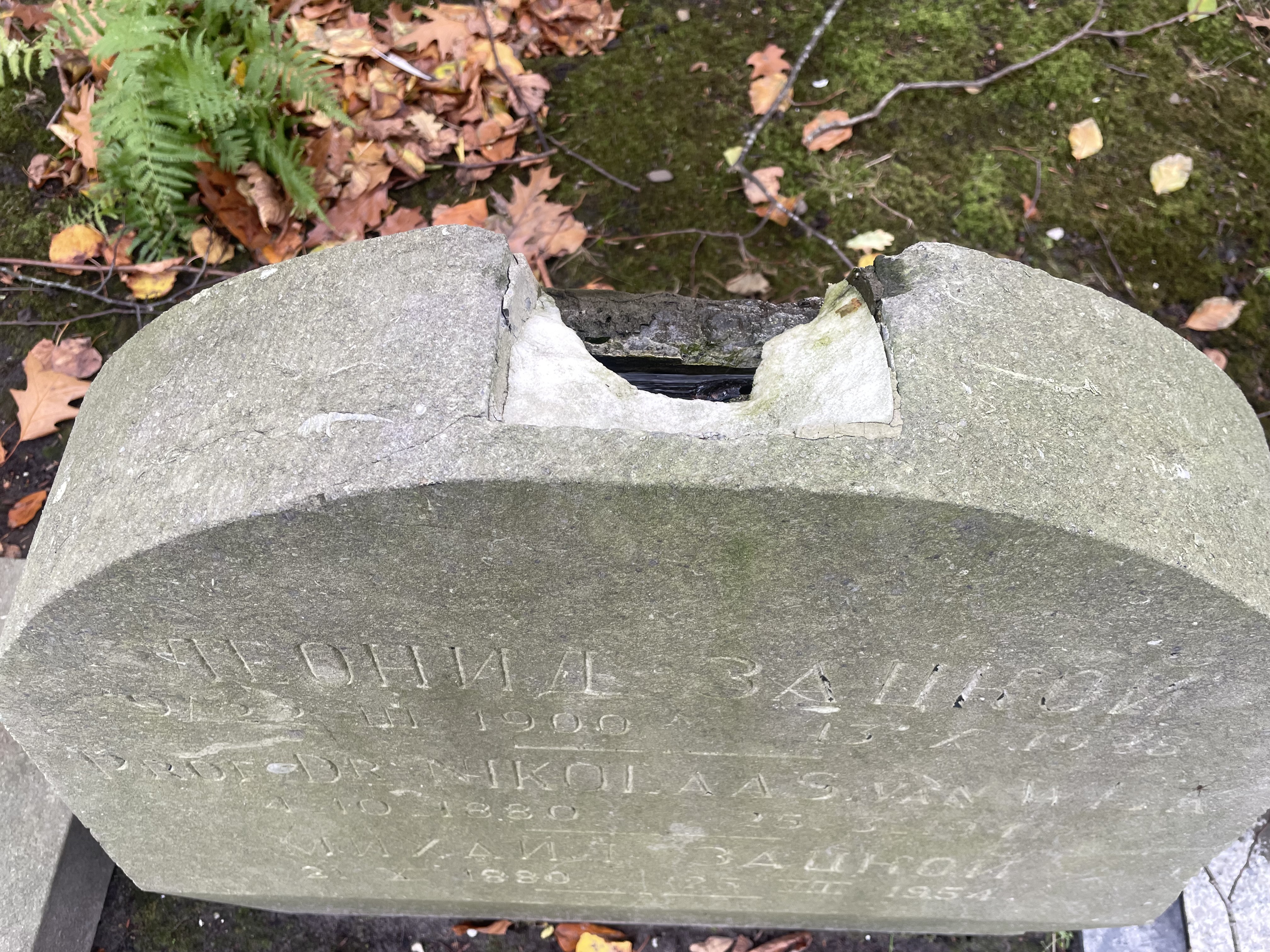
Nicolaas van Wijk
Ten months after Germany invaded the Netherlands, on 25 March 1941, Nicolaas van Wijk died in occupied Leiden at the age of sixty. He was a Dutch Reformed minister's son who had taught himself Russian in a Moscow boarding house, fluent enough by the time he came home in 1903 that he wrote 'I feel the spoken and written just like a Russian does.' From 1913 until his death he held the first chair of Balto-Slavic languages ever created at Leiden University. He had sheltered Polish Jews and Russian dissidents in his own home through one world war. He did not live long enough to see the worst of the second, but the books he had spent his life accumulating, seven thousand of them, were donated after his death to the university library where they remain.
From Delden to Moscow
Van Wijk was born in Delden on 4 October 1880, the only son among five children of a liberal Dutch Reformed minister. The family moved to Zwolle in 1886, and at the local gymnasium he came under the influence of a Frisian linguistics teacher who taught Dutch as a science rather than as a set of rules. Van Wijk would later credit that teacher's 'unbridled energy and pig-headedness' as one of his formative influences. After completing his doctorate at the University of Amsterdam in 1902, he took a grant at Leipzig and sat in on lectures by Karl Brugmann, Hermann Hirt, Ernst Windisch, and the great Slavicist August Leskien. In 1903 he travelled on to Moscow. He chose Russian over the other Slavic options because, as he wrote later, it was the most difficult and would unlock the others most efficiently. He stayed with two Russian families, one in the city and one in the countryside, and within six months could converse easily.
The Disputed Chair
In 1913 Leiden University created the first chair of the Balto-Slavic languages in the Netherlands. The appointment was contested. A respected scholar named Croiset van der Kop had been publicly endorsed by Abraham Kuyper in De Standaard and by ten leading Slavists from Saint Petersburg, including Jan Baudouin de Courtenay and Aleksey Shakhmatov. The Leiden faculty recommended Van Wijk anyway, on the grounds that his comparative work covered the whole Balto-Slavic field rather than Russian and Polish alone. Critics suggested anti-feminist bias was at work, and the Croatian scholar Vatroslav Jagic told Van Wijk plainly that the objections were not personal but reflected disappointment that a comparative linguist had been chosen over a Slavic philologist. Van Wijk responded by writing courteously to Jagic and by promising to teach Russian literature as well as linguistics. The position was renamed at his request, and within months he was on a long acquisition tour through Eastern Europe to fill Leiden's bare shelves.
1914
From late 1913 into the summer of 1914 Van Wijk crossed the Slavic-speaking world. He went to Leipzig first, then Prague, Warsaw, Saint Petersburg, Moscow, Kharkiv, Kyiv, Lviv, Bucharest, Sofia, Belgrade, Zagreb, Ljubljana, Graz, Vienna, and finally Krakow, with a quiet end in Zakopane in the Tatra Mountains. He carried letters of introduction from one librarian to the next. In Lviv the Polish scholar Wojciech Ketrzynski handed him a small library's worth of books at no cost; Van Wijk reassured the Leiden library that the value of the shipment would be 'beyond all proportion' to the freight. He apparently learned of Franz Ferdinand's assassination only after he had crossed into Austria. When World War I broke out, he hurried home, arriving in the Netherlands on 3 August 1914.
Hospitality in Wartime
He became vice chairman of the Dutch Committee for the Philanthropic Support of Poland. In August 1915 the Austro-Hungarian embassy issued him a curfew pass to travel into occupied Poland to oversee aid distribution, and his first piece of journalism for the Nieuwe Rotterdamsche Courant that September gave Dutch readers a glimpse of the war's human cost. Over the following decades he took refugees into his Leiden house: Polish Jews fleeing pogroms, Russians fleeing the Bolsheviks, Eastern Europeans fleeing the wars that punctuated their century. His contacts with so many foreigners drew suspicion from the Dutch government, which briefly wondered whether he might be a communist sympathizer. He was not. He was, if anything, a sharp critic of Soviet communism. What he extended to the people who knocked on his door was not ideology but the kind of hospitality his Reformed pastoral household had taught him, transposed into a half-dozen languages.
Van Wijk's Law and What Came After
Around 1916, deep in the wartime quiet of Leiden, Van Wijk worked out a rule of Slavic accent first hinted at by Shakhmatov in 1898, describing how secondary rising intonation developed in originally short syllables. It is now known to Slavicists as Van Wijk's law. He kept publishing, kept teaching, kept his contacts open across borders that politicians were closing. Germany invaded the Netherlands in May 1940. Van Wijk died ten months later, on 25 March 1941, in Leiden, before the worst of the occupation. His personal library, about seven thousand volumes accumulated through journeys and gifts and the patient correspondence of forty years, was donated to Leiden University Libraries, where it joined the special collections he had spent his career enriching. The chair he founded continues to be held today.
From the Air
Nicolaas van Wijk's principal worksite was Leiden University, in central Leiden at roughly 52.16N, 4.49E. Leiden lies about 15 km north-northeast of The Hague. Schiphol (EHAM) is about 30 km northeast; Rotterdam The Hague (EHRD) about 25 km south. The university buildings cluster along the Rapenburg in the medieval centre.