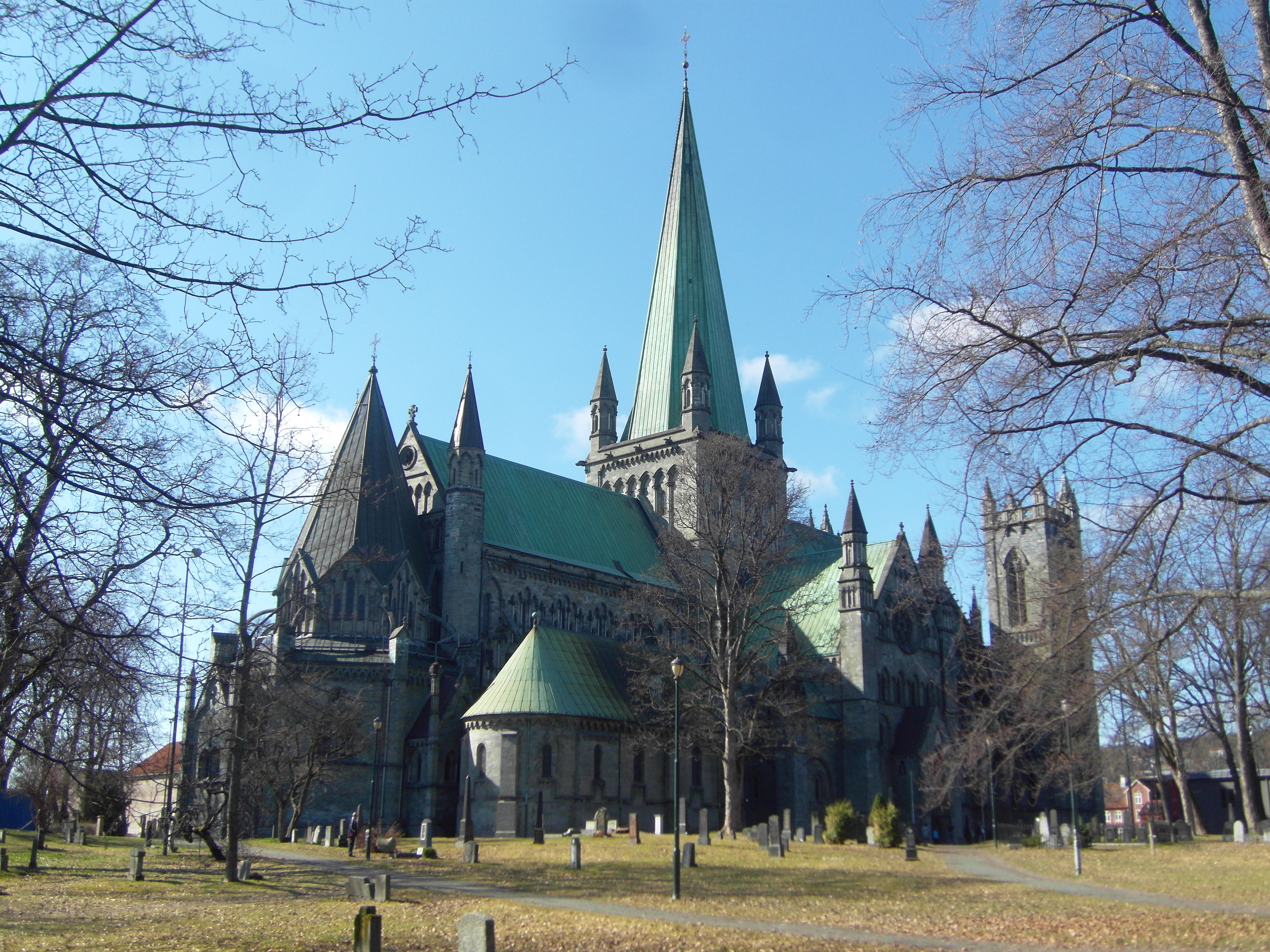
Nidaros Cathedral
Somewhere beneath the stone floor of Nidaros Cathedral lie the remains of a king whose death transformed him into a saint. In 1030, Olav II fell at the Battle of Stiklestad, and within a year the church declared him holy. His nephew began raising a great stone church over the grave around 1070, and for the next 230 years the building grew -- Romanesque arches giving way to Gothic vaults, English influences mingling with Norwegian craft -- until what emerged was the northernmost medieval cathedral on Earth. Nearly a thousand years later, pilgrims still walk the ancient routes to reach it.
A Saint Beneath the Stones
The story of Nidaros Cathedral is inseparable from the story of Olav Haraldsson. Killed in battle trying to reclaim his throne, he was canonized as Saint Olav and became Norway's patron saint. His shrine drew pilgrims from across Northern Europe, and the cathedral rose around it like a reliquary writ large. The silver-gilt casket that once held his remains was shaped like a church, with dragon heads on its gables echoing the carved prows of stave churches. That casket no longer exists -- Christian II melted it down for coinage, and the saint's bones were reburied in an unknown location beneath the cathedral floor. The only relic known to have survived is a femur in a silver-gilt reliquary shaped like a forearm, now in Oslo. But the absence of the shrine has not diminished the pilgrimage. If anything, it has deepened the cathedral's mystery.
Fire, Lightning, and Resurrection
No building endures a millennium without scars. Fires ravaged the cathedral in 1327 and 1531, destroying the nave entirely. In 1708, everything burned except the stone walls. Lightning struck in 1719, bringing fire again. By the 19th century, what remained was a magnificent ruin -- walls standing but hollow, the Gothic ambition of the original builders visible only in fragments. Then, in 1869, architect Heinrich Ernst Schirmer began the painstaking work of restoration. Christian Christie continued after him, and the project would not be officially completed until 2001 -- over 130 years of reconstruction. The octagonal east end, the oldest surviving section, may have been inspired by the Corona of Canterbury Cathedral. The choir shows the influence of Lincoln Cathedral's Angel Choir. These English connections run deep, a reminder that medieval Norway was never isolated from the wider European world.
Crowns and Constitutions
Nidaros Cathedral has witnessed more Norwegian history than perhaps any other building. It is the traditional site for the consecration of Norwegian monarchs, a role it has held across centuries and shifting forms of government. In 1814, when Norway wrote its constitution after centuries of Danish rule, the cathedral served as a polling station -- one of more than 300 churches where citizens voted for representatives to the Constituent Assembly at Eidsvoll. Today the cathedral seats about 1,850 people and functions as the seat of the Bishop of the Diocese of Nidaros. Each year, the Olav's Wake festival marks the anniversary of Saint Olav's death at Stiklestad, drawing visitors who follow the historic Pilgrim's Route to Trondheim. The religious and the national have always been intertwined here.
Stained Glass and Black Metal
Walk through the nave and notice the windows: all the stained glass dates from the 19th and 20th century restoration, since nothing survived the fires. On the north side, Old Testament scenes glow against blue backgrounds. On the south, the New Testament burns in red. Two organs fill the space with sound -- a massive Steinmeyer from 1930, commissioned for the 900th anniversary of the Battle of Stiklestad, and a Baroque instrument built by Joachim Wagner between 1738 and 1740, one of the finest of its era. The cathedral's image has traveled far beyond church circles. It appears on the cover of Mayhem's 1994 album De Mysteriis Dom Sathanas, an artifact of Norway's black metal scene. When police arrested bassist Varg Vikernes in 1993, they found 150 kilograms of explosives in his home and rumors swirled of a planned attack on the cathedral. The building survived, as it has survived everything.
The Weight of a Thousand Years
Standing before Nidaros Cathedral, what strikes you is not grandeur but persistence. This building has burned five times, been struck by lightning, lost its saint's bones, weathered the Reformation, and endured over a century of reconstruction. The stone screen between the octagon and the choir still holds Gustav Vigeland's crucifix between statues of the Virgin Mary and the Apostle John. In the ambulatory, a small well once drew water from the spring at Saint Olav's original burial place. The spring is covered now, sealed beneath layers of later construction. But the cathedral remains what it has always been -- a place where the weight of history pools and settles, where a Viking king's death a thousand years ago still shapes the rituals of a modern nation.
From the Air
Nidaros Cathedral sits at 63.4269°N, 10.3969°E in central Trondheim. The massive Gothic structure with its distinctive west front and octagonal east end is clearly visible from the air. Recommended viewing altitude: 2,000-3,000 feet for detail of the cathedral and surrounding Archbishop's Palace grounds. Nearest airport: Trondheim Airport Vaernes (ENVA), approximately 32 km east. The Nidelva River curves nearby, providing a good visual reference. The cathedral's green copper roof contrasts sharply with surrounding red-roofed buildings.