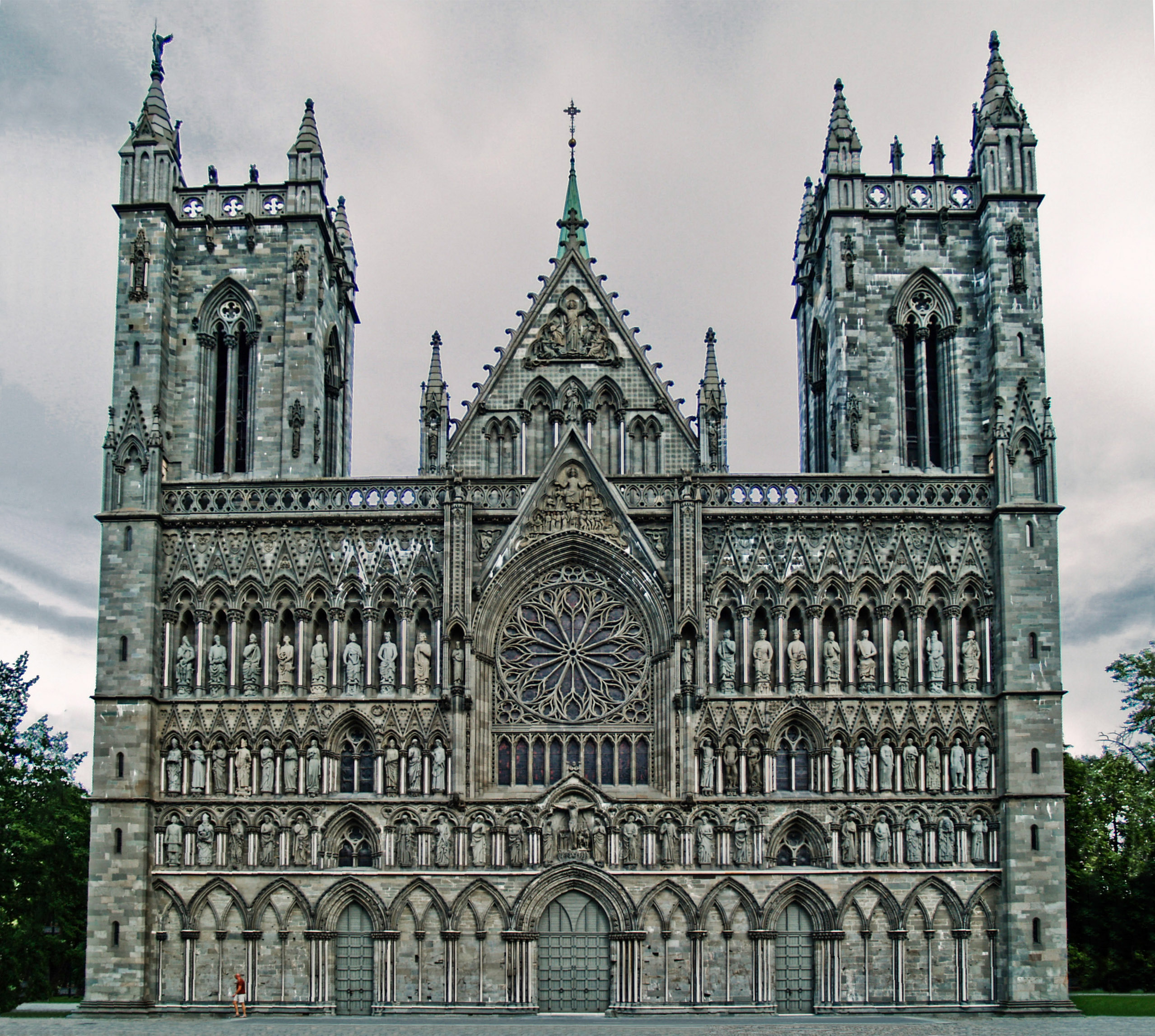
Nidaros Cathedral West Front
High on the northwest tower of Nidaros Cathedral, the Archangel Michael keeps watch over Trondheim. Look closely at the sculpture's face and you might notice something unexpected. Sculptor Kristofer Leirdal modeled the archangel on Bob Dylan - inspired, he said, by the singer's opposition to the Vietnam War. It is one detail among thousands on the cathedral's West Front, a facade so densely carved that architect Helge Thiis once observed that "no human eye can apprehend from the ground all the rich details contained in this Church." The restoration of this single wall took from 1905 to 1983, outlasting three cathedral architects and consuming the careers of Norway's finest sculptors.
A Facade in Ruins
A print from 1661 by Jacob Mortensson Maschius tells the story plainly: by the mid-seventeenth century, only the lower sections of the West Front remained standing. Fire had consumed the upper portions, first in 1328 when the original construction was still incomplete, and again in later centuries. Of the medieval sculptures that once populated the facade, only five survived, all in poor condition. They now rest in the museum at the Archbishop's Palace. When the Nidaros Cathedral Restoration Workshop was founded in 1869, the West Front was simultaneously the most important and most daunting challenge. It was the main entrance to Norway's national sanctuary - the world's northernmost medieval cathedral - but it was also the least documented portion of the building, the most deteriorated, and the most architecturally complex. Many professionals argued that restoration without extensive reconstruction was simply impossible.
Three Architects, One Wall
Cathedral architect Christian Christie spent years debating the approach. Should the West Front be rebuilt in authentic Gothic style, or given a practical modern treatment? His 1903 sketch omitted the rose window entirely, drawing sharp criticism. Christie died in 1906 before work began. An architectural competition followed, and Olaf Nordhagen won jointly with Henrik Bull. Nordhagen's 1913 design - featuring a screen front, rose window, and flanking towers - was approved by the Norwegian Parliament, but he complicated matters by making radical changes in 1915. Meanwhile, historian Macody Lund proposed an entirely different configuration based on the golden ratio. The dispute escalated until an international expert commission rejected Lund's approach in 1923. By Nordhagen's death in 1925, only the first three floors and the rose window were complete. A third architect, Helge Thiis, took over after winning another competition in 1929. He held the position from 1930 until his death in 1972, treating the work as an artistic exercise in the spirit of Gothic architecture rather than strict reconstruction. The West Front as it stands today is largely his vision.
Ten Thousand Pieces of Glass
The rose window dominates the upper facade. Designed structurally by Nordhagen and painted by Gabriel Kielland, it was presented as a gift from the women of Norway on St. Olav's anniversary in 1930. More than 10,000 individual pieces of painted glass compose the window, arranged in an eightfold symmetry around a central red gem symbolizing Christ. Rays of yellow flame radiate outward against a blue background, terminating in angels - the upper ones singing and playing instruments, the lower ones bearing six wings. The outermost ring depicts the angels of judgment, flanked by symbols of the four Evangelists: Matthew as an angel, John as an eagle, Luke as an ox, and Mark as a lion. The entire composition expresses a theological cycle - creation radiating from Christ and converging back to him at the day of judgment. Kielland, who also created windows throughout the cathedral, considered the rose window his masterpiece.
A Gallery of Stone Faces
Below and around the rose window, rows of sculptures populate the facade in tiers. The program was devised by Professor Oluf Kolsrud in 1928, using Maschius's seventeenth-century engraving as a guide for the lower rows and informed speculation for the rest. The bottom row depicts Apostles, saints, and the kings who spread Christianity across Europe. The middle row shows the Expulsion from Paradise and the Annunciation on opposite sides of the rosette, along with Norwegian saints. The top row represents Christ's spiritual and physical ancestors. Between these major figures, smaller sculptures by Odd Hilt represent the twelve months of the year through seasonal labors - only September, depicting the apple harvest, is female. The central axis belongs to Christ: a crucifixion group at the base, a doomsday relief above the rose window, and a triumphant Christ at the peak of the gable. Bears, donkeys, elephants, roosters, bees, gargoyles, masks, and angels crowd every remaining surface. Norway's leading sculptors contributed across decades, including Gustav Vigeland, Wilhelm Rasmussen, and Dyre Vaa, creating what amounts to an open-air gallery of twentieth-century Norwegian sculpture wrapped around a medieval shell.
From the Air
Located at 63.43N, 10.40E in the heart of Trondheim. Nidaros Cathedral is the city's most prominent landmark, with the West Front facing west toward the Nidelva river. The cathedral's Gothic profile and twin towers are visible from considerable altitude. Nearest airport is Trondheim Airport Vaernes (ENVA), approximately 33 km northeast. Best viewed at 1,500-2,500 ft AGL. Norway's largest church bell, weighing 2,400 kg, hangs in the north tower of the West Front.