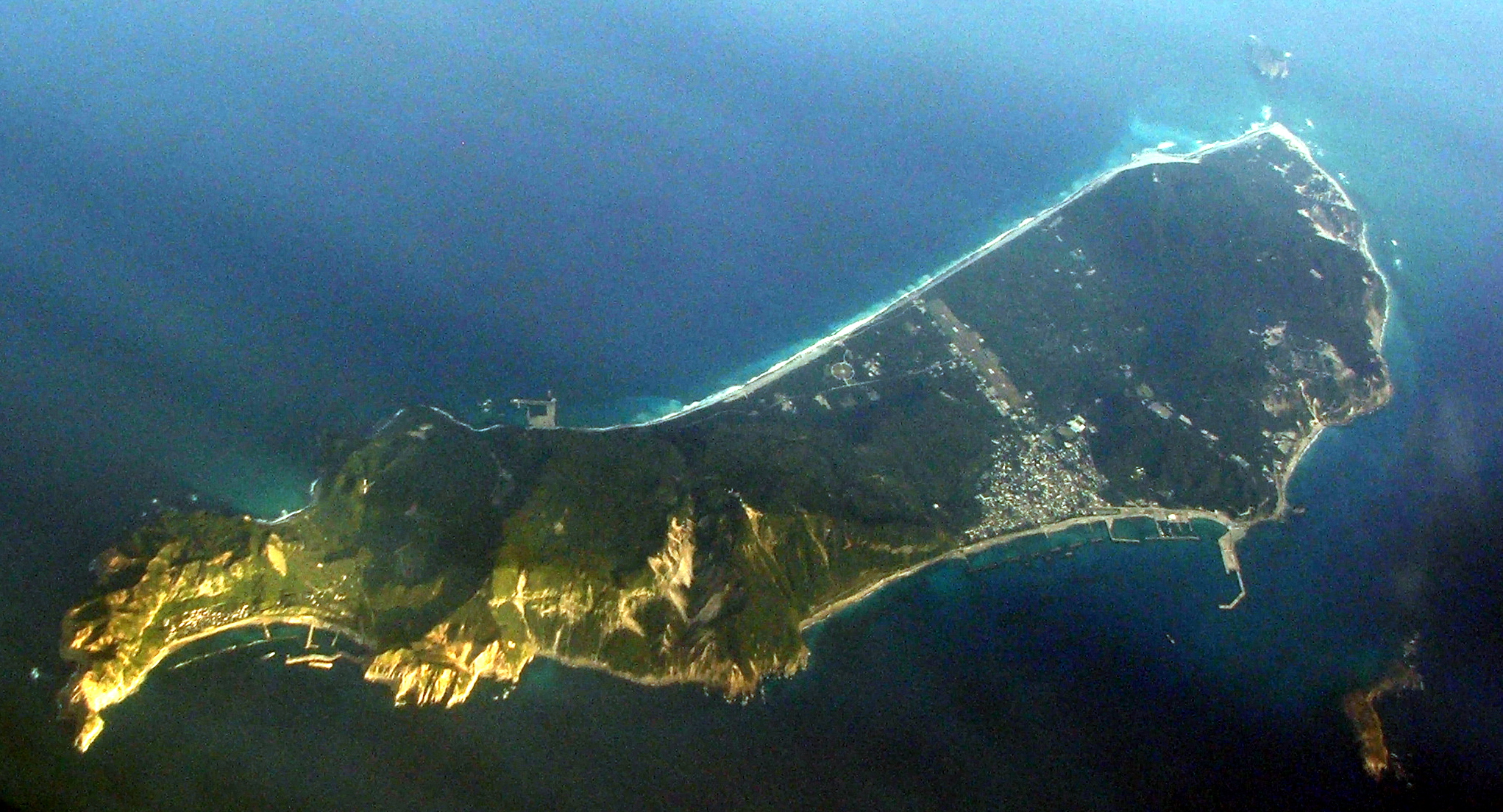
Nii-jima
The stone that makes Nii-jima famous exists in only two places on Earth: here, and on the island of Lipari off the coast of Sicily. Koga stone, a pumice-derived rhyolite, gives Nii-jima its startling white sand beaches and pale volcanic cliffs, and its silica can be blown into transparent green glass. Every autumn, artists from around the world gather at the Niijima International Glass Art Festival to work with this material -- Dale Chihuly among them. It is a strange distinction for a volcanic speck in the Philippine Sea that technically belongs to Tokyo, administered by the same metropolitan government that runs Shibuya and Shinjuku. But Nii-jima has always existed in contradiction: a place of exile that became a surfer's paradise, a seismically restless island where people have lived since the Jomon period, a national park wilderness reachable by a 35-minute flight from Chofu Airport.
Eight Domes of Rhyolite
Nii-jima is unusual among the Izu Islands for its elongated shape, stretching roughly north to south with a land area of 23.87 square kilometers. The island is built from eight rhyolitic lava domes arranged in two clusters at its northern and southern ends, connected by a low, flat isthmus. The most recent volcanic activity dates to the 9th century AD, when eruptions created the complex at the southern end and the Achiyama lava dome at the north. That northern end holds the island's highest point. The Achiyama dome and the neighboring Wakago deposit contain rare xenoliths -- fragments of gabbro carried up from magma chambers deep beneath the volcano. On the eastern coast, the rhyolite forms koga cliffs that rise 250 meters above Habushi Beach, a 6.5-kilometer sweep of white sand protected as a national reserve. The area averages 10 to 20 earthquakes of magnitude 5 or greater each year.
The Exiles' White Sand
Nii-jima has been inhabited since prehistoric times. Archaeologists have recovered Jomon-period stone and ceramic utensils across the island. But its most haunting chapter began during the Edo period, when the Tokugawa Shogunate designated the island as a place of exile for criminals -- a practice shared with Hachijo-jima and Miyake-jima elsewhere in the Izu chain. One hundred eighteen exiles were banished here for non-political crimes. Their gravestones fill the Exiles' Cemetery beside Choei Temple, a Nichiren Buddhist temple near the Jusansha Shinto shrine at the base of Mount Miyatsuka's cliffs. The cemetery is covered with the island's white sand. A short walk away lies the Exile Execution Ground, where eleven exiles who committed further crimes on the island met their end. Among those buried here is Komori Yasu, whose story became the subject of the kabuki play Yowa Nasake Ukinano Yokoguchi. The exile system ended with the Meiji Restoration, but the graves remain.
Glass, Stone, and Moyai
The Niijima International Glass Art Festival has run every autumn since 1988, drawing leading glass artists to workshops and demonstrations at the Niijima Glass Art Center. The adjacent museum houses works by past participants including Dale Chihuly, William Morris, and Lucio Bubaco. Visitors can create their own pieces to take home. The connection between island and art is literal: koga stone's silica content makes it ideal for glassblowing, producing a distinctive transparent green. The same stone has long been carved into moyai, communal stone figures found across the island. More than 100 large moyai stand on Moyai Hill overlooking the beaches. In the local dialect, moyai means 'to work together in effort.' The tradition traveled to the mainland -- a giant moyai statue from the people of Nii-jima stands on the western side of Shibuya Station in central Tokyo, one of the city's most recognizable meeting spots.
Whales at the Port, Kusaya on the Grill
Despite its proximity to Honshu, Nii-jima's small population has left its waters remarkably rich. Indo-Pacific bottlenose dolphins inhabit the nearshore waters. Sea turtles nest on the beaches. Sperm whales and humpback whales pass through on migrations between feeding grounds and wintering areas around the Bonin Islands. In 2011, a North Pacific right whale -- one of the most critically endangered large whale species -- lingered just meters from the port, tail-slapping continuously for hours. The island and neighboring Shikine-jima are designated an Important Bird Area, supporting Japanese murrelets, Japanese wood pigeons, and the endemic Izu thrush. On land, the island's signature souvenir is kusaya -- dried mackerel scad soaked in a fermentation brine whose name translates, frankly, as 'smells bad.' The village museum offers a video on its production. Other local specialties include ashitaba herb, milk senbei crackers, and Shima Jiman, a shochu whose name means 'island pride.'
Greek Ruins at Sunset
Yunohama Onsen may be the most improbable hot spring in Japan. Built in the style of pseudo-Greek ruins on Yunohama Beach, the large outdoor bath accommodates up to 100 bathers and draws its water from the ocean below. The panoramic view faces west, straight into the Pacific sunset. Nearby Maehama Beach, on the western shore, hosts wind surfers, the annual Tokyo Islands Triathlon, and open water swimming events. On clear days, Mount Fuji is visible across the water. On the eastern shore, Habushi Beach draws surfers to its powerful waves beneath the white koga cliffs. The island is connected to Tokyo by a 35-minute flight from Chofu Airport, a two-hour-and-twenty-minute jet boat from Takeshiba Sanbashi Pier, or a nine-hour overnight ferry. On the island itself, the only public transportation is the free Fureai Bus, operated by the municipal government -- a final reminder that this volcanic outpost of surfing, glass art, and exile history is, improbably, a neighborhood of Tokyo.
From the Air
Nii-jima sits at approximately 34.37N, 139.27E in the Philippine Sea, roughly 160km south of central Tokyo. The elongated island is unmistakable from the air -- white rhyolite cliffs on the eastern coast and white sand beaches on both shores contrast sharply with the deep blue sea. Niijima Airport (RJAN) has a single runway serving daily flights from Chofu Airport (RJTF) in western Tokyo, weather permitting. Neighboring islands Shikine-jima and Kozushima are visible to the southwest and south. Izu Oshima (RJTO) lies to the north-northeast. The island sits within the Fuji-Hakone-Izu National Park. On clear days, Mount Fuji is visible to the north-northwest from the western beaches.