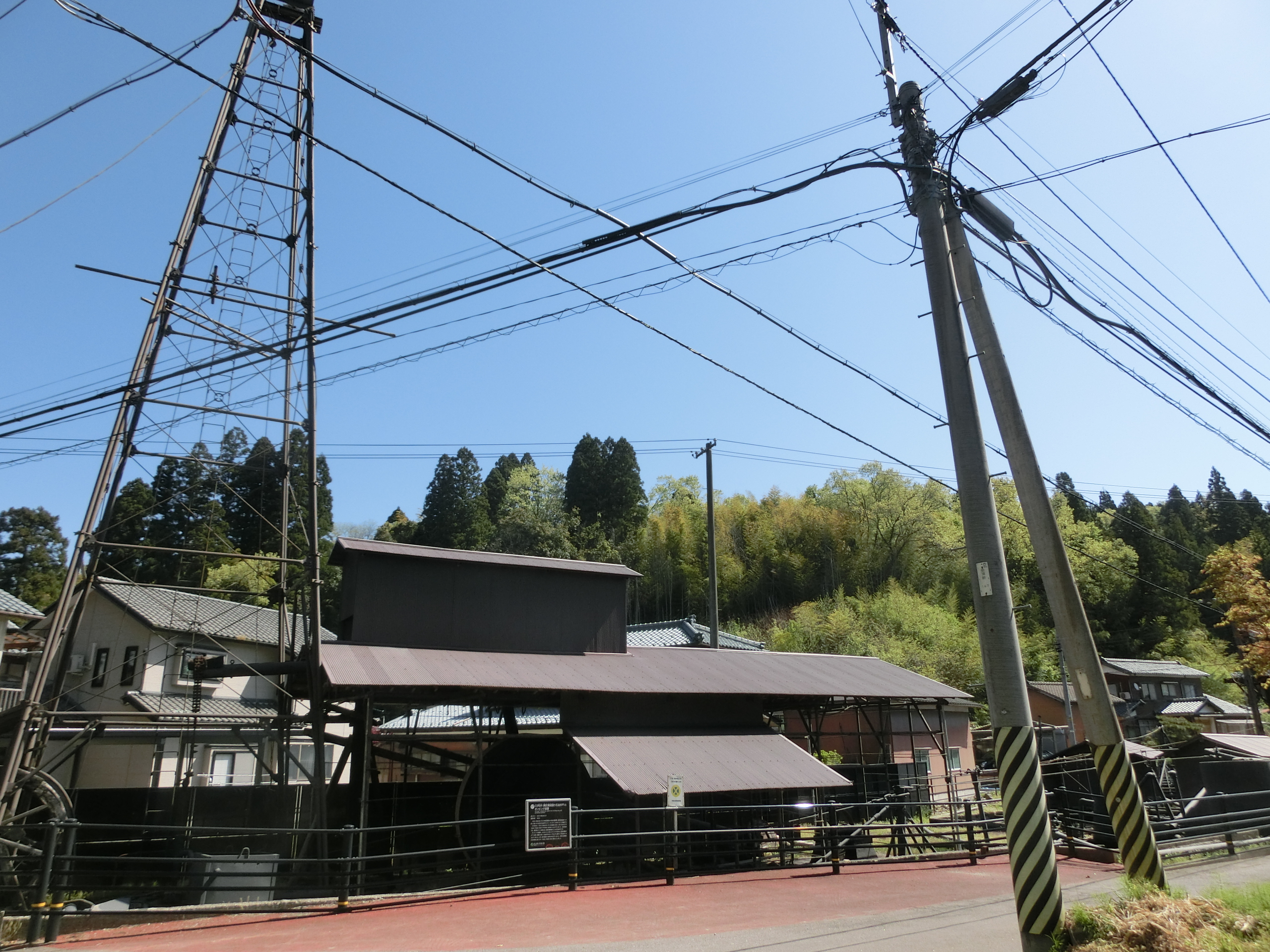
Niitsu Oil Field
Japan imports nearly all of its oil today, so the idea that it once had a booming domestic petroleum industry seems improbable. But in the southeastern hills of what is now Akiha Ward, Niigata City, the evidence is everywhere -- rusting derricks poking through forest canopy, old wellheads capped and silent along walking paths, and strata of oil-bearing rock exposed in roadcuts that formed five million years ago. The Niitsu Oil Field, stretching roughly six kilometers wide and sixteen kilometers long, was the largest producing field in Japan when it peaked in 1917 at 120,000 kiloliters per year. Its story reaches back far further than the industrial age, though. Petroleum seeps in Echigo Province were already documented by the end of the Nara period, more than 1,200 years ago, making this one of the oldest recognized oil deposits anywhere in the world.
Black Gold in the Hills
The crude oil of Niitsu is unusual stuff -- deep black to deep green in color, thick with high viscosity, rich in sulfur and acid, and low in paraffin. In the early Meiji era, when petroleum meant lamp oil, this heavy crude was considered poor quality. Nobody wanted smoky, sulfurous kerosene. But war and technology changed the equation. The First Sino-Japanese War in 1894 and the Russo-Japanese War in 1904 created urgent demand for heavy fuel oil to power warships and machine oil to lubricate factory equipment. Refiners developed processes to make use of exactly the kind of thick, difficult crude that Niitsu produced in abundance. What had been a liability became the field's greatest asset, and production boomed.
The Nakano Clan and the Oil Rush
Commercial extraction began in 1874, when the Nakano clan -- the hereditary village headmen of the area -- applied to the Meiji government for a permit to mine crude oil from the seeps their community had known about for generations. Hand-pumping operations started almost immediately. The Nakano operation was soon absorbed by Nippon Oil, which would grow into one of Japan's largest energy companies (now ENEOS, formerly JXTG Nippon Oil & Energy). As Japan industrialized through the Meiji and Taisho periods, demand for petroleum skyrocketed and the hills around Niitsu became a frenzied landscape of competing enterprises. More than 100 small companies drilled for oil in the area, transforming a quiet agricultural district into an industrial boomtown. By 1917, the field's output of 120,000 kiloliters made it the most productive in the country.
The Long Decline
Peak production could not last. The easily accessible reservoirs were gradually exhausted, and each successive well had to reach deeper into increasingly difficult geology. After 1917, output began a slow, irreversible decline. The field continued producing through the tumultuous decades of the early twentieth century -- through the Great Depression, through World War II, when every barrel of domestic oil was precious to a resource-starved wartime economy -- but the numbers kept falling. By the 1980s, what remained was no longer economically viable against the flood of cheap imported crude from the Middle East. The pumps slowed, then stopped. In 1996, the last well at Niitsu was sealed shut, closing a chapter of industrial history that had run for more than 120 years.
From Derricks to Walking Trails
Where oil rigs once clanked and hissed, visitors now stroll through Sekiyunosato Park, a green expanse built atop the old Kanazu mining site. The exposed geological strata along the park's promenades -- oil-bearing rock formed roughly five million years ago -- offer a rare chance to see the source formations up close. In 2018, the Kanazu Mining Site was designated a National Historic Site of Japan, recognizing its significance in the country's industrial heritage. The park is also home to the Petroleum World Museum, Japan's only museum dedicated entirely to the oil industry. Inside, original tools, vintage photographs, and scale models trace the arc from hand-pumped seeps to mechanized drilling to the quiet abandonment of the 1990s. The field was also selected as one of the Top 100 Geological Sites in Japan in 2007 and designated a Modern Industrial Heritage Site. For a country now wholly dependent on imported energy, Niitsu is a reminder that the relationship between Japan and oil is older, deeper, and more complicated than it appears.
From the Air
Located at 37.750N, 139.114E in the southeastern hills of Akiha Ward, Niigata City. The oil field area stretches approximately 6km wide by 16km long across a hilly, forested landscape southeast of the Niigata urban core. From altitude, look for the transition zone between the flat Echigo Plain and the hill country to the southeast -- the field occupies the rolling terrain at this boundary. Sekiyunosato Park and the Petroleum World Museum are in the Kanazu district. Nearest airport: Niigata Airport (RJSN), approximately 15nm north-northwest. The field is best viewed at 3,000-5,000 feet AGL, where the contrast between the urban plain and the forested hillsides that hide the old wellheads is most apparent.