Nikko Toshogu
There is a gate in the mountains of Tochigi Prefecture covered in 508 carvings. Dragons coil around pillars. Sages contemplate eternity in deep relief. Children play among clouds of painted gold and vermilion. The Yomeimon gate at Nikko Toshogu earned the name 'higurashi no mon' -- the gate where one could gaze until sundown and never tire of looking. It is the entrance to the final resting place of Tokugawa Ieyasu, the man who ended a century of civil war, unified Japan under a single shogunate, and established a dynasty that would rule for 265 years. In death, Ieyasu received a shrine complex so extravagant that it redefined what Japanese sacred architecture could be.
A Shogun's Final Command
Tokugawa Ieyasu died in 1616 after decades as Japan's supreme ruler. His will specified that a small shrine be built at Nikko, in the mountains north of the capital at Edo. His son Hidetada, the second shogun, began construction in 1617, but the shrine as it exists today is largely the work of the third shogun, Iemitsu, who transformed his grandfather's modest memorial into a declaration of Tokugawa power. The shrine was built by the Tokugawa retainer Todo Takatora, and no expense was spared. Five of the resulting structures are designated National Treasures of Japan. Three more hold the status of Important Cultural Properties. Together with neighboring Futarasan Shrine and Rinno-ji temple, Nikko Toshogu forms a UNESCO World Heritage Site encompassing 42 nominated structures.
Carved in Every Surface
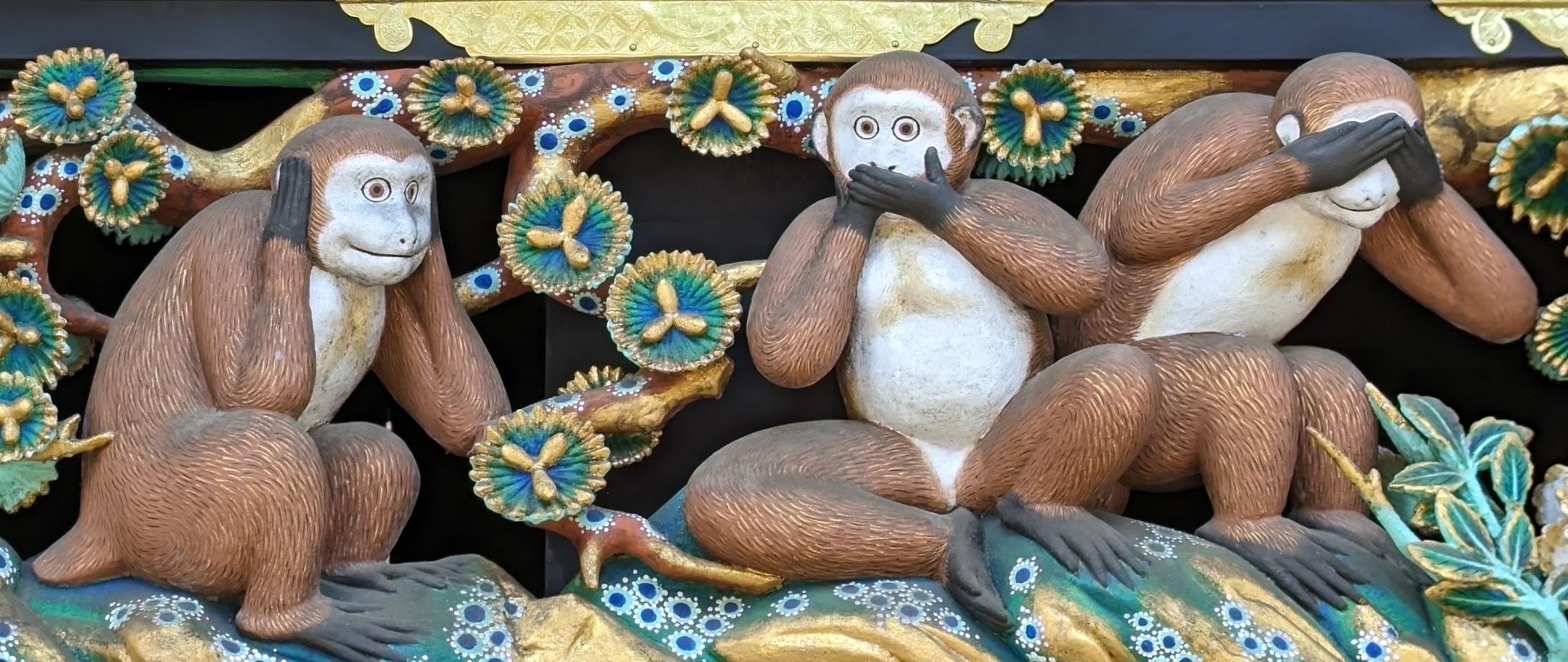
Where most Shinto shrines prize simplicity, Nikko Toshogu revels in excess. The Yomeimon gate alone features 508 carvings painted in rich colors and deep relief, depicting everything from mythical creatures to scenes of daily life. Beyond it stands the karamon, a gate decorated with white ornaments of extraordinary delicacy. Nearby, a small woodcarving of a sleeping cat, the famous Nemuri-neko, is attributed to the legendary sculptor Hidari Jingoro. But the shrine's single most recognized image sits on the stable that houses the sacred horses: three monkeys covering their eyes, ears, and mouth. The three wise monkeys who see, hear, and speak no evil have become a universal symbol, though few who invoke them know they originated here, carved into a wooden beam above a horse stall in the Japanese mountains.
The Thousand-Warrior Road
During the Edo period, the Tokugawa shoguns maintained a grand tradition of ceremonial processions from Edo to Nikko along the Nikko Kaido highway. These journeys, involving hundreds of retainers in full regalia, reinforced the dynasty's connection to its divine founder. Cedar trees were planted along the entire route, creating the Cedar Avenue of Nikko, a corridor of ancient cryptomeria that still lines the approach roads today. Every spring and autumn, the shrine's festivals reenact these processions as the 'processions of a thousand warriors,' with participants in period armor and costume marching through the cedar-lined avenue to the shrine gates, keeping alive a ritual that connects modern Japan to its feudal past.
Pagoda of the Five Elements
The original five-story pagoda was donated by a daimyo in 1650 and burned in a fire, only to be rebuilt in 1818. Each of its five stories represents one of the classical Japanese elements: earth, water, fire, wind, and aether, ascending from ground to sky. Inside, an engineering marvel hides from public view. A central pillar called the shinbashira hangs suspended from chains rather than resting on the ground, a seismic countermeasure that allows the tower to sway with earthquakes rather than resist them. This centuries-old technique anticipates principles used in modern skyscraper design, and the pagoda has survived every earthquake since its reconstruction.
Stone Steps to Eternity
Hundreds of stone steps climb through dense cryptomeria forest to the innermost sanctum of the shrine: the tomb of Ieyasu himself. The path grows quieter with each step, the elaborately carved gates giving way to towering trees and moss-covered stone. At the summit, a torii gate bears calligraphy attributed to Emperor Go-Mizunoo, and a bronze urn contains the remains of the man who shaped modern Japan. In 2008, Yuri Kawasaki became the first female Shinto priest ever to serve at Nikko Toshogu, adding another chapter to a shrine that has been accumulating history for over four centuries. Diplomatic gifts still dot the grounds, including a Dutch lantern presented by the Dutch East India Company in 1643 and a bell gifted by the Korean Joseon dynasty, reminders that even in seclusion, the Tokugawa court maintained connections across the world.
From the Air
Located at 36.76N, 139.60E in the mountainous terrain of Nikko, Tochigi Prefecture. The shrine complex is set within dense cryptomeria forest on the hillside above the town of Nikko. The distinctive five-story pagoda and elaborate rooflines are identifiable from lower altitudes. Nearest airports: Utsunomiya (RJTU) approximately 35 km south, Ibaraki Airport (RJAH) approximately 120 km southeast, and Tokyo Narita (RJAA) approximately 190 km south. The Cedar Avenue of Nikko provides a visible linear feature leading toward the shrine complex. Best viewed at 2,000-4,000 feet AGL to appreciate the forest setting and temple rooflines.