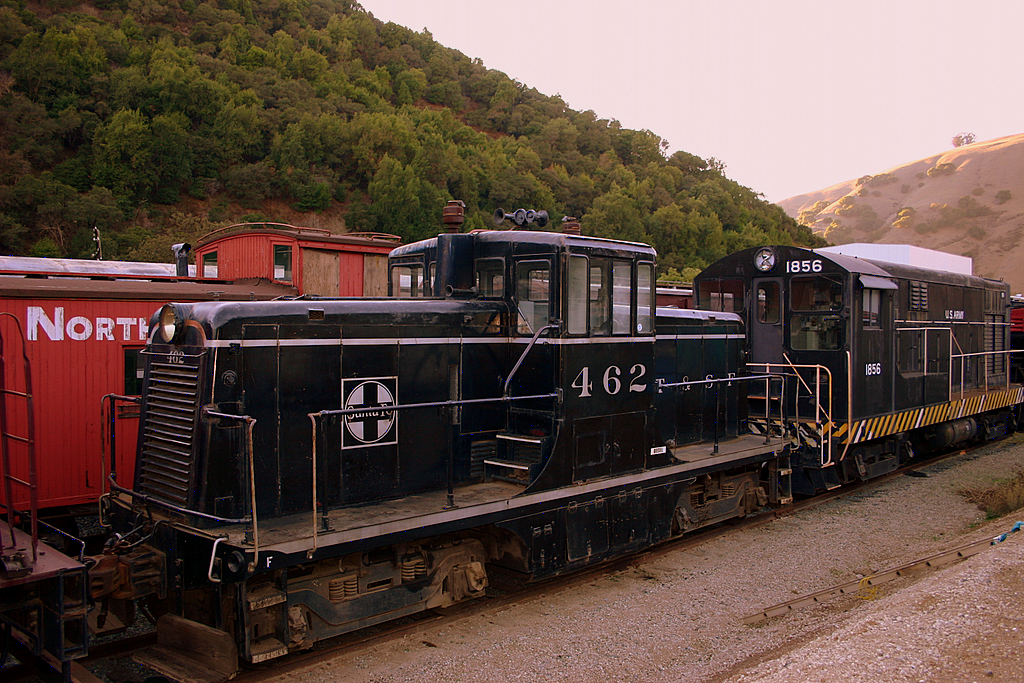
Niles Canyon Railway
The whistle echoes through Niles Canyon as it has for over 150 years, but today the sound carries a different weight. This narrow corridor of rugged terrain in California's East Bay is where the transcontinental railroad dream finally reached the Pacific. On September 6, 1869, just four months after the golden spike ceremony at Promontory Summit, the first Western Pacific train rolled through these tight curves and narrow banks to a cheering crowd at Alameda Terminal. The story of American expansion west is incomplete without this canyon.
Where Chinese Hands Built America
In 1866, five hundred Chinese laborers began carving a railroad through what was then called Alameda Canon. The work was brutal. Tight curves hugged the creek. Narrow banks left little room for error. They built four timber Howe truss bridges to cross Alameda Creek and Arroyo de la Laguna, constructing culverts, retaining walls, and bridge piers entirely in masonry. When financial disputes halted construction halfway through the canyon, the rails simply stopped at Farwell. Three years later, Central Pacific resumed the work with more Chinese crews, building from both ends simultaneously. The cut-stone abutments, culverts, and retaining walls they constructed in the late 1860s still stand visible today along the right of way.
The Junction That Became a Town
At the mouth of the canyon sat Vallejo Mills. Central Pacific renamed the station for their railroad attorney Addison Niles, who would later serve as associate justice on the California Supreme Court. The settlement followed suit. By 1870, a roundhouse, depot, restaurant, and saloon served passengers transferring between the Oakland line and the route to San Jose. For nearly a century, ferries remained the final link to San Francisco itself, until 1958. The small town became an important freight junction as produce from the Santa Clara and Salinas Valleys traveled through the canyon to points east. Today, Niles is a district within Fremont, and the canyon carries its name.
Rise, Decline, and Renaissance
The original route through Niles Canyon was the primary corridor to San Francisco Bay when it opened. But by 1879, a shorter line through Benicia had diminished its importance. The canyon route saw a revival under E. H. Harriman's leadership of Southern Pacific in the early twentieth century, when steel bridges replaced the covered timber spans at Farwell and Dresser. Yet highways eventually captured the produce traffic, and Southern Pacific ceased operations through the canyon in 1984. The land passed to Alameda County. In 1987, the Pacific Locomotive Association leased the right of way and began reconstructing the track. Their first passenger train departed from Sunol on May 21, 1988.
A Living Museum
The Niles Canyon Railway now operates heritage excursions with both steam and diesel locomotives along this preserved section of the original transcontinental route. The railway, its right-of-way, and associated structures earned listing on the National Register of Historic Places as the Niles Canyon Transcontinental Railroad Historic District on October 13, 2010. The Sunol Depot, built in 1884 to Southern Pacific standard design No. 7, is the last of at least eleven such combination depots still standing. At nineteen feet wide and sixty-seven feet long, it housed passenger waiting rooms, freight handling, and the agent's five-window bay. In 2021, plans were announced to relocate Southern Pacific steam locomotive 2479, a water tower, roundhouse, and turntable from the California Trolley and Railroad Corporation to expand the collection.
From the Air
Located at 37.59N, 121.89W in Niles Canyon between Sunol and Fremont. Best viewed at 2,000-3,000 feet AGL following the canyon from east to west. The historic rail line parallels Alameda Creek through the narrow canyon. Nearby airports include Hayward Executive (KHWD) 8nm west and Livermore Municipal (KLVK) 8nm east. Clear weather recommended for canyon viewing.