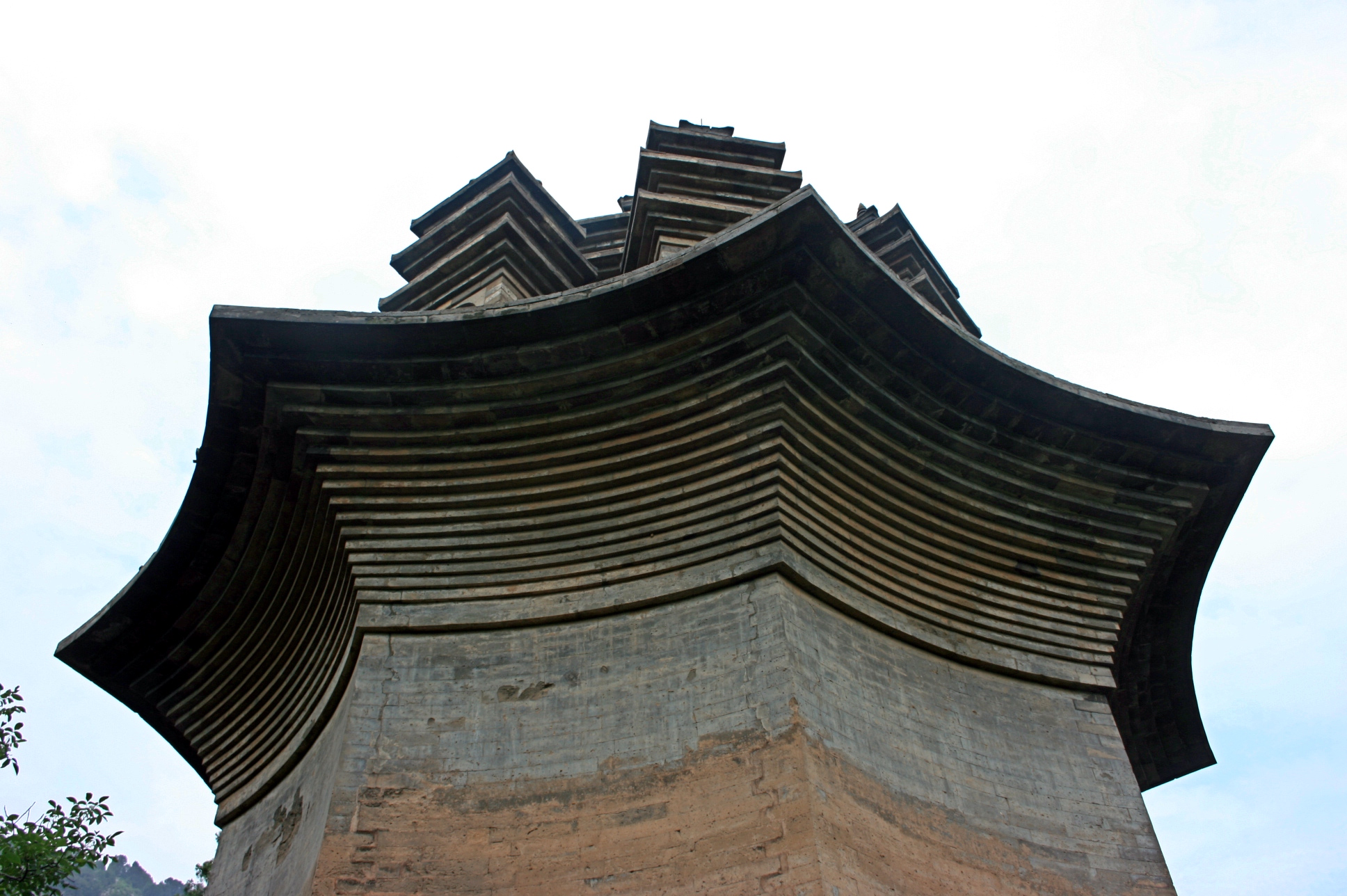
Nine Pinnacle Pagoda
Nine small pagodas sit on the roof of a larger one, and the arrangement is a pun. The Chinese saying "one word, nine ding vessels" -- derived from a Warring States period story -- means that a promise given carries the weight of nine heavy bronze ritual vessels. The Nine Pinnacle Pagoda takes its name from this proverb, since "ding" meaning "pinnacle" and "ding" meaning "ritual vessel" share the same pronunciation in Chinese, though they are written with different characters. Built between 742 and 756 AD during the Tang dynasty, this brick pagoda near Jinan is one of the most architecturally unusual structures in all of Chinese Buddhist building.
An Octagon of Curved Walls
The pagoda's floor plan is an equilateral octagon, which in itself is not remarkable for Tang dynasty architecture. What makes the Nine Pinnacle Pagoda unique is that all eight side walls curve inward -- concave surfaces that create a subtle visual tension between the straight geometry of the octagonal plan and the organic curve of each wall. No other pagoda of the period uses this technique. The entire structure is brick, laid with joint gaps of about one centimeter, achieving a tightness that has held for over twelve centuries. At 3.6 meters above ground, a visible change in the wall's appearance suggests that the lower portion may once have been enclosed by another structure -- perhaps a surrounding hall or corridor that has since vanished.
A Pagoda Wearing a Crown
The main body of the Nine Pinnacle Pagoda contains only a single story, and its most striking feature is entirely on the roof. Nine miniature pagodas crown the structure: eight positioned over the eight corners of the octagonal base with their doors facing outward, and a ninth, larger pagoda occupying the center with its door facing south. Each corner pagoda has three eaved stories and stands 2.84 meters tall. The central pagoda is nearly twice the size at 5.33 meters. Together with the main body, the total height reaches 13.36 meters. The eaves of the main structure are made from 17 layers of brick, a characteristic feature of Tang dynasty construction. The effect of the nine roof pagodas is unlike anything else in Chinese architecture -- a building that reproduces itself in miniature, a structure that seems to be dreaming of more structures.
The Buddha in the Chamber
Above the transition line in the walls, an arched entrance leads to the pagoda's interior chamber. Inside sits a 1.2-meter stone Buddha statue executed in Tang dynasty style, flanked by statues of two monks. Traces of Buddhist murals remain on the chamber walls -- faded remnants of what was likely once a richly painted interior. The pagoda stands on the grounds of the Nine Pagoda Temple, and it has been integrated into the Jiuding Pagoda Park of Folk Customs, a tourist attraction that contextualizes the structure within the broader landscape of Shandong folk culture. The nearby Four Gates Pagoda, Dragon-and-Tiger Pagoda, and Thousand Buddha Cliff form a cluster of Buddhist monuments that make this corner of Licheng District, 33 kilometers southeast of Jinan, one of the most significant concentrations of early Chinese religious architecture in the country.
From the Air
The Nine Pinnacle Pagoda is located at 36.42°N, 117.13°E near Qinjiazhuang Village, Liubu Town, Licheng District, about 33 km southeast of Jinan, Shandong Province. At 13.36 meters tall, the pagoda is modest in height but its unique nine-topped roof profile is distinctive. The structure is part of a cluster of Buddhist monuments including the Four Gates Pagoda and Dragon-and-Tiger Pagoda. Nearest major airport: Jinan Yaoqiang International (ZSJN), approximately 45 km northwest. The terrain is hilly and forested.