Ningaloo Coast
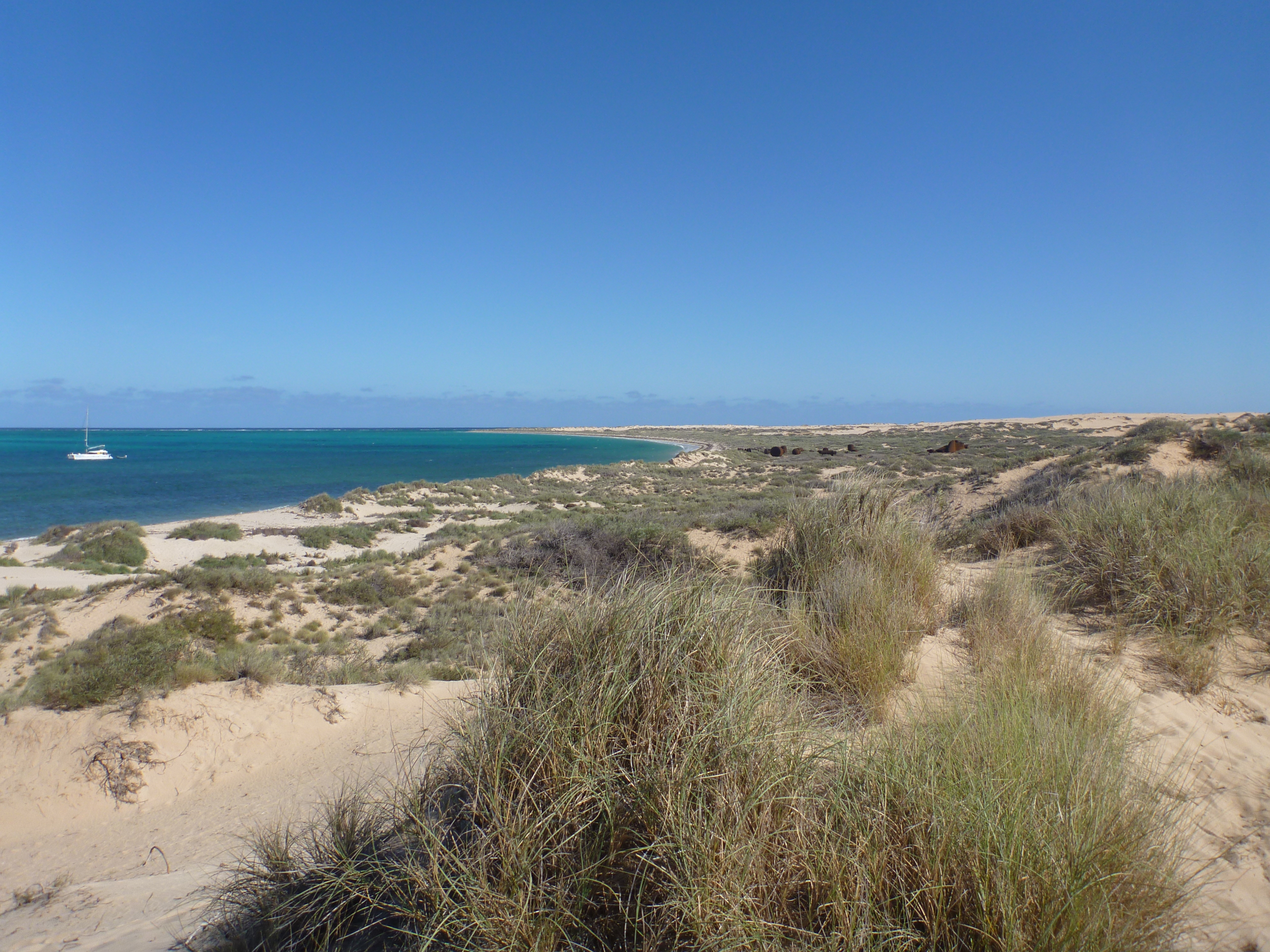
You can walk off the beach and onto a coral reef. That single fact sets Ningaloo apart from every other major reef system on Earth. While the Great Barrier Reef demands boats and day trips and logistics, Ningaloo sits just meters offshore in places, a 260-kilometer ribbon of coral running from Exmouth south to Red Bluff near Carnarvon. The Wajarri people named this stretch of coast for its high land jutting into the sea, and from the air it is easy to see why: the pale turquoise of the lagoon sharpens abruptly into the deep blue of open ocean where the reef wall drops away.
Ancient Architecture, Living Still
The ground you stand on along the Gascoyne Coast was itself a coral reef once, built three to five million years ago in a shallow tropical sea by the slow work of billions of polyps and shellfish. Tectonic forces uplifted that ancient reef into the Cape Range, the limestone hills that now run parallel to the coast. But reef formation never stopped offshore. The present Ningaloo Reef is roughly 8,000 years old, a successor to older structures that drowned as sea levels rose. Those fossil reefs can still be traced beneath the water, layers of geological time stacked like pages in a book. Corals demand a narrow set of conditions to thrive: not too deep, not too shallow, water neither too hot nor too cold. Ningaloo's remoteness has been its best protection. With almost no river drainage, agricultural runoff, or industrial activity along this arid coast, the reef has suffered remarkably little from human hands.
Where Two Currents Collide
Ningaloo's extraordinary biodiversity springs from a collision of water. The warm Leeuwin Current flows south several kilometers offshore, carrying tropical species down from the Indian Ocean. The cooler Ningaloo Current runs north close to shore, rich with nutrients that feed the base of the food chain. Where these two currents meet, life concentrates. Between April and May, whale sharks measuring nine to fourteen meters cruise along the coast, filter-feeding in the nutrient-rich shallows. From June to November, humpback whales migrate south with their calves, breaching and singing in waters they share with dugongs grazing on seagrass meadows. The reef supports 500 species of fish, 300 species of coral, and 600 species of molluscs. In 2006, researchers from the Australian Institute of Marine Science discovered gardens of sponges in the park's deeper waters thought to be species entirely new to science.
A Reef Worth Fighting For
Conservation battles have shaped Ningaloo's modern story. In the early 2000s, developers proposed building a resort at Mauds Landing, a critical nesting beach for loggerhead turtles. The plan galvanized opposition from scientists, locals, and the novelist Tim Winton, who lives in the area. When Winton won the Western Australian Premier's Book Award in 2002, he donated the prize money to the campaign to save the reef. The resort was never built. The marine park had been designated in 1987, but the community fight over Mauds Landing helped build momentum for something larger. In January 2010, the Ningaloo Coast was added to the Australian National Heritage List. The following year, UNESCO inscribed it as a World Heritage Site, encompassing 705,015 hectares of marine parks, coastal parks, Cape Range National Park, and the Muiron Islands. The Yamatji peoples of the Baiyungu and Yinigudura remain the traditional owners of this country.
Stepping Off the Sand
At Coral Bay, the reef lies less than half a kilometer offshore, and snorkelers wade in directly from the beach. Farther north around Exmouth and the Northwest Cape, the reef closes to within a few hundred meters of the shore, enclosing a lagoon so still it barely qualifies as ocean. This accessibility is what draws 200,000 visitors each year, though that number remains a fraction of the crowds at the Great Barrier Reef. Boat trips head out for whale shark encounters in season, and scuba divers descend to deeper formations at both Exmouth and Coral Bay. Surfers find their waves at the southern end near Gnaraloo and Red Bluff, where the reef veers far offshore and Indian Ocean swells roll in unbroken. Despite its remoteness, roughly 1,200 kilometers north of Perth, Ningaloo rewards the journey with something few reef systems can offer: intimacy. Here, the barrier between land and reef is measured in footsteps.
From the Air
Centered at approximately 22.74°S, 113.63°E along the Gascoyne coast of Western Australia. The reef is visible from altitude as a turquoise band against deeper blue ocean. Learmonth Airport (YPLM) near Exmouth serves as the nearest major airfield. Best viewed at 5,000-10,000 ft for reef detail. The arid coastline with the Cape Range limestone hills provides strong visual contrast.