Ninja Museum of Igaryu: Where the Walls Have Secrets
The front door opens into what looks like an ordinary farmhouse. Wooden beams, tatami floors, a layout that any Edo-period visitor would recognize. Then the guide -- a kunoichi, a female ninja -- pushes against a wall panel and it spins on a central axis, revealing a passage that was invisible a moment before. A floorboard lifts to expose a hidden compartment for weapons. A section of ceiling conceals an escape route. The Ninja Museum of Igaryu, established in 1964 in the forested grounds beside Iga Ueno Castle, preserves the architecture of deception that defined an entire school of warfare. Nothing in this house is what it appears to be, which is exactly the point.
The Valley That Trained Itself
Iga Province occupied a basin ringed by mountains on all sides, isolated enough from the great power centers of Nara, Kyoto, and Ise that its inhabitants developed their own approach to survival. When the Ashikaga shogunate's authority crumbled in the mid-fifteenth century, no outside warlord filled the vacuum. Instead, local warrior clans -- jizamurai -- organized themselves into the Iga ikki, a self-governing confederation that relied on intelligence gathering, sabotage, and unconventional tactics to keep larger armies at bay. These techniques became codified as ninjutsu, and Iga became one of its two great schools, alongside the neighboring Koga tradition. The system held for over a century, until Oda Nobunaga crushed the Iga ikki in 1581 with an overwhelming multi-directional invasion. But the techniques survived. After Nobunaga's assassination the following year, Iga and Koga ninja entered the service of Tokugawa Ieyasu, carrying their skills into the new shogunate.
A House Built to Deceive
The museum's centerpiece is a ninja residence -- a reconstructed traditional dwelling moved to the museum grounds, outfitted with the full arsenal of domestic deception that the Iga school perfected. Guides demonstrate revolving walls called donden-gaeshi that pivot silently to open hidden passages, kakushi-tobira concealed doors that blend flush with their surroundings, and otoshi-do trap doors designed to snare intruders. Secret compartments called nukemichi hide weapons within arm's reach of every room. From the outside, the house looks like any other rural dwelling of the period. That anonymity was the first line of defense. A ninja's home did not advertise what its occupant was capable of -- it waited for someone to find out the hard way.
Four Hundred Tools of the Trade
Beyond the ninja house, exhibition halls display over 400 original tools and weapons spanning the history of Iga ninjutsu. Shuriken -- the throwing blades that have become the universal symbol of the ninja in popular culture -- sit alongside less famous but equally practical implements: makibishi, small spiked caltrops scattered on the ground to slow pursuing enemies; mizugumo, foot-worn devices designed to help cross bodies of water; nawabashigo, rope ladders for scaling walls. Ancient ninjutsu manuscripts are displayed alongside scientific analysis of the techniques they describe. The collection bridges the gap between the romanticized ninja of cinema and the pragmatic reality of operatives who needed to climb, hide, gather intelligence, and escape. A mini-theater shows footage of ninja infiltrating Iga Ueno Castle undetected, demonstrating techniques against the very walls next door.
The Last Ninja and an Unlikely Heist
The museum's honorary director is Jinichi Kawakami, born in 1949, who claims the title of 21st head of the Koga Ban family tradition of ninjutsu. Kawakami began training at age six under the tutelage of the 20th heir, learning techniques handed down across five centuries -- physical endurance, infiltration, the suppression of basic human needs. He is also a professor of Ninja Studies at Mie University, lending academic rigor to a tradition that often drowns in pop-culture fantasy. Kawakami has stated that he will not appoint a successor, making him potentially the last authentic grandmaster of ninjutsu. In August 2020, the museum made international headlines for a different reason: thieves broke in during the pre-dawn hours and, within three minutes, removed a 150-kilogram safe containing over one million yen in admission fees. The irony -- real-world stealth deployed against a temple of stealth -- was not lost on the global press.
Shadows Next Door
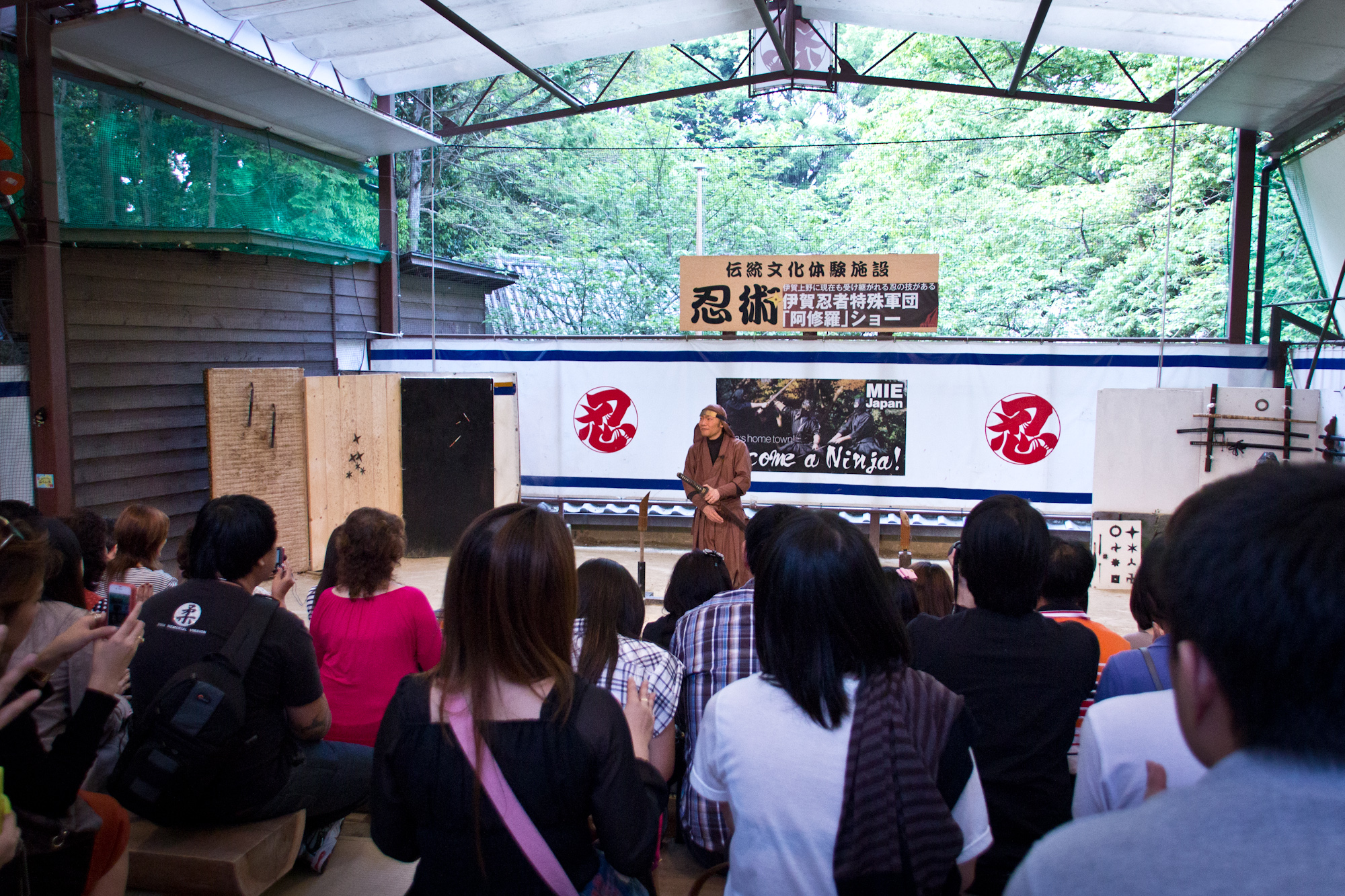
The Ninja Museum sits immediately alongside Iga Ueno Castle in what is now Ueno Park, the cultural heart of Iga city. The pairing is deliberate: the castle occupies the very hilltop where the Iga ikki once held their headquarters before Nobunaga's conquest. Visitors who tour the ninja house's revolving walls can walk next door and stand beneath the tallest castle stone walls in Japan -- 30-meter fortifications built by Todo Takatora to impose the kind of centralized control that the ninja had spent a century resisting. Live ninja demonstration shows featuring real weapons draw crowds to the museum grounds. The museum is accessible via a five-minute walk from Uenoshi Station on the Iga Railway, or a thirty-minute walk from Iga-Ueno Station on the JR West Kansai Main Line.
From the Air
Located at 34.77°N, 136.13°E in forested grounds beside Iga Ueno Castle, in the center of the Iga basin, Mie Prefecture, Japan. The museum is part of the Ueno Park complex visible from altitude as a forested hilltop with the white castle tower as its landmark. The mountain-ringed Iga basin is distinctive from the air, with the Kizu and Tsuge Rivers threading through the valley. Best viewed at 2,000-4,000 feet AGL. Nearest major airports: Chubu Centrair International (RJGG) approximately 60 nautical miles northeast, Osaka Kansai International (RJBB) approximately 55 nautical miles west.