Ninna-ji: Where Emperors Became Monks
For almost a millennium -- from 888 to 1869 -- the head priest of Ninna-ji was always a prince. Reigning emperors sent their sons to take over the temple when a vacancy arose, creating an unbroken chain of imperial abbots that connected the throne to the Buddhist altar across thirty generations. Emperor Uda set the precedent himself: after abdicating, he entered monastic life and became the first Monzeki, the aristocratic priest-leader, of the temple he had completed. No other Buddhist institution in Japan maintained this imperial connection so consistently or for so long. The tradition ended only with the Meiji Restoration, when the old order collapsed and the flow of royal blood into Ninna-ji's robes finally stopped.
Two Emperors and a Temple
The story of Ninna-ji begins with a dying emperor's wish. In 886, Emperor Koko ordered the construction of a new temple called Nishiyama Goganji, intended to bless the nation and spread Buddhist teachings. He died before the first roof tile was laid. His successor, Emperor Uda, completed the project in 888 and named the temple Ninna-ji after the regnal year of Emperor Koko's reign -- a tribute to the man whose vision he had fulfilled. The temple was founded during the early Heian period, when Kyoto was still a young capital and Japanese Buddhism was absorbing and transforming Chinese traditions into something distinctly its own. Ninna-ji became the head temple of the Omuro school of Shingon Buddhism, one of the esoteric traditions that flourished in the courtly atmosphere of Heian Kyoto.
Fire, War, and a Shogun's Purse
Like so many of Kyoto's great temples, Ninna-ji was destroyed in the Onin War of 1467, the catastrophic civil conflict that leveled much of the city. For roughly a hundred and fifty years, the temple lay in ruins. Its resurrection came through an unusual alliance: Kakushin Hosshinno, the eldest son of Emperor Go-Yozei, enlisted the help of Tokugawa Iemitsu, the third shogun of the Tokugawa dynasty. The timing was fortunate -- the Imperial Palace in Kyoto was being rebuilt at the same time, and Ninna-ji received imperial funding as part of that larger project. Most of the buildings that stand today date from this seventeenth-century reconstruction, giving the complex a cohesive architectural character that reflects the confidence of the early Edo period.
Seven Treasures Behind One Gate
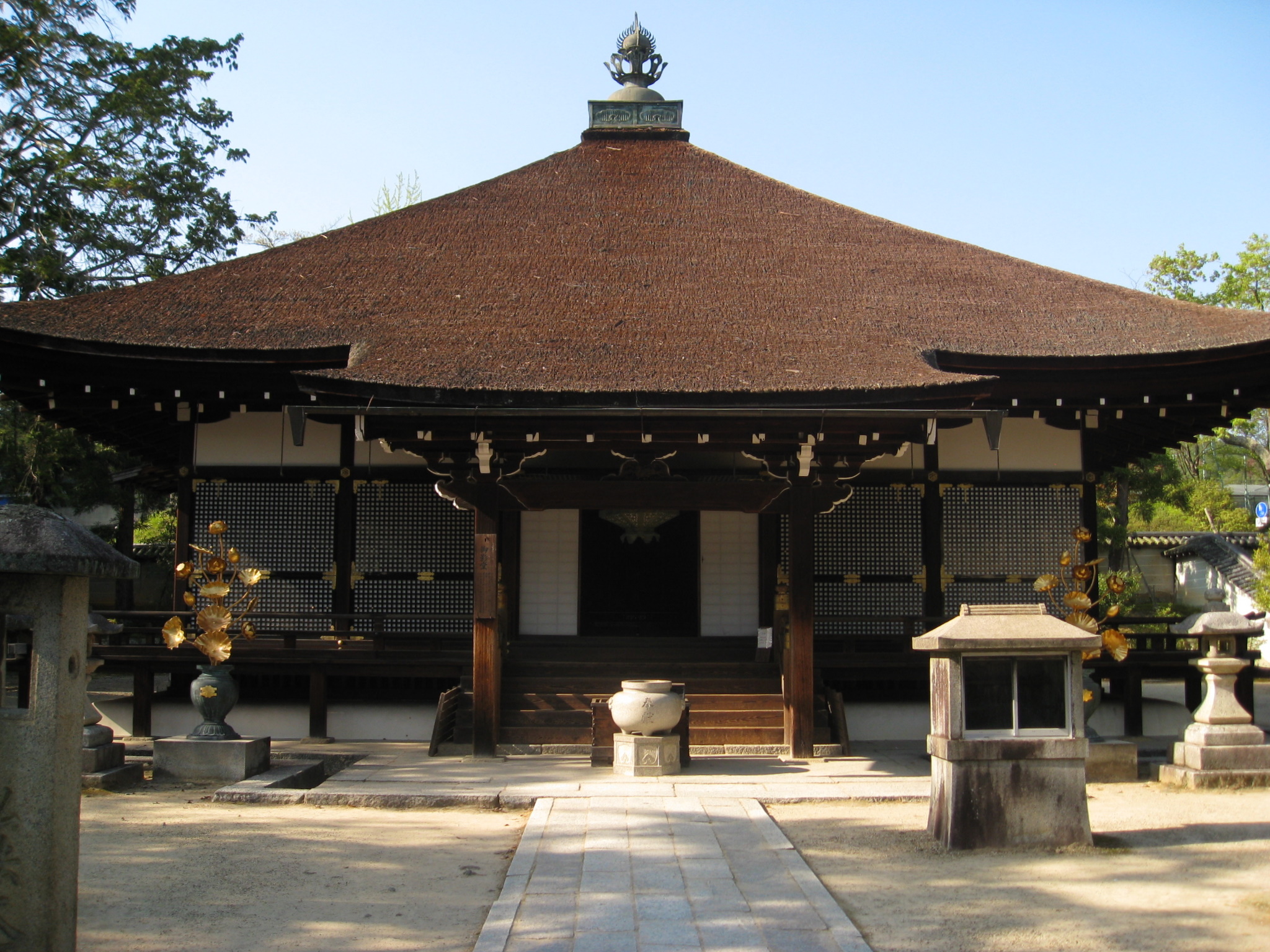
Ninna-ji's Golden Hall holds the designation of National Treasure of Japan -- the highest level of cultural protection the country bestows. Twelve additional structures are classified as Important Cultural Properties, including the five-story pagoda that anchors the skyline of the complex, the Niomon great gate, and the delicate Ryokaku-tei tea pavilion. The temple grounds are organized in the traditional manner: the main halls along a central axis, with subsidiary buildings arranged around gardens and courtyards. Painted screen walls inside the Shinden display the refined artistry of the period, and the walled garden combines carefully placed stones, manicured moss, and raked gravel into compositions that reward long contemplation. In 1994, Ninna-ji was inscribed as a UNESCO World Heritage Site as part of the Historic Monuments of Ancient Kyoto.
The Last Cherry Blossoms in Kyoto
Every spring, after the rest of Kyoto's famous cherry trees have dropped their petals, Ninna-ji's Omuro cherry trees begin to bloom. These dwarf varieties grow only two to three meters tall -- roughly ten feet -- placing their flowers at eye level rather than high overhead. The trees bloom late, typically in mid-to-late April, making Ninna-ji the last stop on Kyoto's cherry blossom circuit. The effect is intimate and unusual: instead of looking up through a canopy of pink, visitors walk among blossoms that brush their shoulders. The orchard fills with visitors who have already seen the famous displays at Maruyama Park and the Philosopher's Path and who come here for one final encounter with the season before it passes. The Omuro cherries have been celebrated in Japanese poetry and painting for centuries, their late arrival a reminder that beauty operates on its own schedule.
The End of the Imperial Line
The thirtieth Monzeki, Junnin Hosshinno, was the last prince to serve as Ninna-ji's head priest. The Meiji Restoration of 1868 dismantled the feudal structures that had sustained the temple's imperial connection, separating Shinto and Buddhism and stripping many temples of their aristocratic patronage. After nearly a thousand years, the line was broken. But Ninna-ji survived the transition, as it had survived the Onin War, as it had survived earthquakes and fires and the shifting politics of shoguns and emperors. Today the temple operates as a functioning religious institution and one of Kyoto's most visited cultural sites, its Golden Hall and pagoda drawing pilgrims and tourists alike. The imperial connection lingers in the architecture, in the quality of the painted screens, and in the name of the surrounding district -- Omuro, the title by which the imperial abbots were known.
From the Air
Located at 35.03N, 135.71E in western Kyoto, near the foot of the Kitayama hills. The five-story pagoda is the most visible landmark from altitude. The nearby Ryoan-ji temple lies approximately 500 meters to the north. Best viewed at 3,000-5,000 feet AGL. Osaka International Airport (RJOO) is approximately 20 nautical miles south-southwest. Kansai International Airport (RJBB) is roughly 50 nautical miles to the south. The temple complex occupies a large rectangular footprint with distinctive dark tile roofs visible against the surrounding green tree cover.