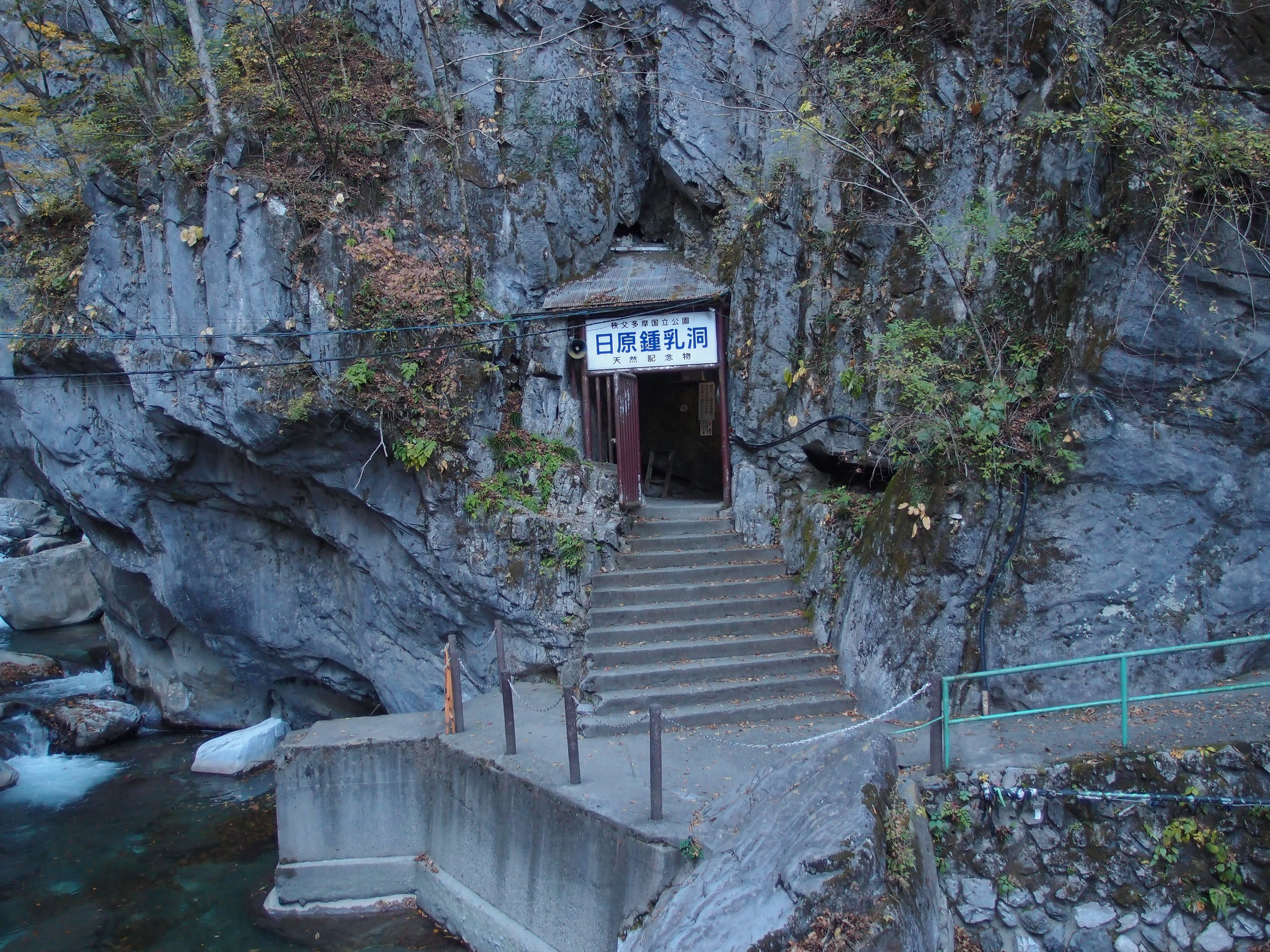
Nippara Cave: Tokyo's Paleozoic Underworld
Tokyo's largest limestone cave sits not beneath the neon canyons of Shinjuku or the glass towers of Marunouchi, but two hours west of the city center, deep in the forested mountains of Okutama. Nippara Shonyudo stretches over 1,270 meters from its entrance to its farthest surveyed point, with a vertical range of 134 meters from floor to ceiling. The rock is Paleozoic -- hundreds of millions of years old -- and the air inside holds at a constant eleven degrees Celsius regardless of the season, a natural refrigerator in summer and a warm refuge in winter. For centuries before it became a tourist attraction, this cave was holy ground. Shugendo monks who practiced severe asceticism in the mountains named the stalagmite formations after sacred objects: Kongozue, the Pilgrim's Staff, a column of mineral deposit 2.5 meters tall that grows one centimeter roughly every 130 years. The cave has been accumulating these ornaments for several hundred thousand years. Tokyo has not been a city for even five hundred.
Stone That Remembers the Paleozoic
The limestone that forms Nippara Cave was laid down during the Paleozoic era, when the region that would become the Kanto plain lay beneath a shallow sea. Over geological time, tectonic forces lifted the seabed into mountains, and water began its slow work of dissolution, carving passages through the soluble rock. The cave's formations grow at a pace that makes even geological time feel rushed: stalactites lengthen by approximately one centimeter every 70 years, while stalagmites below them require about 130 years for the same growth. The largest chamber, called Shingu Do, extends 527 meters into the mountain and represents the cave's most expansive section. A second major cave in the area, Roukokudo, is comparable in size, and together the two qualify as among the largest cave systems in the Kanto region. The entire complex has been registered as a natural monument by the Tokyo Metropolitan Government.
Monks in the Mountain
Long before electric lighting was strung through its passages, Nippara Cave served as a site of spiritual discipline. During the Kamakura period (1185-1333), the cave became a destination for practitioners of Shugendo, a Japanese ascetic tradition blending esoteric Buddhism, Shinto, and mountain worship. These monks endured harsh physical training in remote mountain locations to achieve spiritual power, and a cave of this depth and darkness offered an ideal setting for meditation and ritual isolation. The monk Kobo Daishi, known also as Kukai, who founded the Shingon sect of Buddhism after studying esoteric teachings in China, is traditionally believed to have practiced in the cave. His connection to the site, whether historical or legendary, cemented Nippara's reputation as sacred ground. During the Edo era, Shugendo practitioners named the cave's mineral formations: the stalagmites became Kongozue, pilgrim's staffs turned to stone, as if the mountain itself had been walking a spiritual path for millennia.
A Chamber Called Sainokawara
Inside the cave, named formations mark a route that feels as much pilgrimage as geology tour. Shidenoyama is a broad chamber bathed in carefully placed light, its walls glistening with mineral deposits. Deeper in, Sainokawara houses a statue of Enmusubi-Kannon, a deity associated with forming romantic bonds. Visitors leave one-yen coins at its base, small offerings for luck in love placed in a cavern where water has been sculpting stone since before humans existed. The upper reaches of the cave include Shindo, a limestone gallery discovered only in the mid-twentieth century that extended the known cave significantly. The temperature never varies. The silence is total except for the slow drip of mineral-laden water building the next centimeter of stalactite. It is one of those rare places where the sheer age of the earth becomes tangible -- not as an abstraction in a textbook, but as a physical sensation of cool air and wet stone and deep, implacable time.
Getting Underground
Nippara Cave is open year-round except for a brief closure from December 30 through January 3. Summer hours run from 9 a.m. to 5 p.m.; winter hours end at 4:30 p.m. The journey from central Tokyo involves a train ride on the JR East Ome Line to Okutama Station, followed by a 30-minute bus trip on the Nishi Tokyo Bus. On weekdays the bus stops directly at Nippara Shonyudo; on holidays, the nearest stop is Higashi-Nippara, about a 20-minute walk from the cave entrance. The approach road, Tokyo Metropolitan Route 204, is narrow and winding with occasional falling rocks -- a reminder that the same geological forces that created the cave continue to reshape the surface above it. The cave sits within the broader landscape of Chichibu Tama Kai National Park, where the mountains west of Tokyo still feel genuinely wild, and where a hole in the ground leads to rock older than most life on Earth.
From the Air
Located at 35.853°N, 139.040°E in the mountainous Okutama area of western Tokyo. The cave entrance is not visible from the air, but the surrounding terrain -- steep, forested mountains of Chichibu Tama Kai National Park -- is distinctive. The narrow valley of the Nippara River and the winding Route 204 serve as visual landmarks. Best observed at 3,000-5,000 feet AGL. Nearest airports are Chofu Airport (RJTF) approximately 35 nautical miles southeast, and Yokota Air Base (RJTY) approximately 20 nautical miles south-southeast. Mount Kumotori, Tokyo's highest peak, rises nearby to the northwest.