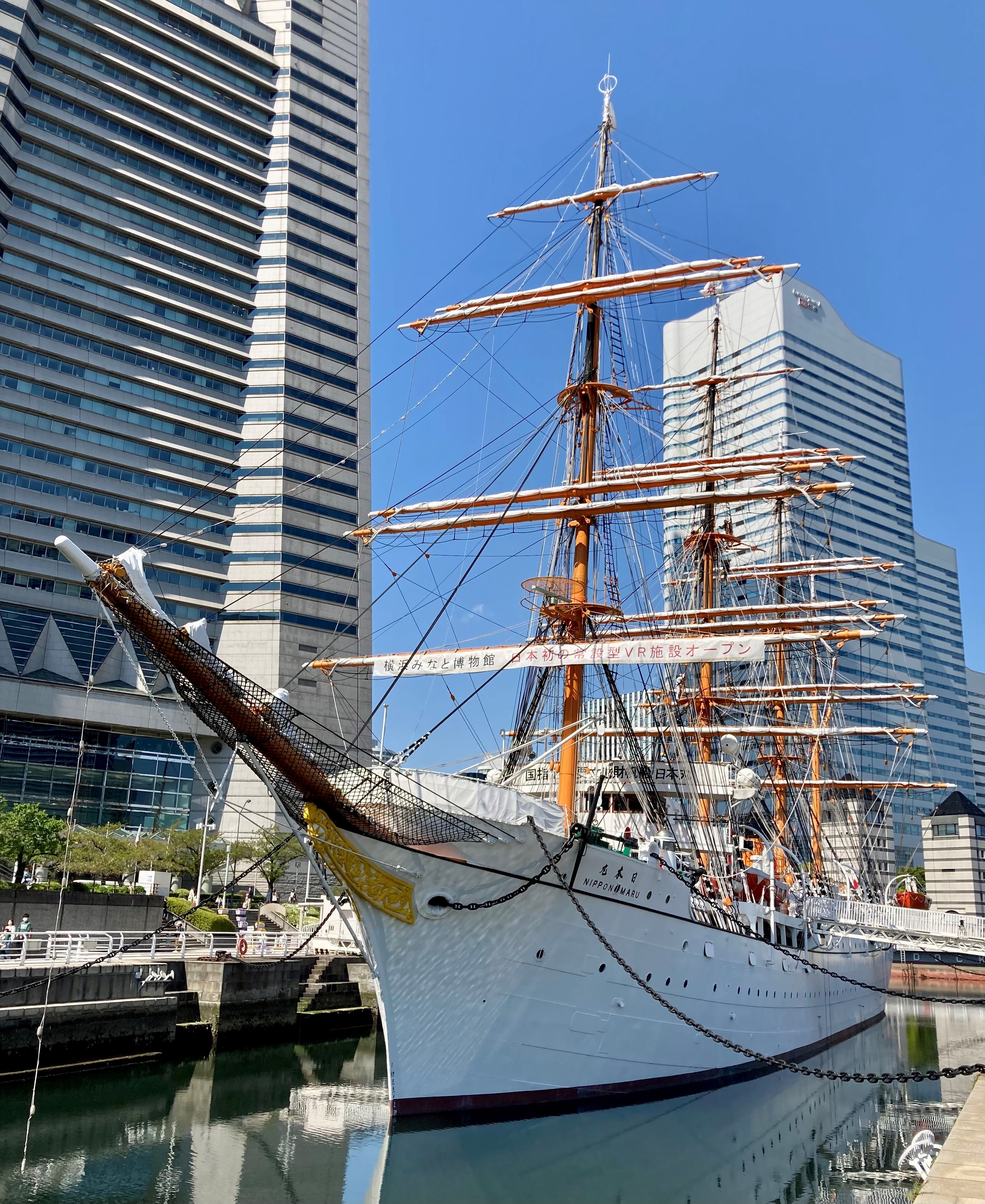
Nippon Maru: The Swan of the Pacific
She sailed the equivalent of 45 laps around the planet. Over 54 years, the four-masted barque Nippon Maru carried 11,500 cadets across 1.83 million kilometers of open ocean, teaching generations of Japanese merchant mariners to read the wind and trust the rigging. When she was launched in Kobe on January 27, 1930, dockworkers and spectators called her beautiful enough to earn the nickname that would follow her across every sea: Taiheiyo no Hakucho -- the Swan of the Pacific. She earned it. With 32 sails unfurled across four masts, her silhouette against the horizon was unmistakable. Now permanently docked in Yokohama's Minato Mirai waterfront district, the Nippon Maru stands as a monument to the age when Japan's maritime ambitions were measured not in container volumes but in canvas and courage.
Built for the Open Ocean
The Kawasaki Shipbuilding Corporation launched the Nippon Maru from its Kobe shipyard on January 27, 1930, alongside her sister ship Kaiwo Maru. Both were commissioned by the Tokyo Institute for Maritime Training to forge officers for Japan's rapidly expanding merchant marine. The Nippon Maru was rigged as a four-masted barque with 32 sails and fitted with two 600-horsepower diesel engines for auxiliary power. She carried a working complement of 27 officers and 48 seamen, plus 120 trainees packed into quarters designed to teach discipline through proximity. With a gross tonnage of 2,286, she was large enough to handle blue-water crossings yet nimble enough under sail to earn comparisons to a swan gliding across the Pacific. Her maiden training voyage set the pattern for decades of service: long ocean passages where cadets learned celestial navigation, sail handling, and seamanship under conditions that no classroom could replicate.
Stripped by War, Restored by Peace
When World War II broke the rhythm of training voyages, the Nippon Maru's sailing rig was stripped away. She spent the war years as a motor-driven transport and training vessel, her elegant masts and yards gone, her identity reduced to a utilitarian hull. After the war, she carried repatriates home across battered sea lanes. But Japan's merchant marine needed skilled officers for the rebuilding ahead, and in 1952, the Nippon Maru's sailing rig was reinstalled. She returned to the open ocean, once again filling her 32 sails with Pacific wind. For the next three decades, she resumed the work she was born for: turning cadets into mariners. Each voyage added to a career total that would eventually reach 1.83 million kilometers -- a distance no single human crew could fathom, accumulated across thousands of watches and countless horizon lines.
The Final Voyage
In September 1984, a newer vessel -- also named Nippon Maru -- took over the training duties, and the original Swan of the Pacific was retired after 54 years of continuous service. The city of Yokohama claimed her. She was towed to a specially constructed dock in Nippon Maru Memorial Park, part of the ambitious Minato Mirai 21 waterfront redevelopment that was transforming the old port district into a modern urban center. Since 1985, visitors have been able to walk her decks, descend into the officers' quarters, and stand at the helm where generations of cadets first gripped the wheel. The Yokohama Port Museum sits alongside the ship, weaving her story into the broader narrative of the city's maritime heritage.
Thirty-Two Sails Against the Skyline
Several times a year, the museum crew unfurls all 32 of the Nippon Maru's sails in a ceremony called soten -- a total sail exhibition. It takes about 100 trained volunteers to set the canvas, climbing the masts and working the yards as the original crew once did. The sight of the fully rigged ship against Yokohama's modern skyline -- the Landmark Tower, the Ferris wheel, the glass facades of Minato Mirai -- creates one of the city's most striking visual contrasts. Sail and steel. The old maritime world and the new. The Nippon Maru's white hull and polished brass fittings gleam in Yokohama Bay's reflected light, a reminder that before containerization and GPS, the ocean demanded a different kind of knowledge. The Swan of the Pacific floats quietly in her berth, her 32 sails ready to catch a wind that no longer needs to carry her anywhere.
From the Air
Located at 35.45N, 139.63E in Yokohama's Minato Mirai 21 waterfront district. From altitude, the Nippon Maru is visible as a white-hulled tall ship docked in a small basin adjacent to the Yokohama Landmark Tower (Japan's third-tallest building at 296 meters) and the Cosmo Clock 21 Ferris wheel. Best viewed at 1,500-3,000 feet AGL approaching from the east over Yokohama Bay. The ship's four masts are distinctive against the surrounding modern architecture. Tokyo Haneda International Airport (RJTT) lies approximately 14 nautical miles north-northeast. The Port of Yokohama's container terminals at Honmoku are visible to the south.