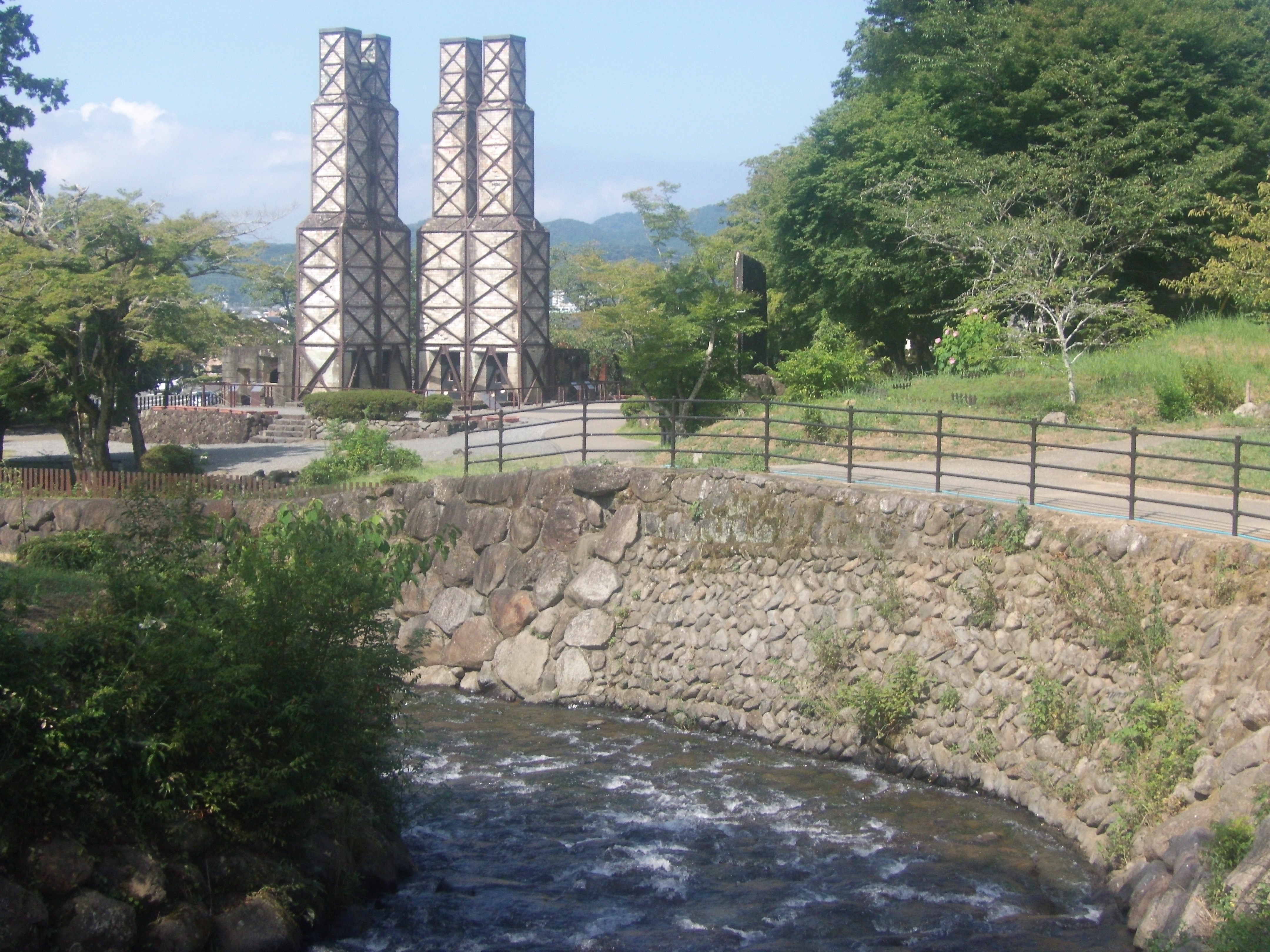
Nirayama Reverberatory Furnace
An American sailor trespassed on a construction site in Shimoda in 1853, and that single intrusion changed the location of one of Japan's most important industrial experiments. The Tokugawa shogunate had been secretly building a furnace to cast Western-style cannon, and the breach of security forced them to relocate the entire operation to a more isolated spot: the village of Nirayama, tucked into the hills of the Izu Peninsula. The four brick chimneys that rose there over the next few years -- each standing 15.7 meters tall, built from refractory bricks fired from Amagi Mountain clay on a base of local green tuff -- still stand today. They are the only reverberatory furnaces from this era surviving intact anywhere in Japan, now a UNESCO World Heritage Site and a National Historic Site that tells the story of a nation scrambling to defend itself against forces it barely understood.
Black Ships on the Horizon
The panic began with the kurofune -- the "black ships" -- foreign warships that appeared with increasing frequency in Japanese waters during the Bakumatsu period. For more than two centuries, Japan had maintained its sakoku isolation policy, and the shogunate had no modern navy, no coastal artillery worth the name, and no capacity to manufacture Western weapons. When Commodore Perry's expedition arrived in 1853 to force open Japanese ports, the military gap was impossible to ignore. The shogunate ordered feudal domains across the country to fortify their coastlines and began a frantic effort to acquire modern weaponry. But buying foreign cannon was expensive and unreliable. Japan needed to build its own, and for that it needed furnaces hot enough to melt iron and bronze into artillery-grade castings.
The Magistrate's Mission
The man tasked with solving this problem was Egawa Hidetatsu, the daikan -- local magistrate -- of the Nirayama Daikansho. Since 1839, Egawa had been assigned to strengthen coastal defenses around Edo Bay, and he recognized early that Japan needed to manufacture its own cannon. As early as 1842, he attempted to build a furnace in Nirayama, but the technology was beyond what local craftsmen could achieve. He sent a student to study a furnace that had been built in Saga Domain using Dutch technical manuals, then began construction at Shimoda in 1853. The Perry incident forced the move to Nirayama. The design came from a Dutch book, Het Gietwezen in's Rijks Ijzer-geschutgieterij te Luik, obtained through the Dutch trading post at Nagasaki -- one of Japan's few windows to Western knowledge during the isolation era.
Fire and Iron
Construction was a race against time, and Egawa Hidetatsu did not live to see it finished. He died in 1855, the year the southern pair of furnaces was completed. His son, Egawa Hidetoshi, an engineer who had worked on a similar furnace in Saga Domain, brought in eleven engineers from Saga to help complete the northern pair by 1857. The facility consisted of two pairs of furnaces designed to cast both bronze and iron cannon. The first cannon was cast in 1858. Over the few years the furnaces operated, they produced 18-pounder cast iron cannon, a 24-pounder bronze cannon, four 80-pounder bronze cannon, and bronze mortars of 20 and 29 inches. The numbers were modest -- only about a dozen weapons total -- but each one represented a step toward military self-sufficiency. The facility ceased operation in 1864, its mission overtaken by the larger political upheaval of the Meiji Restoration.
Centuries of Stewardship
After closing in 1864, the furnaces were purchased by the Egawa clan in 1868, then acquired by the Imperial Japanese Army in 1872. Volunteers from Nirayama Village performed repair work between 1891 and 1908, a grassroots effort to preserve structures that the modern military establishment had largely forgotten. The site became a National Historic Site in 1922, with control passing to the Home Ministry and eventually to the Nirayama municipality in 1957. The long chain of custodians -- from a feudal magistrate's family to village volunteers to national authorities -- kept the four chimneys standing through wars, earthquakes, and Japan's headlong modernization.
World Heritage Recognition
In 2015, the Nirayama Reverberatory Furnace was inscribed as a component of the Sites of Japan's Meiji Industrial Revolution: Iron and Steel, Shipbuilding and Coal Mining, a serial UNESCO World Heritage Site that traces the arc of Japan's transformation from feudal isolation to industrial power. A guidance center now stands beside the furnaces, and a bronze statue of Egawa Hidetatsu marks the site where his vision was realized after his death. A replica 24-pounder cannon, cast in iron in 2015 to replace the original bronze piece, sits on display. The four chimneys remain the most visible artifacts of a moment when Japan stood at the threshold between eras, building Western technology from Dutch books in a hidden valley on the Izu Peninsula.
From the Air
Located at 35.040N, 138.962E in the Nirayama neighborhood of Izunokuni, Shizuoka Prefecture, on the Izu Peninsula. Best viewed from 2,000-4,000 feet AGL. The four tall brick chimneys are distinctive vertical structures visible against the surrounding low-rise development and green hills. The Furukawa River runs alongside the site. Nearest airports include RJTO (Oshima Airport) approximately 50 nm southeast. Mount Fuji is visible to the northwest as a primary navigation landmark. The nearby Nirayama Castle ruins sit on a ridgeline less than one mile to the north.