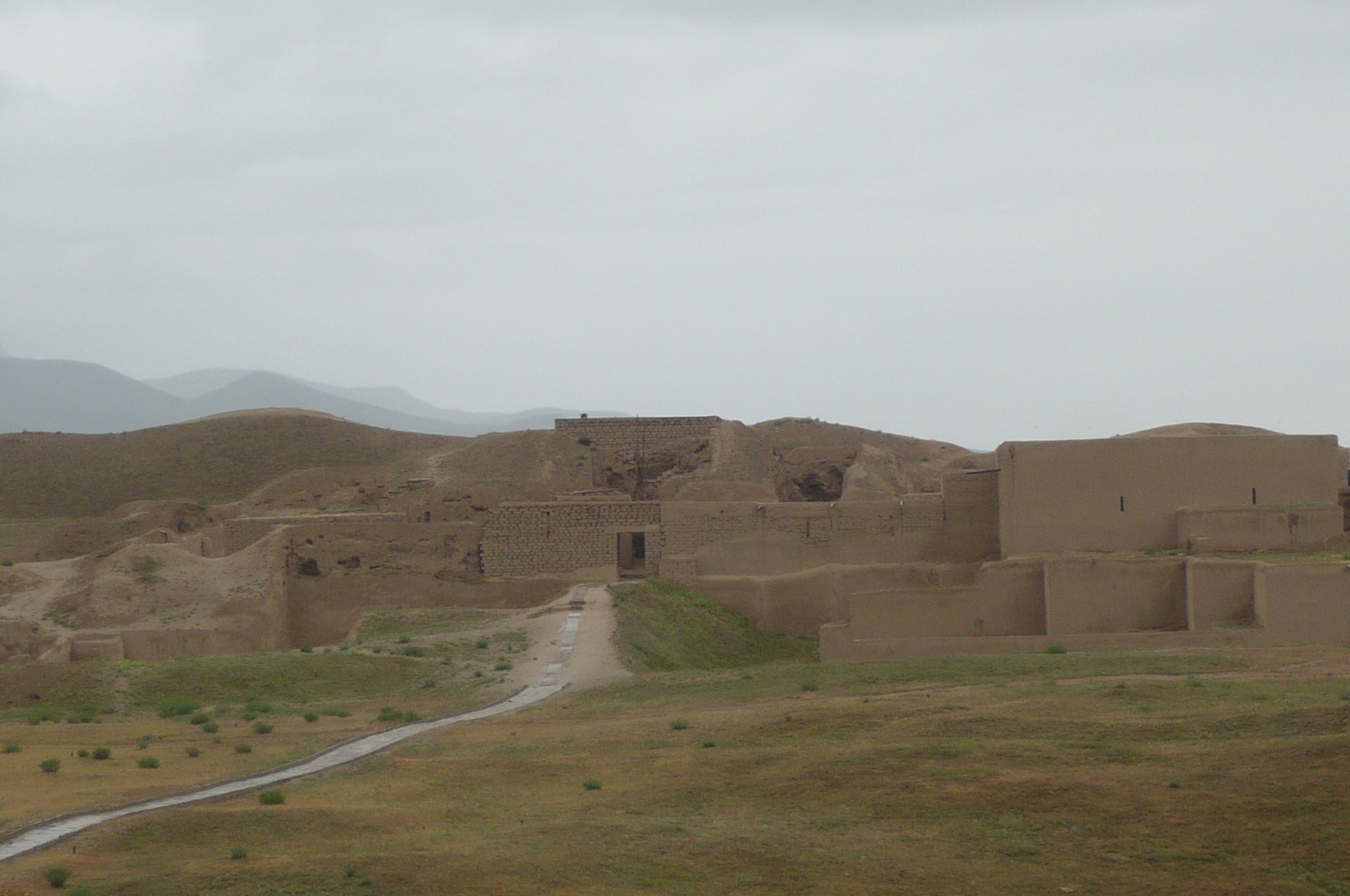
Nisa: The Forgotten Capital of the Parthian Empire
Somewhere in the ruins, archaeologists found the drinking horns. Dozens of ivory rhytons, carved with scenes from Greek mythology and Iranian royal imagery, lay in the remains of a treasury that had been looted centuries before the diggers arrived. These objects -- Greek in form, Persian in spirit -- capture something essential about Nisa, a fortress city eighteen kilometers west of modern Ashgabat where the Parthian Empire kept what may have been its first capital. Founded around 250 BC, probably by Arsaces I, Nisa sat at the intersection of steppe and civilization, absorbing influences from Greece, Persia, and Central Asia and producing something that belonged entirely to none of them. In 2007, UNESCO declared what remains of the fortress a World Heritage Site.
Where the Arsacids Began
The Parthian Empire is one of history's great enigmas -- a power that rivaled Rome for nearly five centuries yet left fewer written records than almost any comparable civilization. What we know of the Arsacid dynasty's origins comes largely from fragmentary sources and archaeological evidence like that found at Nisa. Arsaces I, a chieftain from the Parni tribe of the Central Asian steppes, seized control of the province of Parthia around 250 BC, breaking away from the Seleucid Empire that had inherited Alexander the Great's eastern conquests. Nisa is traditionally identified as his first fortified capital, though scholars debate whether the site served as a royal residence, a treasury, or a necropolis for the dynasty's dead. What is not debated is the scale. The fortress walls enclosed substantial buildings, shrines, and mausoleums -- the infrastructure of a power that intended to last.
Greek Gods on Iranian Soil
The excavations at Nisa have produced some of the most striking examples of cultural fusion in the ancient world. Hellenistic art works -- sculptures and decorative objects showing clear Greek influence -- appear alongside unmistakably Iranian subjects. The ivory rhytons are the most celebrated finds. These ceremonial drinking vessels, shaped like horns and terminating in animal or mythological figures, combine Greek artistic conventions with themes drawn from Iranian royal and religious traditions. Coins recovered from the site bear both Iranian and classical mythological imagery. This was not mere copying. The Parthians selectively adopted elements of Greek culture that served their purposes, creating a court aesthetic that impressed visiting ambassadors and proclaimed sophistication without surrendering identity. Mithridates I, who reigned from approximately 171 to 138 BC, renamed the city Mithradatkert -- the fortress of Mithridates -- marking it as personally his.
The Horses of Nisa
Ancient writers remarked on the horses. The Parthians were celebrated for cavalry mounts of extraordinary beauty, agility, and strength -- the Nisaean horse, one of the most prized breeds of the ancient world. The Greek poet Pseudo-Oppian described these horses in his Cynegetica, and their reputation spread across the Mediterranean. Scholars locate the Nisaean plain in Media near ancient Ecbatana (modern Hamadan), though the breed's name may share roots with the wider Parthian realm that included Nisa. For the Parthians, whose military power rested on mounted archers who could fire backward at full gallop -- the famous "Parthian shot" -- horse breeding was not a luxury but a strategic necessity. The Parthian heartland's position at the northern edge of the Iranian plateau, where grasslands met trade routes, made it ideal territory for raising cavalry mounts.
Shattered and Buried
An earthquake destroyed Nisa during the first decade BC. The seismic event was total, collapsing walls and burying structures that would not be excavated for nearly two thousand years. By then, the Parthian Empire had shifted its center of gravity westward, establishing Ctesiphon on the Tigris as its primary capital. Nisa faded from memory. Soviet archaeologists began systematic excavations in the twentieth century, and Italian missions continued the work from 1990 onward. What they found beneath the rubble -- the inscribed documents, the carved ivory, the architectural remains -- painted a picture of a sophisticated fortress city that had flourished for two centuries before the ground swallowed it. The ruins today sit near the Bagyr neighborhood on the outskirts of Ashgabat, low mounds and eroded walls that barely hint at what lies beneath. UNESCO's World Heritage designation in 2007 recognized both what has been found and what likely remains undiscovered.
From the Air
Located at 37.95°N, 58.21°E, approximately 18 km west of central Ashgabat, Turkmenistan, near the Bagyr neighborhood. The ruins appear from altitude as low mounds and earthwork outlines against the arid terrain at the base of the Kopet Dag mountain range. Ashgabat International Airport (UTAA) is the nearest major airport, approximately 15 km to the east. The Kopet Dag mountains rise sharply to the south, providing a dramatic backdrop. Best viewed at 3,000-5,000 feet AGL. The terrain is dry steppe with generally excellent visibility, though dust haze can develop in summer.