Nishapur
Omar Khayyam was born here in 1048. So was Attar, the Sufi poet whose Conference of the Birds sent thirty seekers on a journey to discover that God was themselves. Both men are buried in Nishapur, their mausoleums standing a few kilometers apart in a city that once ranked among the largest and wealthiest on Earth. That Nishapur produced two of Persia's greatest minds is not coincidence. For centuries, this was where the Silk Road's intellectual currents pooled and mixed -- a crossroads city where mathematicians debated astronomers, where mystics argued with merchants, and where the turquoise pulled from nearby mountains traveled outward to adorn the palaces of empires.
The Crossroads That Built a Civilization
Nishapur sits at the western edge of Greater Khorasan, the vast historical region that once stretched from northeastern Iran into Central Asia. By the 10th and 11th centuries, the city had become one of the Silk Road's essential stops, a place where caravans paused and cultures collided. Under the Samanids and then the Seljuks, Nishapur grew into a center of learning and commerce, its population swelling to an estimated 100,000 to 336,000 people -- enormous by medieval standards. Poets, scholars, and artisans filled its neighborhoods. The city's bazaars hummed with trade in silk, ceramics, and the blue-green turquoise that would become its signature export. This was the world Omar Khayyam inherited when he was born here in 1048: a city buzzing with ideas and confident in its own magnificence.
Turquoise from the Deep Earth
The mines near Nishapur are among the oldest continuously worked in human history. Archaeological evidence suggests turquoise extraction here began around 5,000 BCE, making the deposits over seven thousand years old as a source of human commerce. Persian turquoise from Nishapur adorned Achaemenid palaces and traveled along trade routes to Egypt, Rome, and beyond. The stone's distinctive sky-blue color -- prized above all other varieties -- gave Nishapur the nickname 'the turquoise land.' Today, Iran still produces roughly 19 tons of quality turquoise annually from these deposits. Jewelers in the city and in nearby Mashhad continue to set Neyshabur turquoise into rings, necklaces, and bracelets, selling them as souvenirs that carry seven millennia of geological and human history in their blue-green depths.
The Poets Who Stayed
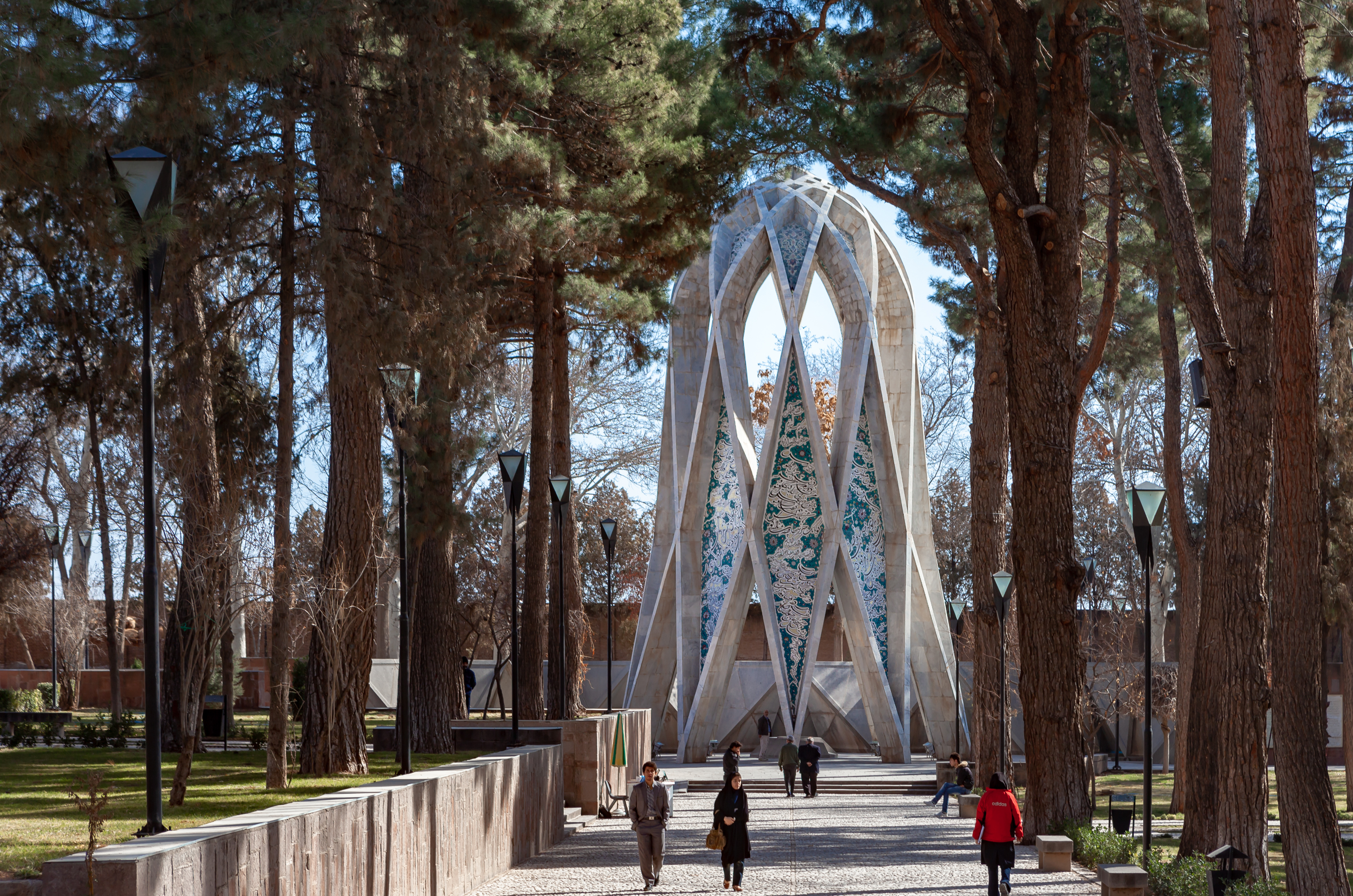
Khayyam was a mathematician and astronomer first, a poet second -- or so he would have said. His reform of the Persian calendar was more precise than the Gregorian system that Europe would not adopt for another five centuries. But posterity remembers him for the Rubaiyat, those quatrains about wine, mortality, and the fleeting nature of joy. Attar, born roughly a century later around 1145, was a pharmacist by trade and a mystic by calling. His Conference of the Birds remains one of Sufism's defining texts: an allegory in which birds travel through seven valleys of spiritual trial only to discover that the divine they sought was a reflection of themselves. Both men died in Nishapur -- Khayyam peacefully in 1131, Attar violently in the Mongol massacre of 1221. Their tombs still draw visitors. The Mausoleum of Omar Khayyam, redesigned in the 20th century by the Iranian architect Houshang Seyhoun, rises in geometric concrete forms meant to echo the mathematician's love of precision.
Destruction and Resilience
The Mongols arrived in April 1221 and left Nishapur in ruins. Under Tolui Khan, son of Genghis Khan, the siege was driven by vengeance: Genghis Khan's son-in-law Tokuchar had been killed during an earlier engagement at the city. The destruction was comprehensive. Medieval chroniclers reported staggering casualty figures, though modern historians estimate the actual death toll in the tens or hundreds of thousands. Nishapur never fully recovered its former scale. Earthquakes compounded the damage across subsequent centuries, and the modern city of roughly 240,000 sits beside -- rather than atop -- much of the ancient urban footprint. Archaeological finds from medieval Nishapur, particularly its celebrated ceramics, are now scattered across museums worldwide, from the Metropolitan Museum of Art in New York to collections in Tehran.
A Quiet City with Deep Roots
Modern Nishapur is modest by Iranian standards, overshadowed by Mashhad just 120 kilometers to the east. The pace is slower here, the streets walkable. Rhubarb grows wild at the foot of the Rivand Mountains, and locals turn it into sharbat-e rivas, a tart drink sold at roadside stalls. The historic bazaar still operates. Workshops produce traditional Persian musical instruments. The Binalud Mountain Range rises to the south, offering hiking trails above the plains. What Nishapur lacks in metropolitan bustle it compensates for in the weight of what has happened here -- the poems written, the turquoise mined, the civilizations that rose and fell across this particular patch of Iranian plateau.
From the Air
Located at 36.21N, 58.80E in Razavi Khorasan Province, northeastern Iran. The city sits in a plain at the western edge of the Binalud mountain range, at approximately 1,250 meters elevation. Nearest major airport is Mashhad Shahid Hasheminejad International (OIMM), about 120 km to the east. Road 44 (a major expressway) is visible running through the city. The Rivand Mountains to the west and Binalud range to the south provide orientation landmarks. Best viewed at 5,000-10,000 feet AGL for city layout and surrounding terrain.