Nishi Hongan-ji: The Temple That Survived a Warlord's Siege
The gate is so densely carved that it earned a nickname: Higurashi-mon, the All Day Gate, because visitors could supposedly spend from dawn to dusk studying its panels without running out of details. Chinese hermits wash their ears beside waterfalls. Farmers scrub their oxen in streams. Dragons coil through peonies. Originally built for Toyotomi Hideyoshi's Fushimi Castle around 1598, the karamon was moved to Nishi Hongan-ji in 1632 and has been astonishing visitors ever since. But the gate is only the threshold. Behind it lies one of Kyoto's most historically turbulent temples -- a place shaped by warlords, shoguns, family betrayals, and a ten-year siege that nearly erased Pure Land Buddhism from Japan.
The Founder's Bones
The original Hongan-ji was established in 1321 on the site where Shinran, the founder of Jodo Shinshu -- True Pure Land Buddhism -- was buried. Shinran's grandson Kakue tended the Otani Mausoleum, and Kakue's son Kakunyo became the first chief priest and third monshu, dedicating the temple to the worship of Amitabha. For a century, the Hongan-ji remained modest. Then Rennyo became the eighth monshu in the fifteenth century, and everything changed. Under Rennyo's charismatic leadership, the Pure Land movement expanded rapidly, attracting farmers, merchants, and commoners with its message that salvation required only sincere faith in Amida Buddha. The Tendai monks of Mount Hiei, watching their influence erode, attacked the Hongan-ji three times with their army of warrior monks. Rennyo fled to Yoshizaki-gobo, where he built a new compound and continued his ministry.
Nobunaga's Ten-Year War
By the Sengoku period, the Hongan-ji had become powerful enough to frighten Japan's most ambitious warlord. Oda Nobunaga, the general who would begin the unification of Japan, saw the temple's vast network of militant followers as a threat to his authority. In 1570, he laid siege to the Ishiyama Hongan-ji in Osaka, one of the sect's two great fortress-temples. The siege lasted ten brutal years. In 1580, the abbot Kennyo finally surrendered. But his son Kyonyo refused to yield, and Kennyo publicly disowned him for his defiance. That family rupture -- father against son, surrender against resistance -- would split the entire Hongan-ji institution in two within a generation.
How One Temple Became Two
After Nobunaga's death in 1582, Toyotomi Hideyoshi rose to power and rewarded Kennyo for his surrender with a grant of land in Kyoto. Nishi Hongan-ji -- the Western Hongan-ji -- was established at its current site in 1591. Kennyo's legitimate son Junnyo succeeded him as abbot in 1592. Meanwhile, the disowned Kyonyo re-established the Osaka Hongan-ji in 1596 with local support. When Hideyoshi died in 1598, Kyonyo allied himself with Tokugawa Ieyasu, who became shogun in 1602. Ieyasu rewarded Kyonyo with land just east of his brother's temple, and in 1603 Higashi Hongan-ji -- the Eastern Hongan-ji -- was born. In 1619, the government formally recognized the two as separate congregations. Popular legend claims the split was a deliberate government strategy to weaken the order, but the truth is simpler and more human: two brothers chose opposite sides in a war, and neither would bend.
Seven National Treasures Under One Roof
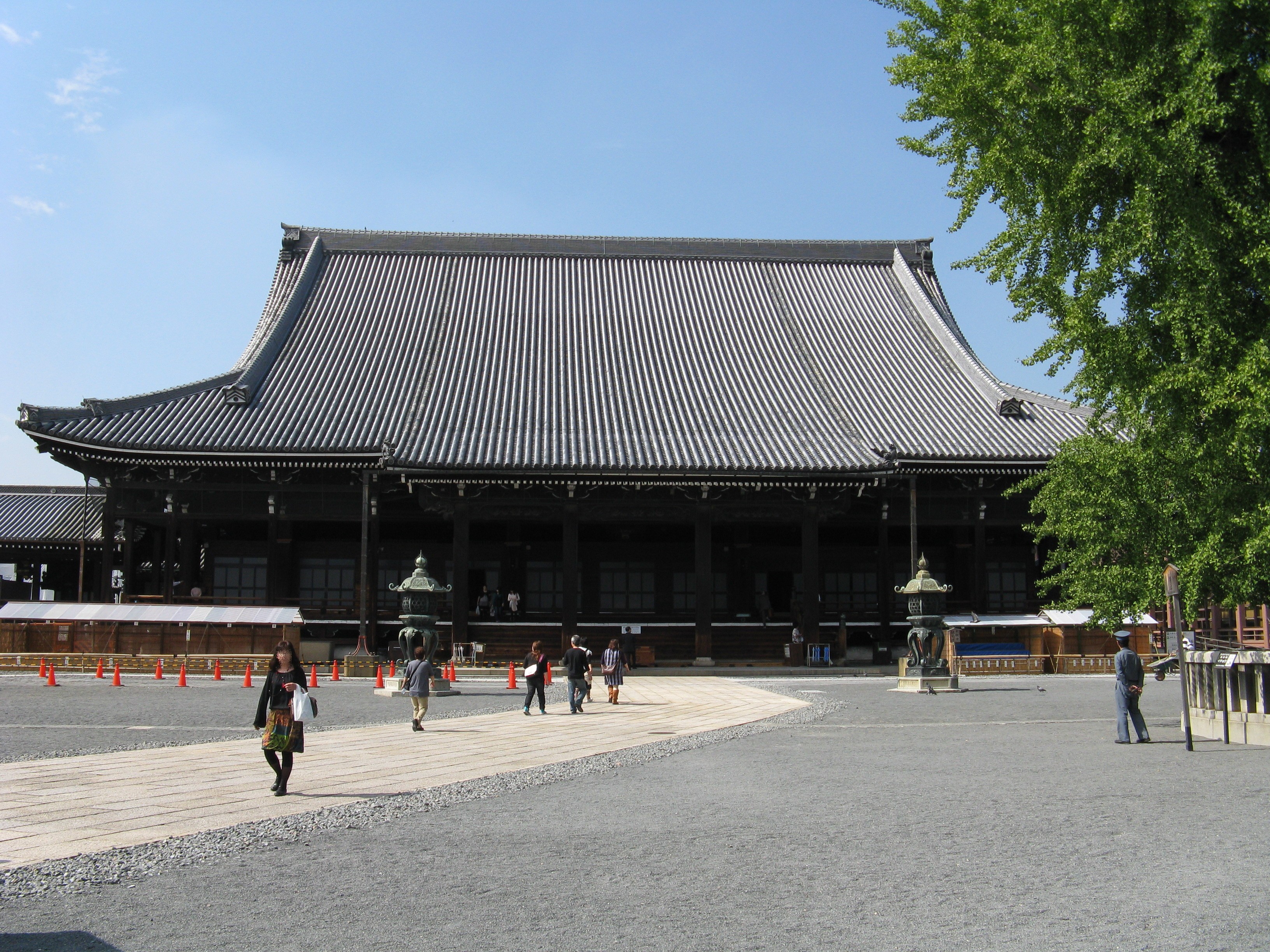
Nishi Hongan-ji holds more National Treasure designations than almost any other single religious complex in Japan. Seven structures bear the distinction across three categories: the karamon gate, the Goei-do Founder's Hall, and the Amida Hall among the temple buildings; the Flying Cloud Pavilion, the shoin study hall, and the Black study hall with its Denro gallery among the residences; and the north Noh stage as a miscellaneous structure. The Goei-do, rebuilt in 1636 after an earthquake and fire destroyed its predecessors, is an enormous single-story building measuring sixty-two meters by forty-eight meters with a height of twenty-nine meters, its irimoya-style tile roof dominating the complex's skyline. Inside, a sculpture of Amida Buddha sits surrounded by portraits of the Pure Land Masters, alongside images of Shinran's teacher Honen and Prince Shotoku. Many of these structures date from the Azuchi-Momoyama and early Edo periods, making the complex one of the finest surviving examples of Japanese architecture from the seventeenth and eighteenth centuries.
A Gate That Traveled from Castle to Temple
The karamon deserves a final look. Built for Hideyoshi's Fushimi Castle, it was moved to Nishi Hongan-ji in 1632 when Tokugawa Iemitsu planned a visit. The gate is constructed with four legs and karahafu gables -- undulating curves on front and back -- topped by an irimoya hip-and-gable roof covered in bark shingles made from hinoki cypress. Its carvings are so numerous and so fine that they justify the All Day Gate nickname: flowers, animals, mythical creatures, and scenes from Chinese legend crowd every surface. In 1910, a four-fifths replica was built for the Japan-British Exhibition in London. After the exhibition closed, the replica was reconstructed in Kew Gardens, where it remains the centerpiece of the Japanese garden. The original was last restored between 2018 and 2021. Nishi Hongan-ji was designated a UNESCO World Heritage Site in 1994 as part of the Historic Monuments of Ancient Kyoto.
From the Air
Located at 34.99N, 135.75E in the Shimogyo ward of central Kyoto, south of Kyoto Station. The temple occupies a large rectangular block bounded by Horikawa-dori to the east and Shichijo-dori to the south. The massive Goei-do roof is the most visible feature from altitude. Higashi Hongan-ji, the sister temple, lies approximately 500 meters to the east. Best viewed at 3,000-5,000 feet AGL. Osaka International Airport (RJOO) is approximately 22 nautical miles south-southwest. Kansai International Airport (RJBB) is roughly 50 nautical miles to the south.