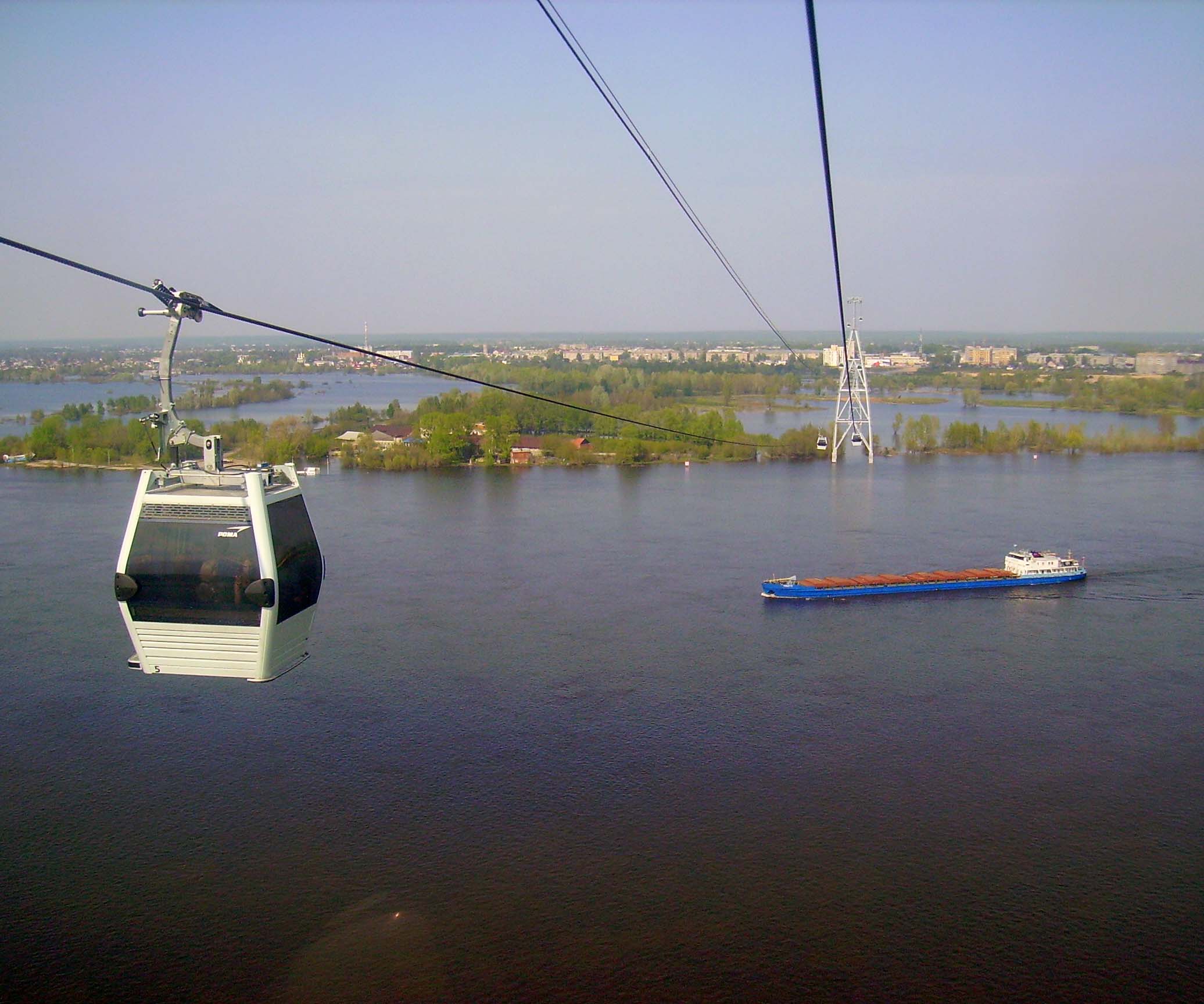
Nizhny Novgorod Cableway
The first passengers were not sandbags. They were supposed to be -- the engineers had planned to test the gondola system with weighted bags before allowing anyone aboard. But 16 officials, led by Governor Valery Shantsev, did not have time to wait. They climbed into the cabins and glided 3,660 meters across the Volga River, suspended from cables strung between 82-meter masts, connecting the city of Nizhny Novgorod to the town of Bor on the opposite bank. The Nizhny Novgorod Cableway opened to the public on February 9, 2012. It had taken four years to build, survived multiple delays, and required a helicopter to string the ropes. Within its first year, nearly two million people rode it.
Stringing a River
The idea arrived from France. In December 2007, the company Poma presented a cable car project to Nizhny Novgorod officials. By 2009, the Moscow-based firms Energomash and StroyArchitecture had completed the engineering drawings: 10 support pylons ranging from 40 to 80 meters tall, with a total steel weight of 560 tons. The two tallest masts, each 82 meters high and weighing 6 tons apiece, were shipped as oversized loads through the city in November 2009. Construction permits arrived in late 2009 and early 2010, and physical work began on January 20, 2010. The original opening target of September 2010 slipped when project documentation was sent back for revision, requiring a new state examination. By December 2010, all pylons were in place, but work on the T7 support, located on an island in the Volga, dragged into early 2011.
A Helicopter and 78 Road Trains
Installing the cables over the Volga required a Ka-32T helicopter, which worked in stages, closing individual river sections for three-hour windows over several days in September 2011. The logistics of the entire project were formidable: 78 road trains delivered the metal structures for the supports, 47 trucks carried equipment, and sea ferry and railway transport moved the cable rope itself. The cableway crosses the Volga in a single 900-meter span between the two tallest masts -- a distance that places it among the longest river-spanning aerial tramways in Europe. A one-way trip takes 13 minutes, offering riders an unbroken view of the Volga, the Nizhny Novgorod skyline, and the flat forested expanse of the Bor district on the far shore.
Wind, Lightning, and Two Million Riders
The cableway's early operational history reads like a stress test conducted by the Russian climate. One week after opening, on February 15, 2012, strong winds triggered the automatic safety system and halted the gondolas. Hovercraft -- the Khivus-10 and a 48-seat Khivus-48 -- were deployed to shuttle stranded passengers across the river. On February 25, the wind shut the system down nine more times in a single day. On March 22, a Bell 407 helicopter crashed into power lines a few hundred meters from the cableway, though the cable car equipment was unharmed. In July 2014, lightning struck a pylon next to an occupied cabin with such force that passengers inside dropped to their seats; they emerged at the station on shaky legs. Despite these episodes, demand consistently outstripped capacity. By May 2012, passenger loads at peak times exceeded the system's design limits.
A Commute Above the Water
What makes the Nizhny Novgorod Cableway unusual is not merely its engineering but its function. This is not a ski lift or a tourist attraction built for scenery alone. It is commuter infrastructure, connecting a major city of over a million people with a satellite town across one of Europe's great rivers. A one-way ticket costs 100 rubles -- roughly $1.50 -- compared to 28 rubles for the Nizhny Novgorod metro or 46 rubles for the electric train from Bor. By October 2015, 6.68 million people had ridden the cableway. By August 2016, the figure reached 8 million. By April 2018, it had passed 10.77 million. Suspended above the Volga, the gondola cabins travel a route that most cities would bridge with concrete and steel. Nizhny Novgorod chose cables and sky.
From the Air
Located at 56.34N, 44.05E, the cableway stretches across the Volga River between Nizhny Novgorod and Bor. The two 82-meter support masts and the cable line are visible from low altitude as they cross the wide river. Nizhny Novgorod Strigino Airport (UWGG) is approximately 15 km to the southwest. The cableway is best spotted from 2,000-5,000 feet, where the cable span across the Volga is clearly visible against the water. The city's location at the Volga-Oka confluence provides an unmistakable landmark.