Nizhny Novgorod Fair
Every July for nearly four hundred years, the banks of the Volga transformed into something like a temporary city. Tens of thousands of merchants arrived by river barge and overland caravan, pitching their stalls among 60 buildings and 2,500 bazaars. By the time an American journalist named Kellogg Durland visited in 1905, the Nizhny Novgorod Fair had been running, as he put it, since "before the discovery of America." At its peak, half of Russia's total export goods changed hands here in a single summer season. It was not merely a market; it was the commercial heartbeat of an empire that stretched from Poland to the Pacific.
A Rivalry Born on the Volga
The fair's origins trace to the mid-16th century, when Muscovite princes established it near the Makaryev Monastery on the Volga's left bank. Their motivation was strategic: a rival fair had operated since 1257 in Kazan, the Tatar capital, and Moscow wanted to draw commerce away from it. The location worked. Sitting at the confluence of the Volga and Oka rivers, Nizhny Novgorod was a natural crossroads where European Russia met the trade routes of Asia. Merchants from India, Iran, and the Central Asian khanates mingled with traders from Moscow and beyond. The fair grew so large that it became known simply as Makaryev Fair, after the monastery that watched over it. Then, in 1816, a massive fire destroyed the fairground. Rather than rebuild on the same spot, organizers relocated the fair downstream to Nizhny Novgorod itself, though the old name lingered for decades.
Architecture of Commerce
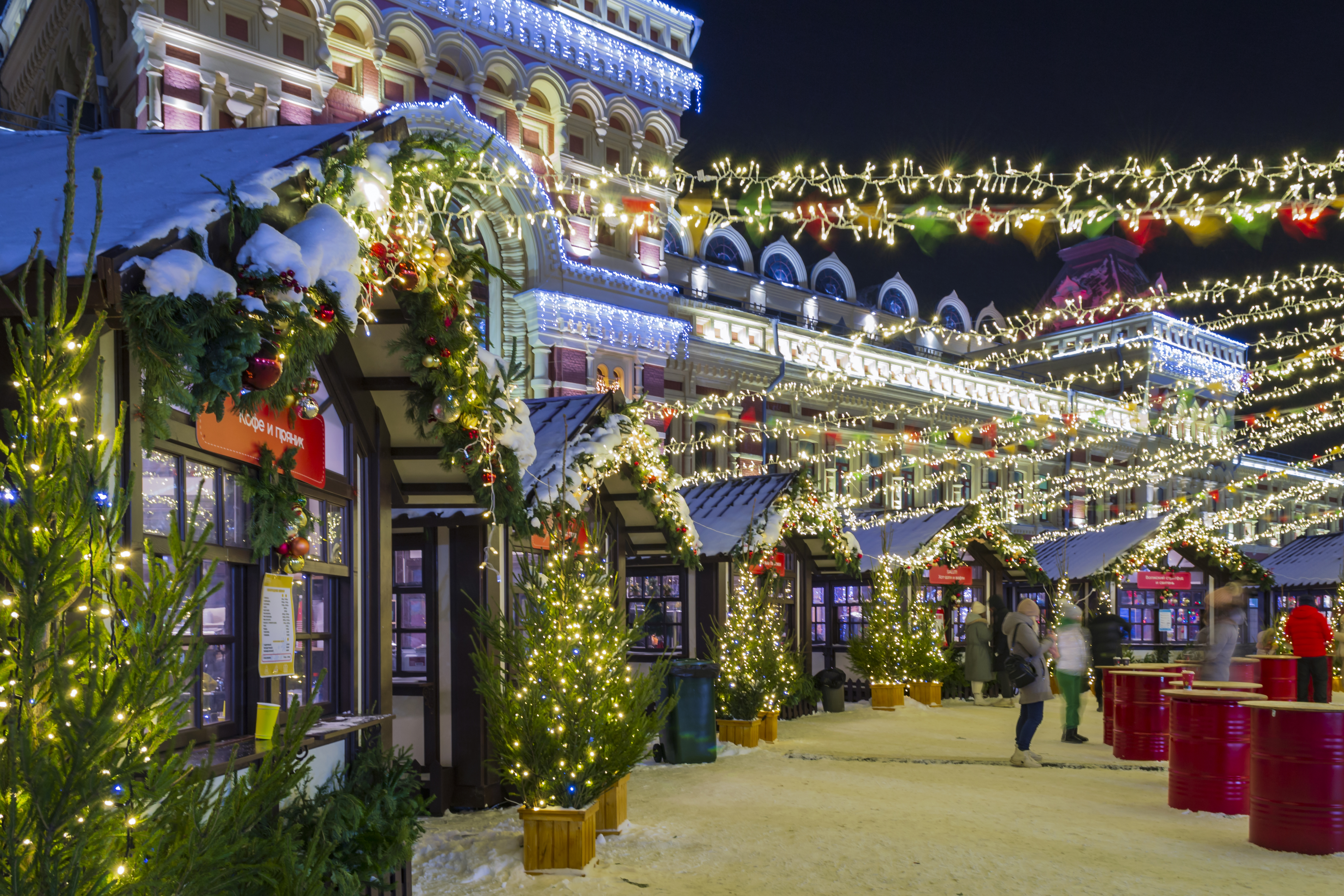
The relocated fair's centerpiece was a grand Main Building, originally constructed in the spirit of classicism, flanked by administrative buildings that formed a central square. A dam standing 3.5 meters high protected the entire complex from the Volga's spring floods. By the late 1880s, the Main Building had grown so outdated that it was torn down and replaced with an entirely new structure in the style of 17th-century Russian architecture, complete with ornamental facades that gave the administrative center something of a fairy-tale appearance. Behind the main fairground stood the Transfiguration Cathedral, a late-classicist temple begun in 1816, positioned on a mound along the fair's central axis. Groundwater and seasonal flooding gradually undermined its foundations, cracking the walls. After the revolution closed the church, its nave became a warehouse and its administrative wing was carved into apartments.
Cathedral on the Spit
The fair's most ambitious structure was the Alexander Nevsky Cathedral, built between 1868 and 1881 on the Strelka, the dramatic spit of land where the Oka meets the Volga. Merchants funded its construction to commemorate Emperor Alexander II's visit, raising 454,667 rubles and 28 kopecks over a decade of donations. Icons salvaged from the fire-damaged Makaryev Monastery were brought to the new cathedral. But the Soviet era dealt the building harsh blows. In 1929 the temple was closed and its valuables seized. The following winter, the Volga Flotilla's leadership ordered the iconostases and all wooden ornaments broken up for firewood to heat the city's homes. A plan emerged in the late 1920s to demolish the cathedral entirely and erect a lighthouse topped with a monument to Lenin. The demolition never happened, though the roof tents were dismantled in the late 1930s.
From Anti-Aircraft Battery to Restoration
During World War II, an anti-aircraft battery was mounted where the cathedral's central tent had stood, defending what was then called Gorky from Luftwaffe air raids. The bombers targeted the nearby Kanavino bridge and the fairground, but the improvised defenses held. After the war, the cathedral stood roofless and scarred for decades. Restoration did not begin until 1983, and the broken tents were not rebuilt until 1989. In June 1992, the Russian Orthodox Church finally reclaimed the building, and by 2009 it was elevated to cathedral status. The fair itself had ceased operating in 1929, but the old Main Building found new life in 1991 when a society called Nizhegorodskaya Yarmarka established its headquarters there, turning the former marketplace into an exhibition center. Today, the building houses a multimedia exhibition on the history of Nizhny Novgorod, tracing the region's story from its Finnic peoples origins through to the modern era.
Echoes of a Vanished Marketplace
Jules Verne set scenes of his novel Michael Strogoff at the Nizhny Novgorod Fair. Alexandre Dumas wrote about it during his 1858 journey from Paris to Astrakhan. Durland, visiting just after the dissolution of Russia's first Duma in 1905, described 8,000 exhibits alongside a broad range of public performances. The fair that once handled half of Russia's exports has left behind buildings that now serve as churches, museums, and convention halls. Walking the grounds in the old Kanavino district, you can still trace the central axis that once organized thousands of bazaars, and the Alexander Nevsky Cathedral still rises above the Strelka, its profile visible for miles along the Volga. What began as a Muscovite challenge to a Tatar trading post became, for nearly four centuries, the place where East met West on Russian soil.
From the Air
Located at 56.33N, 43.96E on the left bank of the Volga River at its confluence with the Oka, in the Kanavino district of Nizhny Novgorod. The Alexander Nevsky Cathedral on the Strelka (spit) is the most visible landmark from the air. Recommended viewing altitude: 2,000-5,000 feet. Nearest airport: Nizhny Novgorod Strigino (UWGG), approximately 15 km southwest. The Volga and Oka rivers provide clear navigation references.