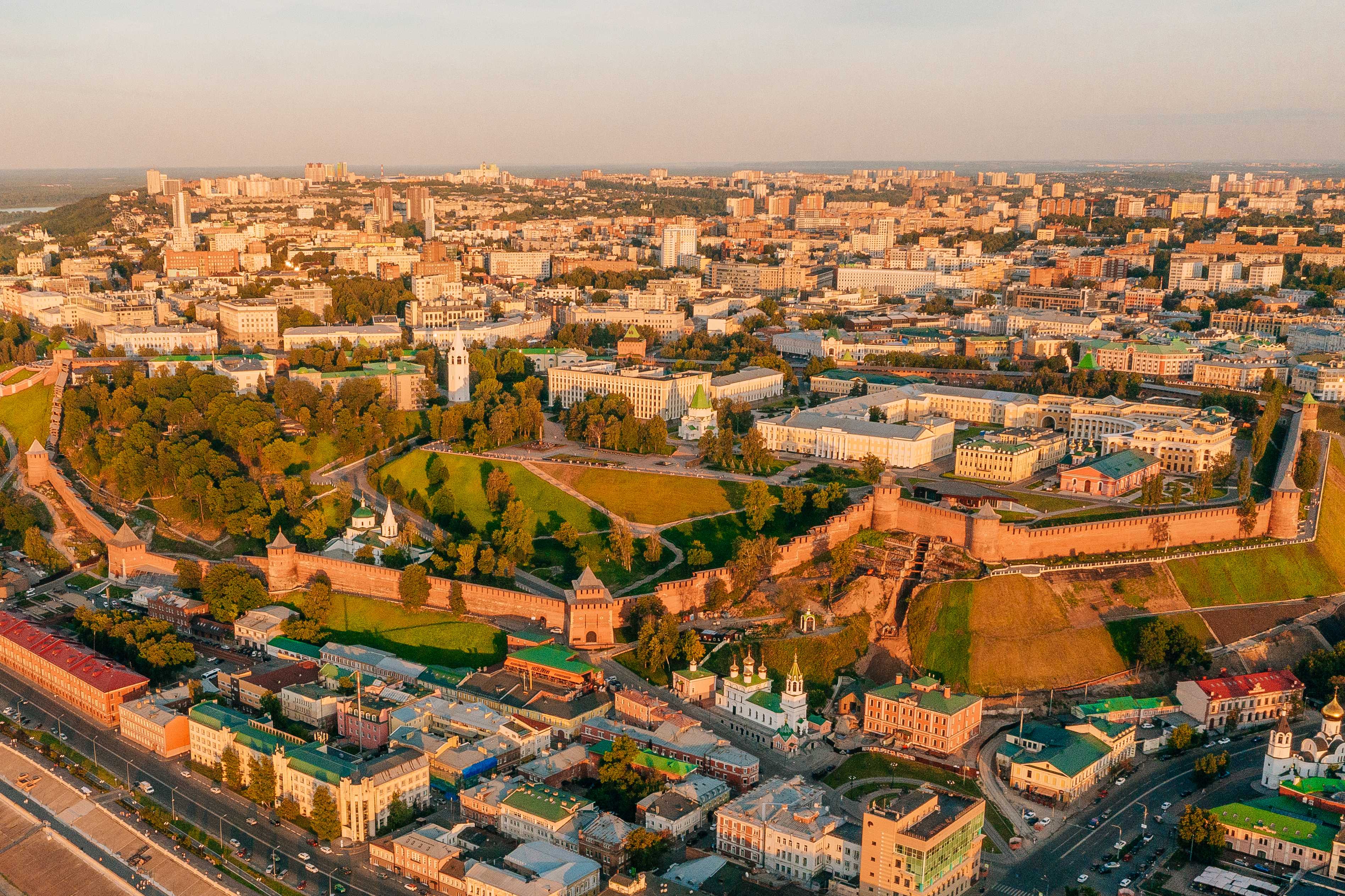
Nizhny Novgorod Kremlin
Thirteen towers, and every one of them has watched history march past. The Nizhny Novgorod Kremlin sits on a high bluff where the Oka pours into the Volga, commanding one of the most strategic river junctions in all of Russia. The first wooden fort here was old when the first stone tower went up in 1374. When the full stone walls were finally completed in 1515, they enclosed a "Stone City" with a permanent garrison and heavy artillery -- a forward operating base for Moscow's campaigns against the Khanate of Kazan. Once Kazan fell, the fortress traded its military purpose for a civic one, but the walls never stopped being useful. During World War II, anti-aircraft guns were mounted on three of its towers to defend the city from Luftwaffe bombers.
From Wooden Palisade to Stone City
The fortress evolved in stages. The first recorded attempt to replace the original wooden fort with stone dates to 1374, when the Dmitrovskaya Tower was built. That tower has not survived, but its name persists in the replacement that stands today. Under Ivan III, Nizhny Novgorod became a garrison city tasked with marshaling troops for Moscow's wars against the Khanate of Kazan. Construction of the stone kremlin began in earnest in 1500 with the Ivanovskaya Tower, and by 1515 a two-kilometer wall reinforced by 13 towers encircled the hilltop. A massive fire in 1513 had already destroyed the old oak fortifications, lending urgency to the project. One tower, the Zachatskaya, stood on the banks of the Volga itself. A landslide swallowed it in the 18th century; it was not rebuilt until 2012.
The Heroes Within the Walls
Inside the kremlin, the oldest surviving building is the Michael the Archangel Cathedral, constructed no later than the mid-16th century and rebuilt between 1628 and 1631. It holds the tomb of Kuzma Minin, the merchant who, alongside Prince Dmitry Pozharsky, organized the volunteer army that expelled the Polish-Lithuanian occupiers from Moscow in 1612 -- an event so central to Russian identity that it is still commemorated as a national holiday. An obelisk honoring both men was erected in front of the cathedral in 1828. Other buildings accumulated over the centuries: the military governor's house (1837-1841, now the Museum of Art), an arsenal built at Nicholas I's direction between 1840 and 1843, and the House of Soviets, which in 1931 replaced a Transfiguration Cathedral that had stood on the same ground.
Fortress Against the Luftwaffe
When the Second World War came to Gorky -- as Nizhny Novgorod was then known -- the kremlin returned to its original purpose. The roofs of the Taynitskaya, Severnaya, and Chasovaya towers were dismantled and anti-aircraft machine guns installed on their upper platforms. The Luftwaffe targeted the Kanavino bridge and the nearby fairground, but the kremlin's improvised air defenses helped protect these vital structures. The city earned the title "City of Labour Valour" for its wartime industrial contributions, manufacturing tanks, planes, and artillery shells. Since 1980, a military-patriotic memorial called "Gorky for the front!" has displayed the equipment the city supplied to the Eastern Front. A granite slab at its entrance bears words from a 1942 edition of Pravda: words of recognition for those who forged weapons and cooked steel alongside those who carried rifles.
Unearthing the Founding Layer
In October 2018, archaeologists working on the site of the destroyed Church of St. Simeon Stylites discovered the remains of a medieval settlement and cemetery within the kremlin walls. The finds dated to the 13th century, with the most ancient cultural layer reaching back to 1221 -- the year Nizhny Novgorod was founded. The discovery pushed the tangible archaeological record of the site to the city's very origin. It also underscored how much history remains buried beneath the fortress: centuries of occupation, worship, and daily life compressed into layers of earth behind walls that have themselves been rebuilt, reinforced, and restored through war, neglect, and ambition.
Walking the Battle Road
For 230 years, the interior "battle road" -- the walkway inside the kremlin wall that soldiers once patrolled -- was closed to the public. Before the city's 800th anniversary in 2021, a major restoration reopened the full two-kilometer circular route. Visitors can now walk the entire perimeter within the wall, passing through or alongside all 13 surviving towers. The Chasovaya (Clock) Tower still keeps time. The Koromyslova Tower carries a legend about a woman with a yoke who single-handedly defeated a raiding party. From the Dmitrievskaya Tower, the main entrance since the fortress was first built, the view opens across the confluence of two of Europe's great rivers. In 1949, the Council of Ministers ordered the kremlin's restoration. It took decades -- and the work, in many senses, continues still.
From the Air
Located at 56.33N, 44.00E on a prominent bluff at the confluence of the Volga and Oka rivers. The kremlin's two-kilometer wall and 13 towers are clearly visible from the air, forming a distinctive irregular polygon on the hilltop. Recommended viewing altitude: 1,500-4,000 feet. Nearest airport: Nizhny Novgorod Strigino (UWGG), approximately 14 km southwest. The river confluence below the kremlin provides an unmistakable navigation reference.