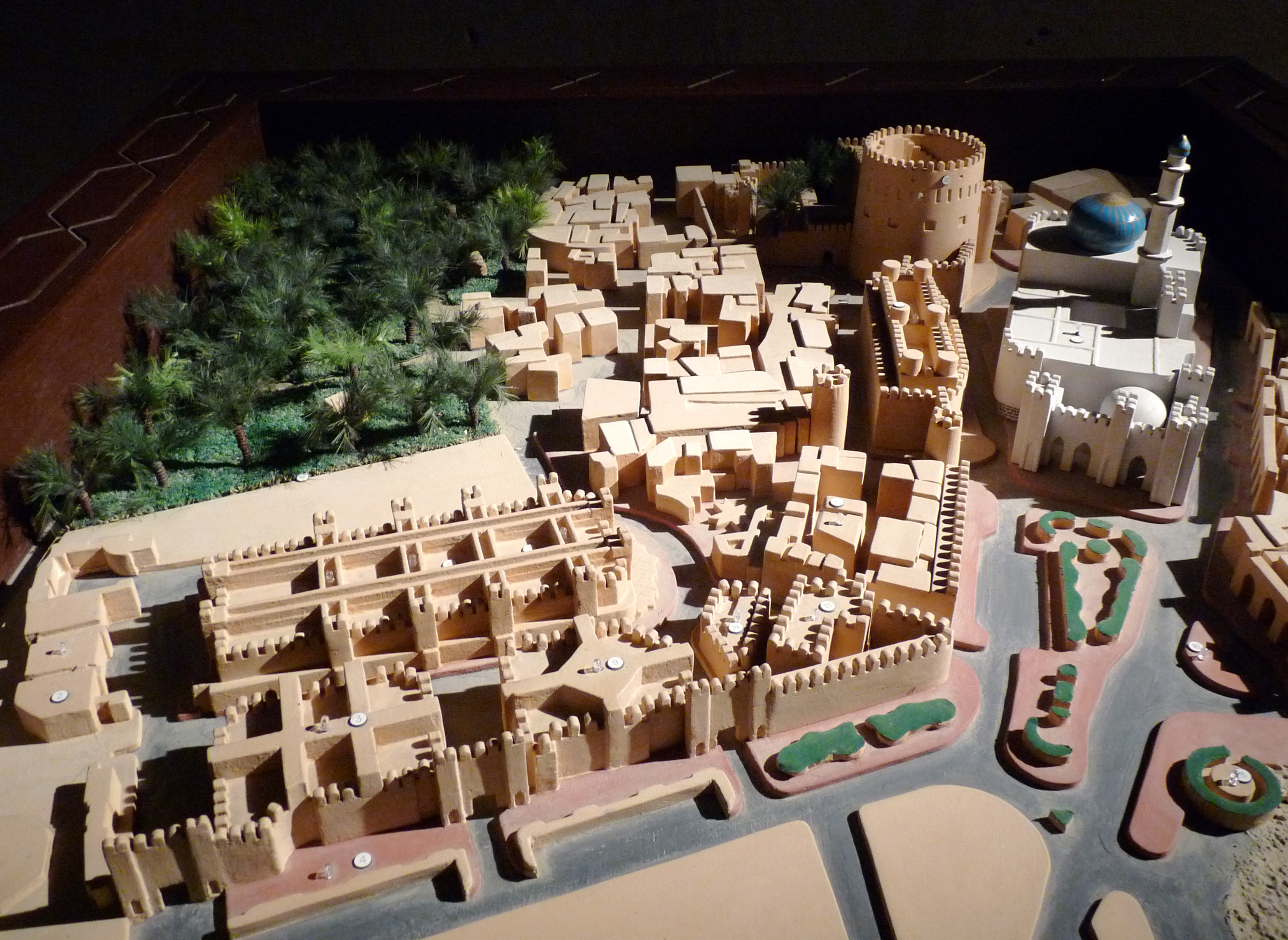
Nizwa Fort
The stairs inside Nizwa Fort have a secret. Some of the wooden planks can be removed, exposing deep pits underneath. In the darkness of the narrow passageways, an invading soldier would step forward confidently and vanish. Six such pitfalls line the route from the entrance to the interior, each one a quiet, lethal surprise waiting in a corridor designed to be as disorienting as possible. The fort's builders did not simply want to repel attackers. They wanted to make the attempt unthinkable.
Imam Sultan's Twelve-Year Project
Imam Sultan bin Saif Al Ya'rubi began construction in the 1650s, though the site's foundations reach back to the 12th century. The Ya'riba dynasty was transforming Oman into a maritime and military power, and Nizwa Fort was their administrative seat in the interior. Twelve years of labor produced a fortress that doubled as a center of governance: the presiding imams and walis conducted both military and peacetime affairs from within its walls. The massive circular tower, the fort's defining feature, was engineered for total defensive coverage. Its rounded walls absorbed mortar fire rather than splintering against it, and its thick doors were designed to resist battering.
A Fortress That Thinks
Nizwa Fort was not built to endure a siege passively. It was designed to fight back with overwhelming force from every angle. Twenty-four openings around the top of the tower allowed mortar fire in every direction. Four cannons still sit on the tower's summit, remnants of the original twenty-four that once provided full 360-degree coverage. No attacking force could approach from any direction without facing a response. Below, 480 gun ports honeycombed the outer walls, allowing 120 guards to pour concentrated musket and flintlock fire into an attacking force. Underground cellars stockpiled food and munitions for extended defense. Two cannons guarded the entrance, which opened into a deliberate maze of rooms, high-ceilinged halls, terraces, and narrow corridors that forced invaders to navigate unfamiliar space while defenders knew every turn.
The Maze and Its Teeth
Beyond the cannons and gun ports, Nizwa Fort relied on deception. The internal passageways were intentionally dark and confusing, forcing any enemy who breached the outer defenses to feel their way through unknown corridors. The six pitfall traps, hidden beneath removable wooden planks on certain staircases, meant that even a successful assault could end suddenly and silently. The fort's architects understood that defensive architecture is as much about psychology as engineering. An attacker who knows that the floor might open beneath his feet moves differently than one who doesn't. Fear is a force multiplier. The narrow staircases and tight doorways also neutralized numerical superiority: no matter how large an invading force, only a few soldiers could advance at once.
Oman's Most Visited Monument
Today Nizwa Fort is the most visited national monument in Oman. The cannons are silent, the pitfalls covered, the gun ports empty. Visitors climb the tower for panoramic views of Nizwa and the surrounding countryside, the same landscape the 120 guards once watched from behind the parapet wall. From the top, the date palm groves stretch toward the Hajar Mountains, and the adjacent Nizwa Souq spreads out below. The fort sits at the heart of a town that was, for centuries, the cultural and spiritual capital of the Omani interior, the seat of the Imamate, and the destination for scholars and traders from across the Islamic world. The walls that were built to keep armies out now welcome them in.
From the Air
Located at 22.93N, 57.53E in the center of Nizwa, Oman. The massive circular tower is a prominent landmark visible from altitude. Nearest major airport is Muscat International (OOMS), approximately 170 km northeast. The fort sits adjacent to the Nizwa Souq and is surrounded by date palm groves at the edge of the Hajar Mountains.