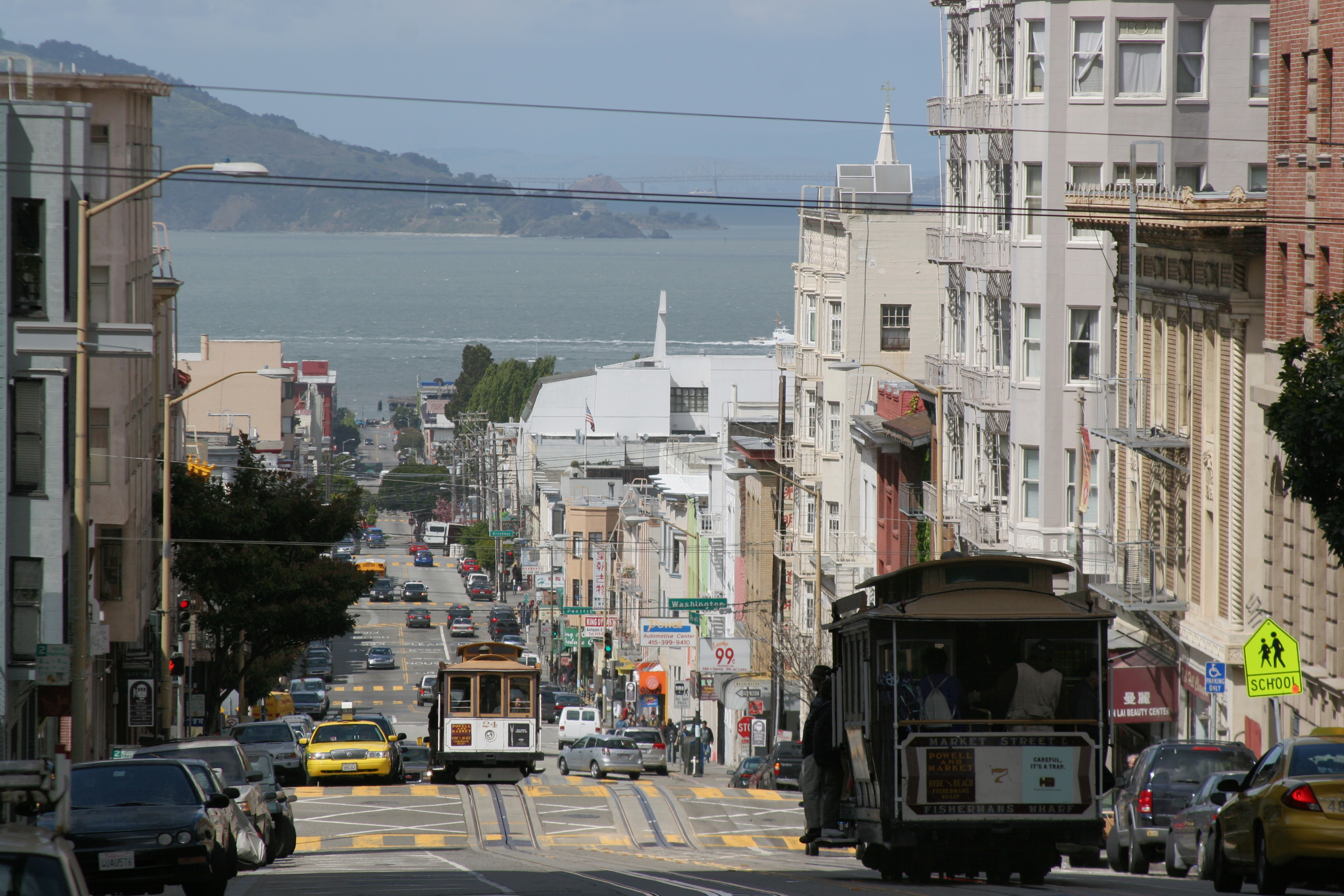
Nob Hill, San Francisco
Every mansion on Nob Hill burned in 1906. The railroad barons who built them -- Stanford, Hopkins, Huntington, Crocker -- had filled the hilltop with palaces that proclaimed their wealth to the city below. The earthquake and fire erased them all. What replaced them defines Nob Hill today: the Fairmont, the Mark Hopkins, the Huntington Hotel, and Grace Cathedral -- institutions that inherited the hill's reputation for exclusivity without inheriting its architecture.
The Big Four's Hilltop
Nob Hill got its name from the nabobs who colonized it in the 1870s and 1880s. Leland Stanford, Mark Hopkins, Collis P. Huntington, and Charles Crocker -- the Big Four who built the Central Pacific Railroad -- constructed mansions that competed with each other in scale and opulence. The California Street cable car, installed in 1878, made the steep hill accessible to the wealthy who previously had to struggle up its slopes by carriage. The mansions were monuments to Gilded Age wealth, built with money extracted from the transcontinental railroad and the labor of thousands of Chinese immigrants.
Fire on the Hill
The 1906 earthquake damaged the mansions, but it was the three-day fire that followed that destroyed them completely. The ornate wooden and stone structures burned along with most of downtown San Francisco. Only the granite walls of James Flood's mansion survived, and these were incorporated into the Pacific-Union Club, which still occupies the site. On the ruins of the other mansions, the great hotels rose: the Fairmont on the Stanford site, the Mark Hopkins on the Hopkins site, the Huntington on the Huntington site.
Grace and Cable Cars
Grace Cathedral, the Episcopal cathedral of San Francisco, stands on the site of the Crocker mansion. Its Gothic revival architecture -- including replicas of Ghiberti's Gates of Paradise doors from the Florence Baptistery -- gives Nob Hill its most visible architectural landmark. The California Street cable car line still climbs the hill, carrying tourists and commuters past the hotels and the cathedral. Nob Hill remains one of the most expensive neighborhoods in San Francisco, its exclusivity now maintained by real estate prices rather than by railroad fortunes.
From the Air
Located at 37.79323N, 122.41448W in the San Francisco Bay Area. Nearby airports: KSFO (San Francisco International), KOAK (Oakland International).