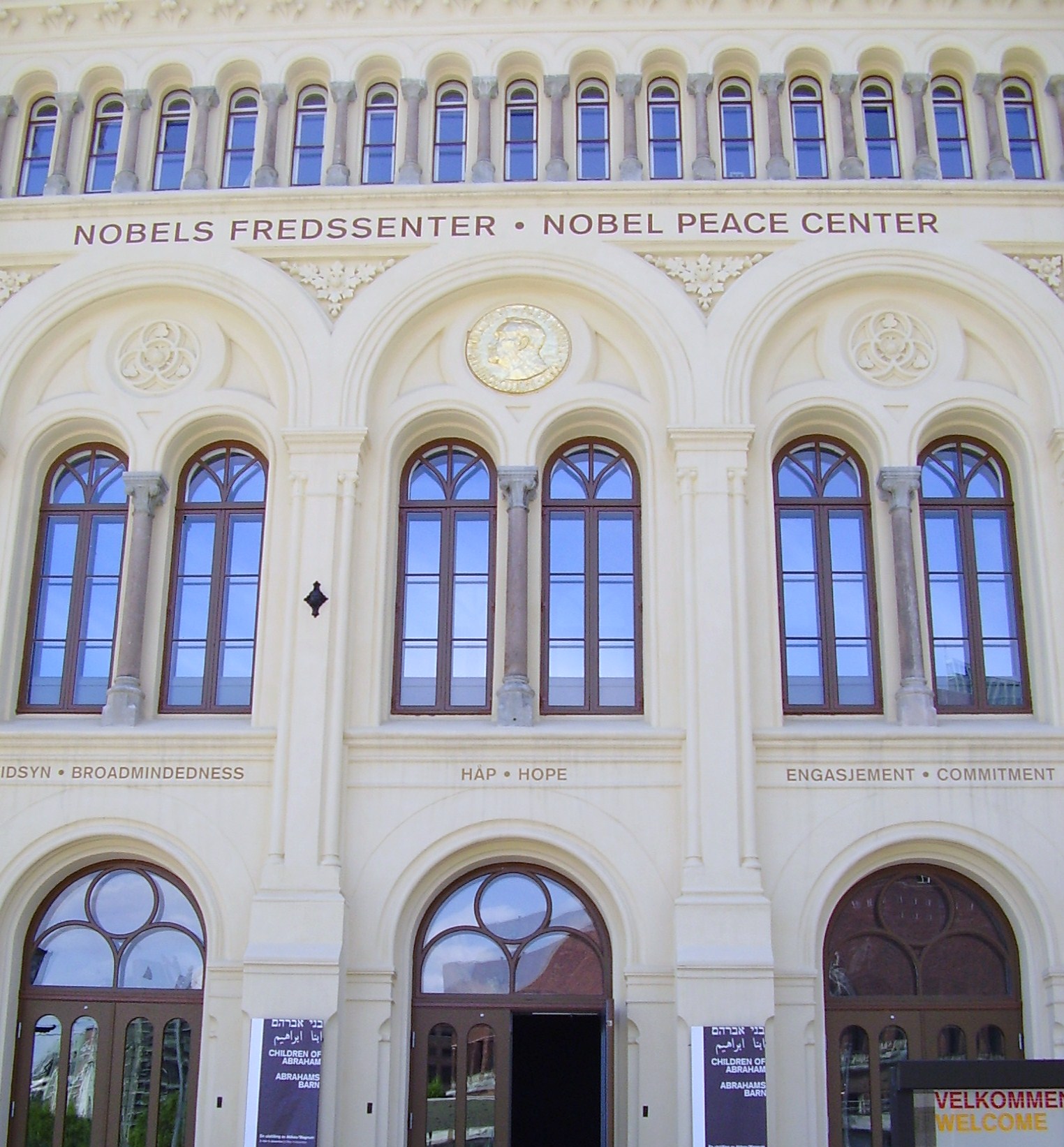
Nobel Peace Center
Every December 10th -- the anniversary of Alfred Nobel's death -- the Nobel Peace Prize is awarded in a ceremony at Oslo City Hall. Afterward, the laureate walks a few hundred meters to a converted railway station on the harbor's edge, where their portrait will join a gallery of the most consequential peacemakers of the past century. This is the Nobel Peace Center, and the geography is no accident. Norway is the only country that awards a Nobel Prize (the others are given in Stockholm), and Oslo has built an entire institution around explaining why peace deserves its own dedicated space.
From Platform to Podium
The Nobel Peace Center occupies the former Oslo Vestbanestasjon, the western railway station that served the city from 1872 until 1989. The building was designed by architect Georg Andreas Bull, and its Romanesque Revival facades give it the dignified weight of a 19th-century public institution -- quite different from the modernist glass and steel that dominates the surrounding waterfront. When the station closed, the building sat largely unused for over a decade. The Nobel Peace Center opened inside it in 2005, inaugurated by King Harald V in a ceremony attended by the royal families of Norway and Canada. Nobel Peace Prize laureate Wangari Maathai, the Kenyan environmentalist who had won the prize the year before, was also present. The transformation from railway station to peace museum gave the building new purpose without erasing its history -- the grand proportions of a station hall now serve as exhibition space rather than a departure lounge.
Design as Statement
British architect David Adjaye, whose later work would include the Smithsonian National Museum of African American History and Culture in Washington, designed the center's interior spaces and color schemes. American designer David Small developed the high-tech installations that form the core of the visitor experience. The center uses multimedia and interactive technology to present the laureates and their work, but it also tells the broader story of Alfred Nobel himself -- the Swedish chemist and industrialist who invented dynamite, amassed a fortune, and then directed his wealth toward prizes for those who confer the greatest benefit on humankind. The contrast between Nobel's invention and his legacy is a tension the center does not shy away from. It frames peace not as an abstraction but as a discipline, something requiring the same rigor and persistence as any scientific breakthrough.
The Weight of December
The center welcomes approximately 250,000 visitors per year, making it one of Norway's most visited museums. Its location on Radhusplassen -- City Hall Square -- places it at the ceremonial heart of Oslo's relationship with the Peace Prize. The Oslo City Hall, where the award ceremony takes place, stands directly across the square. This proximity turns the center into something more than a museum: it is the permanent complement to an annual ritual, the place where the fleeting drama of the ceremony becomes lasting record. Temporary exhibitions address contemporary conflicts and peace processes, while the permanent collection profiles every laureate since the prize was first awarded in 1901. The center also hosts debates, theater performances, concerts, and educational programs, fulfilling a mandate that extends well beyond display.
Norway's Singular Role
Alfred Nobel's will specified that the Peace Prize should be awarded by a committee appointed by the Norwegian parliament, the Storting -- a decision that has never been fully explained but that gave Norway a unique position in global diplomacy. The Nobel Peace Center is a foundation governed by a board appointed by the Norwegian Nobel Committee, and it operates as part of a broader network of Nobel institutions coordinated by the Nobel Foundation in Stockholm. The arrangement means that while the science and literature prizes belong to Sweden, peace belongs to Norway. The center takes this responsibility seriously, presenting the prize not merely as an honor but as a challenge. Each laureate's story is framed as unfinished work, an ongoing struggle rather than a concluded achievement. In a world that generates no shortage of conflict, the converted railway station on Oslo's harbor remains a place where the idea of peace is treated not as naive but as necessary.
From the Air
Located at 59.912N, 10.730E on Radhusplassen (City Hall Square) in central Oslo, directly on the harbor. The center occupies a distinctive 19th-century Gothic Revival building on the waterfront, identifiable from the air by its proximity to the twin-towered Oslo City Hall. Nearest airport is Oslo Gardermoen (ENGM), approximately 47 km northeast. The building sits alongside the National Museum and near Akershus Fortress along the inner harbor. Recommended viewing altitude: 1,500-2,500 feet AGL.