Nok Culture
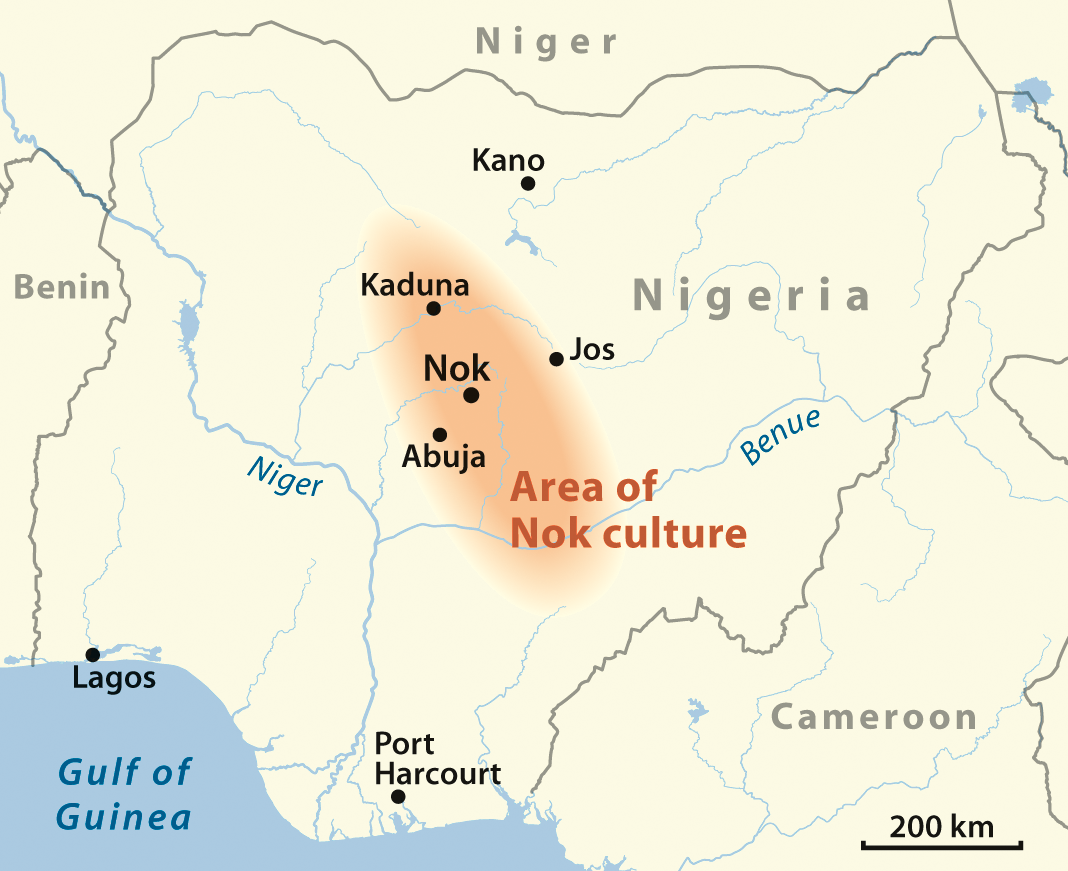
A mine clerk pulls a terracotta head from the mud of a tin mine in central Nigeria and takes it home. For a year it sits atop a stick in his yam field, scaring birds. Then in 1943, a Cambridge-educated administrator named Bernard Fagg notices the scarecrow and recognizes something extraordinary: a face sculpted with such sophistication that it could only have come from a civilization no one knew existed. That scarecrow launched one of the most important archaeological discoveries in African history. The Nok culture, named after the Ham village near where the first sculptures emerged in 1928, flourished in what is now central Nigeria from roughly 1500 BCE to 500 CE -- a span of two thousand years during which its people created hauntingly expressive terracotta figures, cultivated pearl millet and cowpeas, and may have independently invented iron smelting.
Faces from the Deep Past
The Nok terracottas are hollow, coil-built figures -- nearly life-sized human heads and bodies with highly stylized features, elaborate jewelry, and varied postures. Their eyes are rendered as triangles, semicircles, or circles, giving the faces an otherworldly intensity. Craftspeople shaped them by hand from coarse-grained clay, subtractively carved in a manner suggesting influence from wood carving, then covered the surfaces with slip and burnished them to a smooth gloss before firing under mounds of grass and leaves. Radiocarbon and thermoluminescence dating at the undisturbed sites of Samun Dukiya and Taruga place these sculptures between roughly 2,900 and 2,000 years ago, making them the oldest large-scale figurative art in sub-Saharan Africa outside Egypt. Among the figures found at Pangwari are a teeth-baring human-feline therianthrope, warriors wielding slingshots and bows, and a depiction of a dugout canoe that hints at trade along tributaries of the Niger River. Nobody knows their original purpose with certainty -- theories range from ancestor portraits to grave markers to charms against crop failure.
Forging Iron Before the Iron Age
Between 750 and 550 BCE, evidence suggests the Nok people began smelting iron -- a development that may have been wholly independent of outside influence. If confirmed, this places Nok among the earliest iron-producing cultures in sub-Saharan Africa. What makes this even more remarkable is the archaeological context: Nok stone tools show almost no cutting implements. Apart from stone axes, no tools with a cutting edge have been found, and projectile points of either iron or stone are absent. What the Nok did have in abundance were grinding stones made of quartzite, granite, and metamorphic rock, used to process pearl millet into flour for porridge. At the site of Ido, massive grinding slabs were arranged upright alongside pots and stone beads in what appears to have been a ritual installation. The Nok inhabited a world transitioning between technologies -- still grinding grain on stone while learning to coax metal from ore.
Small Villages, Vast Influence
Nok people lived in small settlements -- hamlets and single compounds similar in scale to the farmsteads that still dot the Nigerian savanna. They built houses from wood, plant stalks, grasses, and animal hides, materials that decomposed without leaving visible traces. No evidence of towns, urban environments, or elite structures has been found. These were locally autonomous groups, not a centralized kingdom. Yet the homogeneous composition of their sculptures across hundreds of sites suggests centralized, specialized production: the clay for sculptures came from just a few deposits, even as pottery was made from varied local sources. This paradox -- political simplicity combined with artistic sophistication -- is part of what scholars call the Nok enigma. Their cultural influence extended far beyond their settlements. Later West African artistic traditions -- the Bura terracottas of Niger, the bronzes of Ife and the Kingdom of Benin -- may trace their origins to the Nok. The Ham and Bassa peoples of modern Nigeria may be their descendants.
Plundered Heritage
The same beauty that makes Nok terracottas invaluable to archaeologists has made them irresistible to looters. A joint research project between Goethe University Frankfurt and Nigeria's National Commission for Museums and Monuments found that more than 90 percent of known Nok sites in the study area had been illegally dug. Over 1,000 sculptures have been smuggled to Europe, the United States, Japan, and beyond. In 2013, Nigeria recovered five Nok statuettes looted by a French thief in 2010, after French customs agents intercepted them. Complicating matters further, workshops now produce convincing fakes that flood the art market alongside authentic pieces. Every illegal excavation destroys irreplaceable context: the relationship between a sculpture and the soil around it, the charcoal that could be dated, the pottery fragments that could tell a story. When a Nok head ends up on a collector's shelf, what vanishes is not just an artifact but the knowledge it could have yielded about one of Africa's most enigmatic early civilizations.
From the Air
Located at approximately 9.50N, 8.02E in central Nigeria's Kaduna State. The Nok archaeological region lies in the savanna zone between the Niger and Benue river valleys. From altitude, the landscape appears as gently rolling terrain with scattered settlements and farmland. The nearest major city is Jos, capital of Plateau State, approximately 80 km to the east. Jos airport (DNJO) is the closest facility with scheduled service. The terrain includes distinctive inselbergs and flat-topped hills visible from cruising altitude.