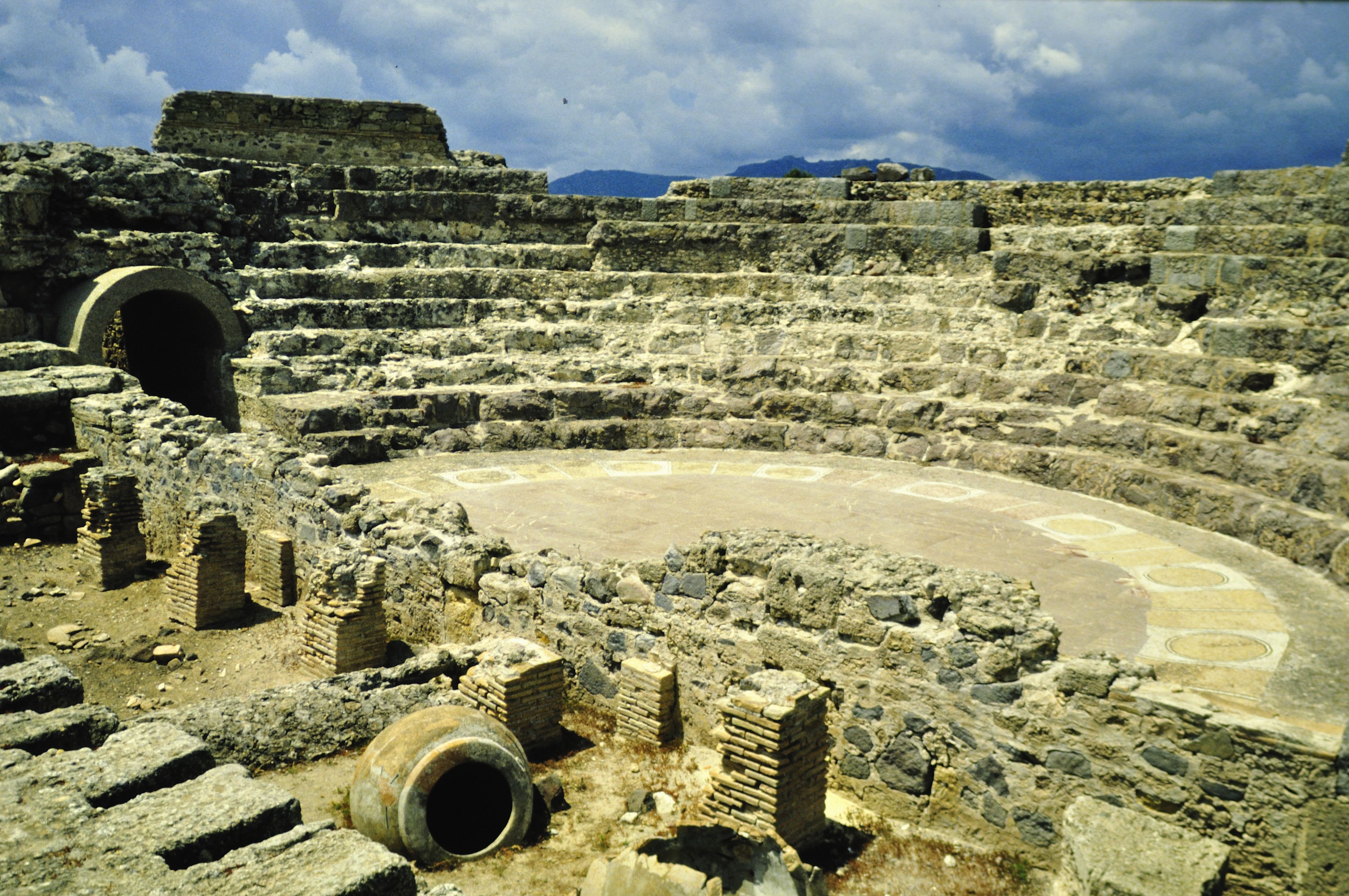
Nora, Italy
According to Greek myth, the demigod Norax led Iberian settlers across the sea to found a city on this windswept Sardinian peninsula -- the first city on the island, if you believe the second-century geographer Pausanias. Myth aside, what is certain is that by the 9th or 8th century BC, Phoenician sailors had recognized what every subsequent civilization would confirm: this slender finger of land jutting into the Mediterranean, with a protected harbor on each side, was too perfect a trading post to ignore. The Nora Stone, a Phoenician inscription discovered here in 1773, records a military victory and stands as one of the oldest written artifacts ever found in the western Mediterranean.
Crossroads of Ancient Empires
Nora's story is a layered chronicle of Mediterranean power. Indigenous Sardinians settled the area first, but the Phoenicians transformed it into a thriving emporium -- a hub on the sea route from Carthage to Sardinia's largest city, Cagliari. When Carthage conquered the region, Nora flourished alongside nearby Bithia as the first landfall for ships crossing from North Africa. Then came Rome. After seizing Sardinia in 238 BC, the Romans reshaped Nora in their own image, building a theater whose stone seats still catch the afternoon light, along with baths, temples, and the ordered streets of a provincial city. The town earned a place on the Tabula Peutingeriana, a Roman road map that documented the empire's vast network of routes.
A Slow Surrender to the Sea
Walk the ruins of Nora today and you are walking on borrowed time -- borrowed from the Mediterranean itself. Southern Sardinia is gradually sinking, and a substantial portion of the ancient city now lies submerged beneath turquoise waters. Nearby Bithia has disappeared entirely below the surface. For divers and archaeologists, the underwater ruins offer a ghostly mirror of the streets above: walls, foundations, and harbor structures visible through the clear shallows. What remains on land is an open-air museum where Roman mosaics catch the sun, and the theater occasionally hosts summer concerts, filling ancient stone with modern sound. A significant section of the site sits on Italian Army property and has never been excavated, leaving future discoveries hidden beneath military ground.
Layers Beneath the Surface
The visible ruins show several distinct building styles stacked and interwoven -- Phoenician foundations beneath Carthaginian walls beneath Roman columns. This palimpsest of construction tells the story of a city that was never abandoned and rebuilt from scratch but continuously adapted by each new ruler. The two harbors, one on each side of the peninsula, gave Nora a rare commercial advantage: ships could dock regardless of wind direction, making the city a reliable port in an era when weather dictated trade. The Vandals disrupted this prosperity when they conquered Sardinia in the mid-5th century AD. The Eastern Romans recaptured the island in 535, but by the time the Arabs took Carthage in 698, Nora had lost its economic purpose. It shrank to a simple fort -- Nora praesidium -- and was abandoned entirely during the 8th century.
A Name That Outlasted the City
Though Nora's population vanished more than a thousand years ago, the name endured. It survived as the title of a curadoria -- a major administrative district -- in the Giudicato of Cagliari at the start of the second millennium, long after the last residents had departed. Today the peninsula itself remains hauntingly beautiful, a narrow strip of land surrounded by some of Sardinia's clearest waters. The Roman theater's curved rows of seats face the sea, and on summer evenings, musicians and audiences share a stage that has hosted performance for over two millennia. Nora is a place where the deep past is not buried under modern construction but laid open to the sky and the tides, slowly dissolving into the element that made it great.
From the Air
Located at 38.99N, 9.02E on a peninsula near Pula, southern Sardinia. Best viewed at 2,000-3,000 feet to appreciate the narrow peninsula and submerged ruins in the surrounding waters. The Roman theater and excavated streets are visible from low altitude. Nearest airport: Cagliari-Elmas (LIEE), approximately 30 km northeast. The coastline and turquoise waters around the peninsula are distinctive landmarks.