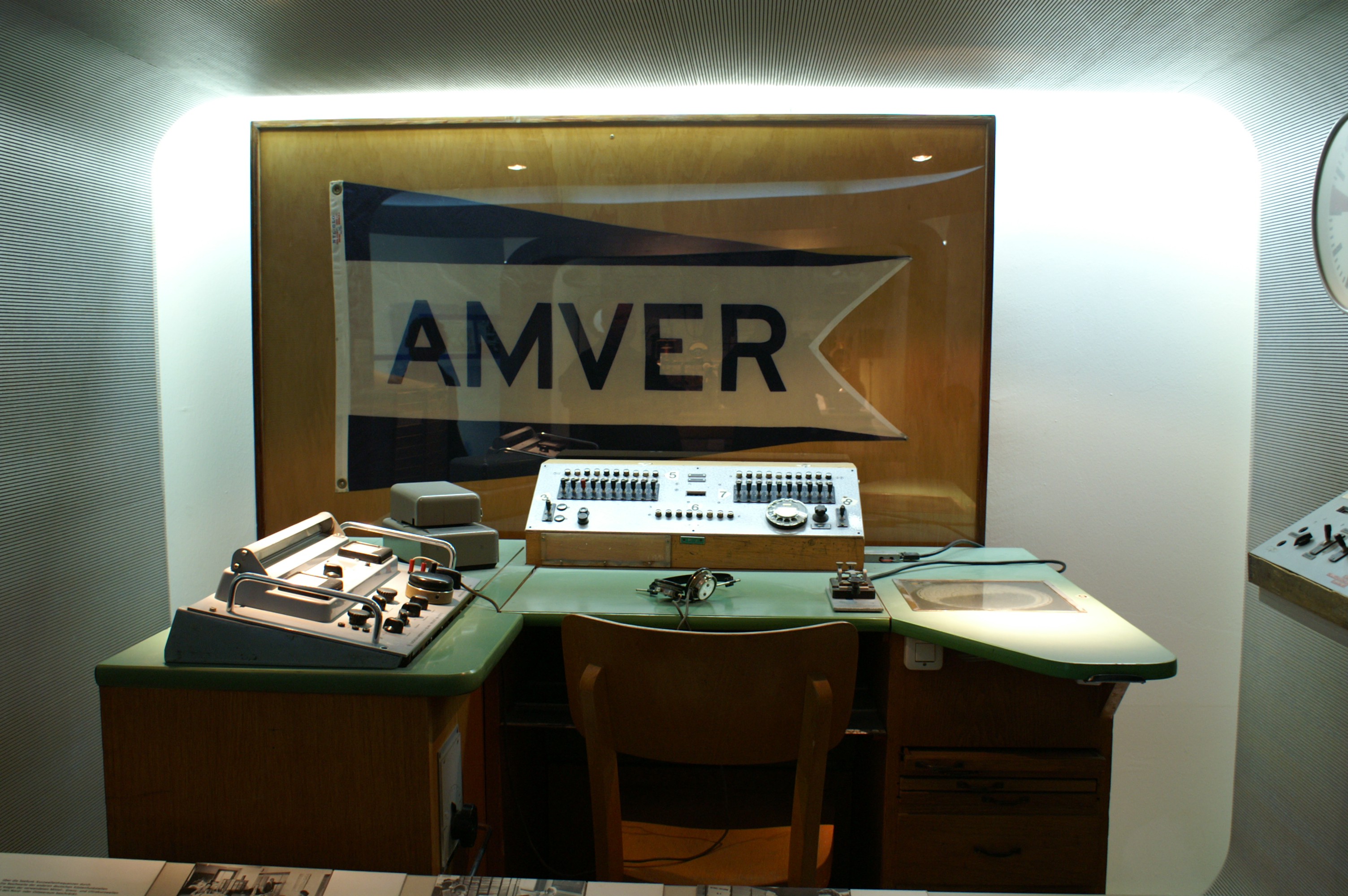
Norddeich Radio Station
Picture a freighter in the South Atlantic in 1972. The radio officer adjusts a dial, listens through static, and hears the call sign DAN coming in clear from a flat patch of marshland 8,000 nautical miles away on the German North Sea coast. He thumbs his Morse key and reports his position. The operator at Norddeich logs the contact, slides the message across to the traffic desk, and within hours the family in Hamburg gets word that their husband, son or brother is well. For ninety-one years this is what Norddeich Radio did. It was the line between German ships and the people who loved them.
1907: Four Masts in the Marsh
The planners originally wanted to put the station on Borkum, the largest of the East Frisian islands, but in the end Norddeich - then a separate village, now part of the city of Norden - was chosen. The reasons were practical: mainland connection for the telegraph cables, room to spread out, and a generous arc of clear horizon over the German Bight. Historians today believe the founding intent was military: the Imperial German Navy needed to communicate with warships from the western German Bight down to the English Channel, and a coast station with serious range solved that problem. Operations began in 1907 with a Telefunken spark-gap transmitter and an antenna suspended from four masts, each 65 metres tall. At 150 kHz the station could reach more than 1,500 km. The official name on the early documents was Funkentelegraphenstation Norddeich. The world called it KND, the original call sign.
Time Signals and Records
By 1910 Norddeich was broadcasting a time signal, working in tandem with the broadcast tower on the Eiffel Tower in Paris to give ships at sea a precise reference - the difference between knowing where you were and guessing. The ability to set a ship's chronometer by radio transformed navigation; combined with a sextant sun-shot, mariners could now fix their position with previously unheard-of accuracy. In 1912 the station was involved in a record-breaking transmission of 2,400 miles. As technology moved from spark-gap to vacuum tubes to single-sideband, Norddeich kept pace, expanding its range and its services. The longwave call sign DAN became something approaching a household name in German maritime culture - the voice on the other end of the static, the place that knew where you were.
The Camouflaged Transmitter
World War I placed the station under Imperial Navy command, and the antennas that had been talking to merchant ships now coordinated naval operations across the North Sea and beyond. The Second World War turned the station into something darker. From autumn 1939, a new Norddeich Radio facility transmitted the English-language propaganda program Germany Calling - the show whose Lord Haw-Haw broadcasts beamed Nazi rhetoric at British listeners. To disguise its origin, the transmitter was camouflaged as Reichssender Bremen or, initially, as the deliberately bland Studio facility of the experimental transmission system N. The medium-wave frequencies 759 and 904 kHz carried voices that the Nazi regime had decided needed to reach into homes in England, Scotland, Ireland and Wales. After the war, Norddeich returned to its civilian purpose, and the propaganda chapter was quietly closed.
Voices Across the Ocean
For most of the 20th century, Norddeich Radio was simply how German seafarers stayed in touch with the world. The traffic on its frequencies was extraordinary in volume and ordinary in content: position reports, weather forecasts, telegrams to wives and children, ship-to-shore phone calls patched through to homes in Bremen and Hamburg and Wilhelmshaven, distress signals from vessels in trouble, the daily liturgy of maritime communication. Operators came on shift, took their headphones off the hook, and entered a soundscape where storms in the Indian Ocean shared the airwaves with calm seas off Cape Verde. Generations of radio officers earned their tickets training to copy Morse at twenty-five words per minute under the spell of that call sign: DAN, DAN, DAN.
Last Signal, 31 December 1998
The world that needed coast radio stations did not last. Satellite communication, then mobile phones, then GPS chipped away at the reasons ships had to talk to a longwave station on the German coast. Throughput fell. By the 1990s, Norddeich Radio was a service in slow retreat. On 31 December 1998 the station transmitted its final operational signal and shut down. The masts came down. The frequencies went silent. Some of the buildings still stand on the marshland behind Norden, a memorial to nine decades of voices carried across the Atlantic, the Pacific, the Indian Ocean, the Mediterranean and every sea between. If you walk past the site today you can stand on land that once converted the hopes of thousands of seafarers into electromagnetic waves and threw them, hour after hour, at the curvature of the Earth.
From the Air
Located at 53.60°N, 7.14°E on the marshland just inland from Norddeich, the seaward edge of the city of Norden. The former transmitter site is identifiable as a flat cleared area surrounded by polder farmland; some of the original buildings remain. Nearest airfield: Norden-Norddeich (EDWS) about 2 km north. Best viewed from low altitudes (1,000-2,000 ft) on clear days. The North Sea coast just beyond, with the Norderney ferry terminal and the Wadden Sea tidal flats, makes for striking context to the south.