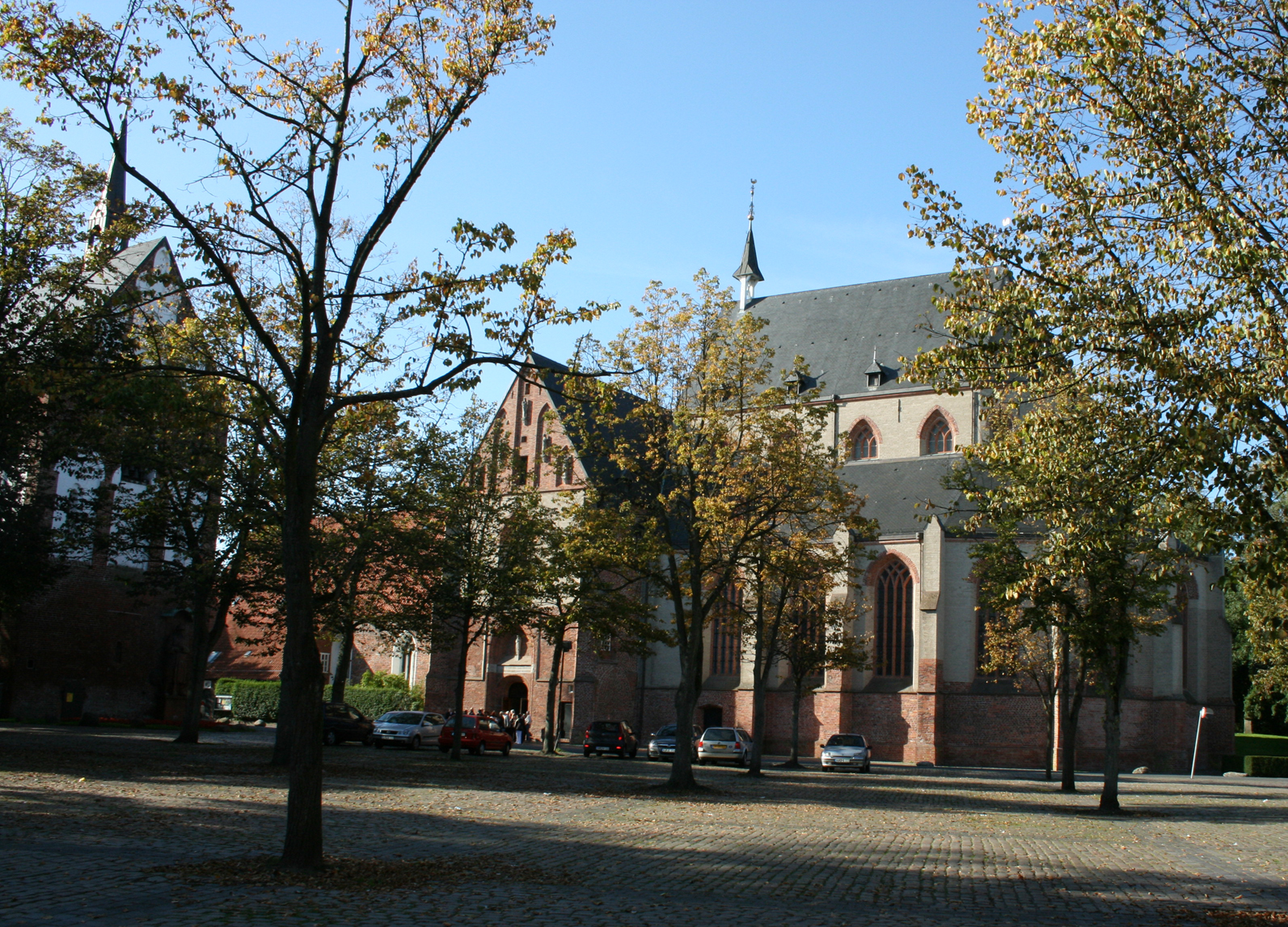
Norden, Lower Saxony
The smell of toasted grain used to drift across the rooftops of Norden, the unmistakable signature of a triple-distilled korn called Doornkaat. The distillers founded their business here in 1806, and for nearly two centuries the brick warehouses, malting floors, and copper stills of their compound formed a working district at the edge of town. The buildings still stand. Their interiors have changed - the schnapps brand was sold off decades ago, and the protected complex now hosts a museum and a small constellation of new companies - but the geography of Norden still tilts toward that old empire of bottled wheat.
First City of the Frisians
Norden received its city rights in 1255, the earliest in East Frisia, and that primacy has shaped its character ever since. Set just inland from the North Sea shore in the district of Aurich, the town sits at the seam between marsh and sand. A medieval merchant arriving by ship would have found a place already wealthy with cattle, peat, and the income that came from controlling traffic between the Frisian interior and the sea. The old centre still preserves the geometry of those years: a market square, a parish church, narrow lanes spreading outward into Ekel, Lintel, and Westgaste. Locals still refer to one residential quarter as the Millionärsviertel - the millionaires' quarter - a nickname that says everything about how money once moved through this town.
An Organ Heard Across Continents
The Ludgerikirche, just off the market square, houses one of the most important pipe organs ever built. Arp Schnitger constructed it between 1686 and 1692, and to this day it is the second-largest surviving Schnitger instrument in Germany, surpassed only by the organ of St. James' Church in Hamburg. Forty-six stops. Three manuals and pedal. Three thousand one hundred ten pipes spread across an unusual arrangement that straddles two parts of the building. Recordings of this organ circulate among Baroque musicians worldwide, and pilgrims of a particular sort - organists, builders, cantors - travel to East Frisia specifically to hear it. For a town of just over twenty-five thousand, having an internationally ranked work of art at the heart of its parish church is a kind of quiet inheritance.
Cable to the Other Side of the World
Most Norden residents will mention something almost in passing: their town is the landing point of SEA-ME-WE 3, once the world's longest submarine telecommunications cable. The line surfaces just north of town at Norddeich, the seaside district that joined the borough in 1972. From here it runs under the North Sea and onward through the Mediterranean, the Red Sea, the Indian Ocean, and into Asia and Australia - thirty-nine thousand kilometres of glass on the seabed, all of it terminating in flat Frisian marshland. Norddeich itself is a ferry port for the East Frisian islands and a small resort, but the cable station sits inland, unremarkable, the kind of building that looks like it might house a regional insurance office.
People the Town Sent Out
Norden has been exporting characters for centuries. Ulrich I, Count of East Frisia, was born here in 1408. So was Pieter Claesen Wyckoff, who emigrated to what is now Brooklyn in the 1630s and whose farmhouse there is among the oldest surviving Dutch-style structures in North America. Wilhelm von Freeden, born in 1822, founded the North German Naval Observatory; the writer Recha Freier, born in 1892, was honoured with the Israeli State Prize for her work rescuing Jewish children from Nazi Germany. More recently, show jumper Marco Kutscher took bronze at the 2004 Athens Olympics. For a small Frisian town, the diaspora carries a surprising weight.
Where Land Meets Tide
The whole borough of Norden is essentially a patchwork of polders - dyked fields reclaimed from the sea, each named for whoever drained it or whichever direction it faces. Westermarsch I, Westermarsch II, Süderneuland I, Süderneuland II, Ostermarsch, Leybuchtpolder: ten subdistricts in all, most of them barely above sea level. About 92.5% of the population lives in the compact eastern town, while the western polders remain rural, green, threaded by ditches and dotted with Gulf farmhouses. From the air it looks like a board game of long thin rectangles, the dykes drawing hard geometric lines through what was once tidal flat.
From the Air
Norden lies at 53.60°N, 7.21°E in the East Frisian marshlands of northwestern Germany. Recommended viewing altitude 1,500-3,000 feet for the polder geometry; from FL080 the dyke lines and the seam between marsh and Wadden Sea are clearly visible. Look for the Ludgerikirche tower in the old town centre and the ferry harbour at Norddeich just north. Nearest airfield is Norden-Norddeich (EDWS) immediately to the north; Emden (EDWE) lies about 20 nm south. Coastal weather, frequent low cloud and onshore wind from the North Sea.