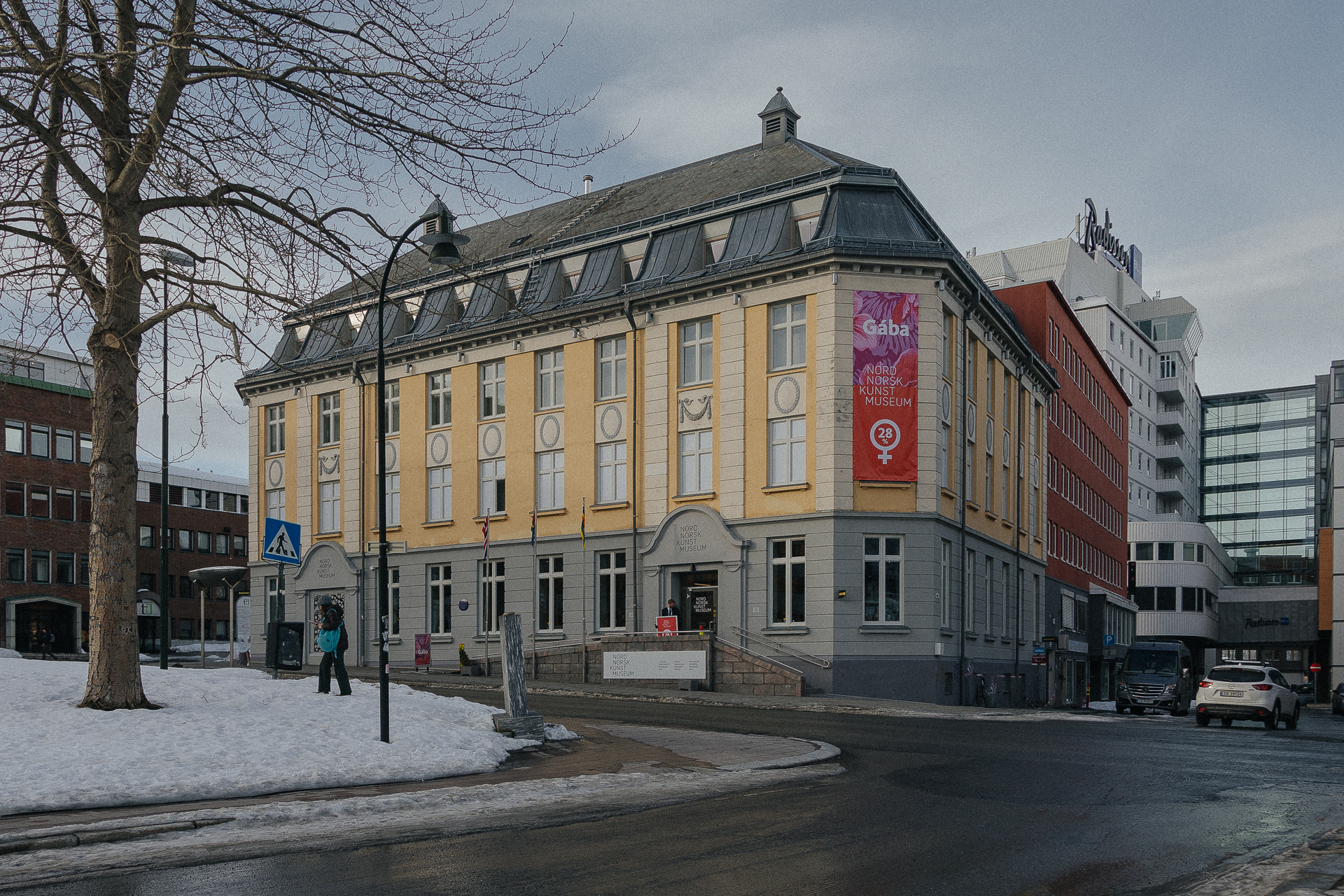
Nordnorsk Kunstmuseum
The building started as a post and telegraph office in 1917, designed by architect Soren Andreas Wiese-Opsahl for the practical business of sending messages across northern Norway. By 1967, it had become a police station. Today, it holds Peder Balke's stormy seascapes and Francois-Auguste Biard's paintings of Sami life, and it has been named Norway's Museum of the Year. The Nordnorsk Kunstmuseum -- the Northern Norway Art Museum -- has occupied this reinvented building in Tromso since 2001, and its story mirrors the region it serves: resilient, adaptive, and far more interesting than its remote latitude might suggest.
Art at the Top of the Map
Established as a foundation in 1985, the Nordnorsk Kunstmuseum carries responsibility for visual art across all of northern Norway -- the counties of Nordland, Troms, and Finnmark, plus the Arctic archipelago of Svalbard. That territory stretches from the Lofoten Islands to the Russian border, encompassing some of the most sparsely populated landscape in Europe. The permanent collection holds over 2,250 works spanning from the late 18th century to the present, though only a fraction can be displayed at any time. The museum also borrows from major institutions including the National Museum of Art, Architecture and Design in Oslo and KODE in Bergen, weaving together a collection that tells the story of how artists have seen and interpreted the far north across three centuries.
Painters of the Northern Edge
The collection's anchor is Peder Balke, the 19th-century painter who made North Cape and the Arctic seas his subjects when most Norwegian artists were focused on the gentler landscapes of the south. Balke's From North Cape, painted in the 1860s, captures the raw energy of the northernmost point of continental Europe in a way that feels almost abstract. Alongside him hang works by Adelsteen Normann, whose luminous fjord scenes helped create the international image of Norway, and Harriet Backer, whose interiors glow with the controlled warmth of domestic light. Francois-Auguste Biard, a French painter who traveled to Scandinavia in the 1830s, documented Sami life and the Arctic landscape in large-scale canvases that mix ethnographic curiosity with Romantic grandeur. John Savio, a Sami artist who died young in 1938, contributes woodcuts that distill the northern landscape into stark contrasts of black and white. Together, these artists map a region where the light changes everything -- from the flat blue of polar winter to the golden saturation of midnight sun.
The Svalbard Satellite
In 2015, the museum opened Kunsthall Svalbard in Longyearbyen, making it among the world's northernmost contemporary art spaces. Queen Sonja of Norway performed the official opening, and the inaugural exhibition was Glacier by American artist Joan Jonas. The satellite gallery operates in a place where permafrost dictates construction methods and polar bears dictate how far you walk from town. It represents the museum's conviction that contemporary art belongs everywhere -- not just in cities with established gallery scenes but in communities perched at the edge of habitable terrain. The museum tours two to three smaller exhibitions annually through northern Norway and Svalbard, bringing art to communities that might otherwise see it only on screens.
Recognition and the Sami Dialogue
The museum's work has earned sustained critical attention. It won Norway's Art Critics Award in 2014 for the exhibition Peder Balke: Vision and Revolution, and again in 2018 for Sami Daiddamusea, a performance collaboration with RiddoDuottarMuseat that explored the intersection of Sami culture and contemporary art. That same year brought Tromso municipality's culture award and a national audience development prize. Being named Norway's Museum of the Year in 2017 confirmed what the critics had been signaling: that the Nordnorsk Kunstmuseum had evolved from a regional institution into one of the country's most vital cultural spaces. Its engagement with Sami art and artists is central to this identity -- not as an ethnographic exercise but as an ongoing creative conversation between indigenous and non-indigenous traditions about what it means to make art in the north.
From the Air
Located at 69.65N, 18.96E in central Tromso, Norway. The museum is in the city center, identifiable from the air by its position among the historic buildings near the waterfront. Tromso Airport Langnes (ENTC) is approximately 4 km northwest. The Arctic Cathedral across the Tromsosundet strait is a useful visual reference. At 2,000-3,000 ft, the compact city center of Tromso is clearly visible on its island. Kunsthall Svalbard is in Longyearbyen (ENSB), roughly 1,000 km to the north.