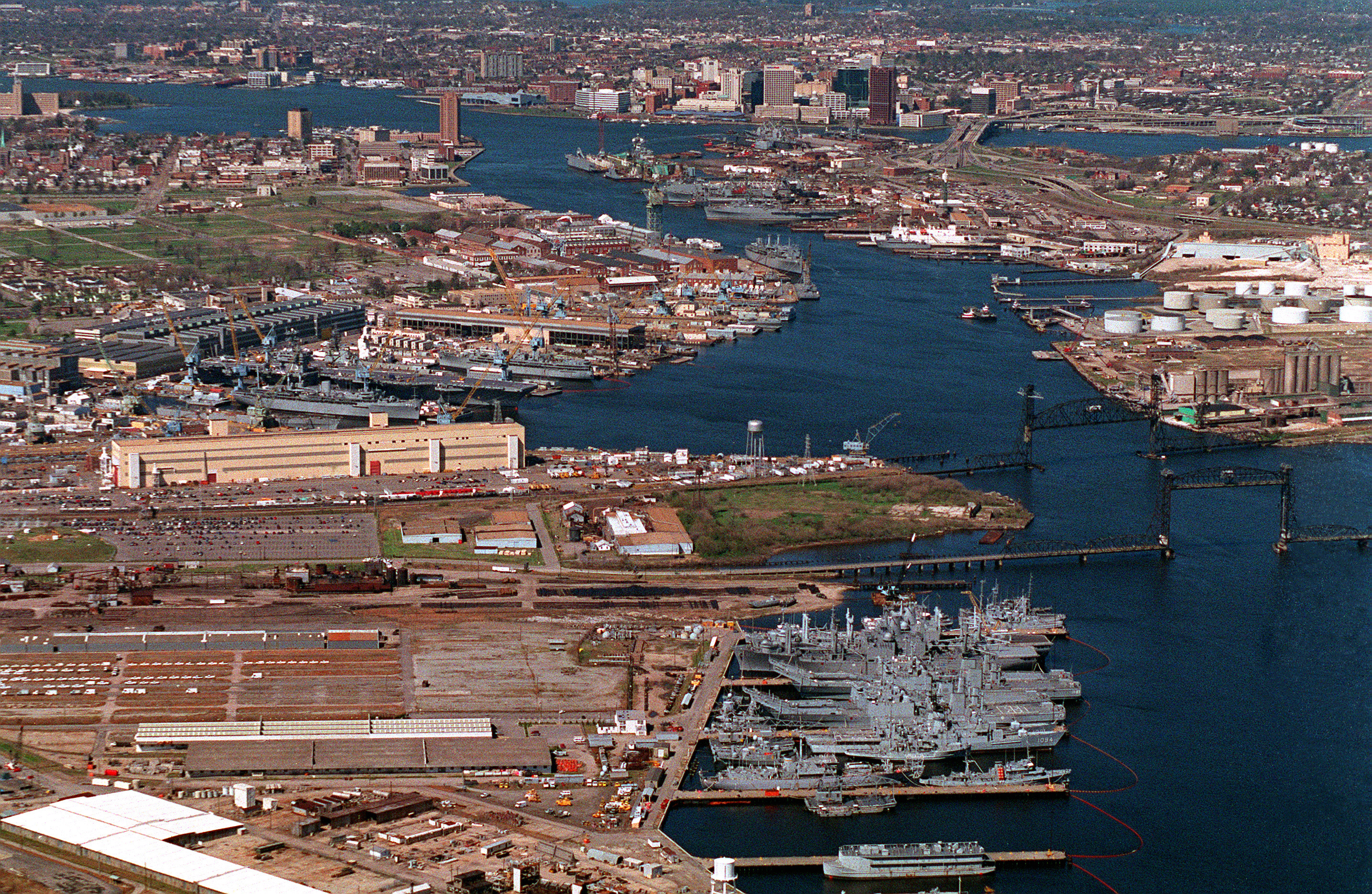
Norfolk Naval Shipyard
A single passenger train won the shipyard without firing a shot. In April 1861, with Virginia freshly seceded and the Civil War days old, railroad builder William Mahone devised a ruse so audacious it still reads like fiction. He ran one train into Norfolk with whistles screaming and bells clanging, quietly backed it out, then sent it roaring back in again, and again, creating the illusion of a massive troop arrival. Across the Elizabeth River in Portsmouth, the Union commander listening to the racket panicked and ordered the shipyard burned. The Confederates walked in the next morning to find 1,195 heavy guns waiting among the ashes. The yard on the Elizabeth River had already survived one burning, during the Revolution. It would survive this one, and another, before becoming the most comprehensive industrial facility the U.S. Navy has ever operated.
A Scotsman's Wharf on the Elizabeth
Scottish merchant Andrew Sprowle founded the Gosport Shipyard on November 1, 1767, on the western shore of the Elizabeth River in Norfolk County, Virginia. The yard prospered under the British Crown, building and servicing both naval and merchant vessels. When revolution came in 1775, Sprowle stayed loyal to the king. The new Commonwealth of Virginia confiscated everything he owned. Sprowle was exiled to Gwynn's Island with other Royalists and died there on May 29, 1776, buried in an unmarked grave. His shipyard outlived him by centuries. Virginia operated the yard until 1779, when British forces burned it during the Chesapeake raid. Congress leased it back from Virginia in 1794, and in 1795 the keel of USS Chesapeake was laid there -- she was launched in 1799 -- making her the first ship built at Gosport for the U.S. Navy. The federal government purchased the yard outright in 1801 for $12,000.
The First Dry Dock in the Americas
Construction began in 1827 on what would become Dry Dock One, and it was completed three weeks ahead of competing projects in both Boston and South America, making it the first functional dry dock in the Western Hemisphere. That dock is still operational today, a working monument listed as a historical landmark in Portsmouth. But the labor that built it carried a profound human cost. Enslaved workers made up a significant portion of the shipyard workforce from its founding through the Civil War. By 1832, 78 of the 261 men working on the dry dock were enslaved. George Teamoh, who labored as a ship caulker at the yard in the 1830s and 1840s, later wrote that the government had given encouragement to slavery to a greater extent than the great majority of the country had been aware. As late as 1848, almost one third of the 300 workers at the Gosport Navy Yard were hired enslaved workers.
Ironclad Revolution
After the Union abandoned and burned the shipyard in April 1861, the Confederates salvaged something extraordinary from the wreckage. The steam frigate USS Merrimack had been scuttled but only destroyed above the waterline. Confederate engineers built an innovative iron-armored superstructure onto the surviving hull and rechristened her CSS Virginia. In March 1862, Virginia steamed out of the rebuilt yard and sank two Union warships before engaging the USS Monitor in the Battle of Hampton Roads, the first clash between ironclad warships in history. The engagement changed naval warfare forever, and it began in a shipyard that had been left for dead. When the Confederates abandoned the yard in May 1862, they burned it for the third time. Union forces recaptured it and renamed it Norfolk Naval Shipyard, choosing the county name to avoid confusion with the Portsmouth Naval Shipyard in Maine.
Arsenal of the World Wars
The yard expanded during World War I to accommodate 11,000 workers. But it was World War II that transformed the facility into a colossus. The shipyard doubled in physical size, and at peak wartime production from 1940 to 1945, 43,000 personnel were employed. They repaired 6,850 vessels during those years alone. The yard modernized the battleships USS Arizona, USS Oklahoma, and USS Texas in the 1920s and 1930s, and launched the aircraft carrier USS Shangri-La in 1944, the only U.S. carrier paid for solely by war bonds. After the war, the yard shifted from construction to overhaul and repair. Its last newly built vessels, a pair of wooden minesweepers, were christened on March 28, 1953.
Nuclear Giants on the Elizabeth
Today Norfolk Naval Shipyard remains the oldest and largest industrial facility belonging to the U.S. Navy. The yard provides repair and modernization services for every type of vessel in the fleet, from submarines to guided-missile cruisers to supercarriers. In recent years its primary focus has been nuclear-powered ships. It is one of only two facilities on the entire East Coast capable of dry-docking nuclear aircraft carriers, the other being Huntington Ingalls Industries across Hampton Roads in Newport News. From Sprowle's colonial wharf to a facility that services the most powerful warships ever built, the yard on the Elizabeth River has been destroyed and rebuilt so many times that persistence itself seems to be the place's defining quality.
From the Air
Located at 36.82N, 76.30W on the western shore of the Elizabeth River in Portsmouth, Virginia. The shipyard's dry docks, piers, and industrial buildings are clearly visible from the air, sprawling along the riverfront. Look for the distinctive shape of Dry Dock One, operational since the 1830s. Naval Station Norfolk sits across Hampton Roads to the north. Nearest airports: Norfolk International (KORF) approximately 5 miles northeast, and Naval Station Norfolk (Chambers Field, KNGU). Hampton Roads Bridge-Tunnel is visible to the north. Best viewed at 3,000-5,000 feet AGL for full shipyard context.