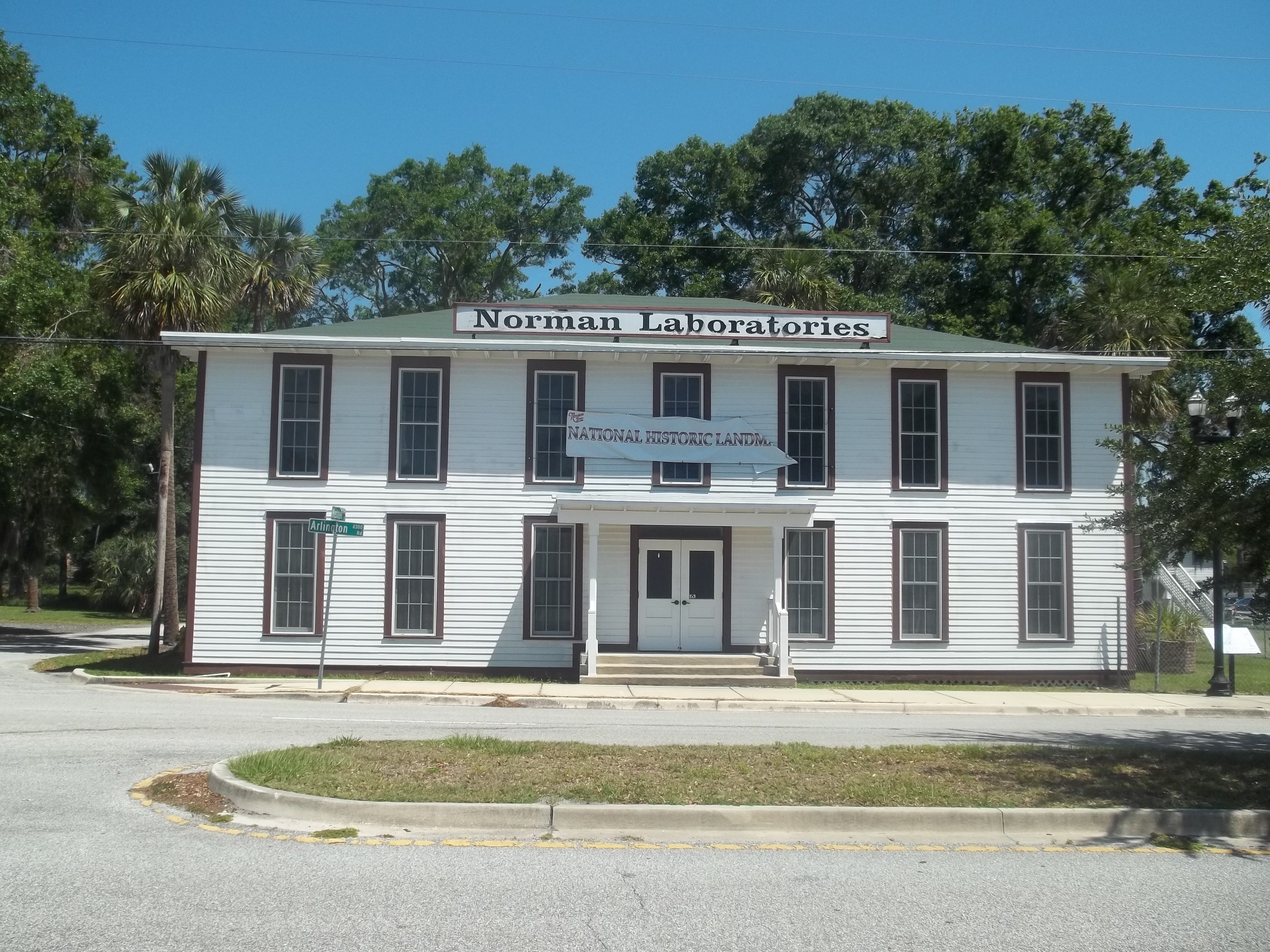
Norman Studios
Before Hollywood, there was Jacksonville. In the early twentieth century, Florida's largest city was the filmmaking capital of America, drawing studios with its year-round sunshine and cheap labor. Most of those studios vanished decades ago - torn down, repurposed, forgotten. All except one. On a quiet block in the Arlington neighborhood, five modest buildings still stand where Richard Edward Norman once did something radical: he made movies starring Black heroes. Not villains, not comic relief, not shuffling stereotypes - heroes. Cowboys who saved the girl, fighter pilots who cracked the case, sailors who found buried treasure. Between 1919 and 1928, Norman Studios produced eight feature films and numerous shorts that gave African-American audiences something mainstream Hollywood refused to offer: themselves, on screen, winning.
A Small-Town Dreamer with a Camera
Richard Edward Norman was born in 1891 in Middleburg, Florida, a rural town southwest of Jacksonville. He started young, touring small towns with a projector and a camera, filming local events like parades and church gatherings, then screening the footage and splitting the proceeds with the town. He processed his early films at a laboratory in Chicago and traveled the Midwest filming everything from civic events to a production of "Pro Patria" at the University of Illinois. His first all-Black cast film, The Green-Eyed Monster, arrived in 1919 - a railroad drama adapted from an earlier production called The Wrecker. The initial cut drew mixed reviews, so Norman did something shrewd: he split it into a drama and a comedy, releasing them separately to far better reception. The success drew attention from Black actors across the country, and Norman moved to Jacksonville, purchasing the studio in 1920 at the age of 29.
Black Cowboys and Skeleton Bandits
Norman understood that genre mattered. His films were not gentle dramas about racial uplift - they were westerns, thrillers, and adventure stories that happened to feature all-Black casts. The Bull-Dogger (1921) was shot in Boley, Oklahoma, a town billed as exclusively Black, and starred the legendary cowboy Bill Pickett alongside actress Anita Bush and Steve "Peg" Reynolds, a one-legged actor who became a Norman regular. The Crimson Skull (1922), filmed simultaneously, featured a villain in a skeleton costume terrorizing a town. Regeneration (1923) sent its characters to a deserted island for a Robinson Crusoe adventure. Norman promoted it by encouraging theaters to fill their lobbies with sand. These were race films - made by, for, and about Black Americans - but Norman's motivation ran deeper than business. He saw the untapped market of Black filmgoers and the wealth of talented performers shut out of mainstream cinema, and he filled the gap.
The Greatest Airplane Thriller Ever Filmed
Norman's masterpiece arrived in 1926. The Flying Ace told the story of a World War I fighter pilot who returns home to work as a railroad detective, solving a case of stolen payroll and a missing employee. The film was dubbed "the greatest airplane thriller ever filmed." Norman built a prop plane and used creative camera angles to simulate upside-down flying sequences - all the more remarkable because African Americans were barred from serving as pilots in the United States armed forces at the time. The Flying Ace is the only Norman Studios film known to have survived. The Library of Congress restored and preserved it, deeming it culturally significant. His final film, Black Gold (1928), was a drama about oil drilling in Oklahoma inspired by the real story of John Crisp, a Black leaseholder who struck oil on his property.
When the Pictures Learned to Talk
The rise of sound cinema killed Norman Studios. Richard Norman invested in developing a system to synchronize audio with moving images, selling units to theaters across the country. But the technology was quickly overtaken by sound-on-film methods, rendering his system obsolete. Jacksonville's film industry was already bleeding out for other reasons: Mayor John W. Martin had won election in 1917 on an anti-film platform, fed up with studios staging car chases on public streets, pulling fire alarms to capture real trucks on camera, and occasionally inciting riots. By the 1930s, the industry had decamped to southern California. Norman pivoted to distribution, then exhibition, screening films through the 1940s. His wife Gloria opened a dance school on the studio's second floor in 1935. When Pettis - as some called him - died, the buildings endured.
The Last Studio Standing
The city of Jacksonville purchased four of the five original buildings in 2002 for $260,000. Exterior restoration was completed around 2008, and the complex was reborn as the Norman Studios Silent Film Museum. On October 31, 2016, the site was designated a National Historic Landmark - the only surviving studio from Jacksonville's silent film era, and a rare monument to the race film movement that gave Black audiences stories of courage, adventure, and triumph decades before mainstream Hollywood even considered the idea. Today the museum preserves not just the physical buildings but the memory of a time when a small Florida studio dared to put Black cowboys, pilots, and adventurers at the center of the frame.
From the Air
Located at 30.334N, 81.594W in the Arlington neighborhood of Jacksonville, Florida, on the east bank of the St. Johns River. The studio complex is a small cluster of buildings not easily distinguished from altitude, but the broader Arlington area is identifiable east of downtown Jacksonville. Nearby airports: Jacksonville International (KJAX) approximately 15nm north; Jacksonville Executive at Craig (KCRG) approximately 5nm east; Jacksonville NAS (KNIP) approximately 8nm south. Best viewed at low altitude approaching from over the St. Johns River. The sprawling Jacksonville metro area and its distinctive river system provide good orientation landmarks.