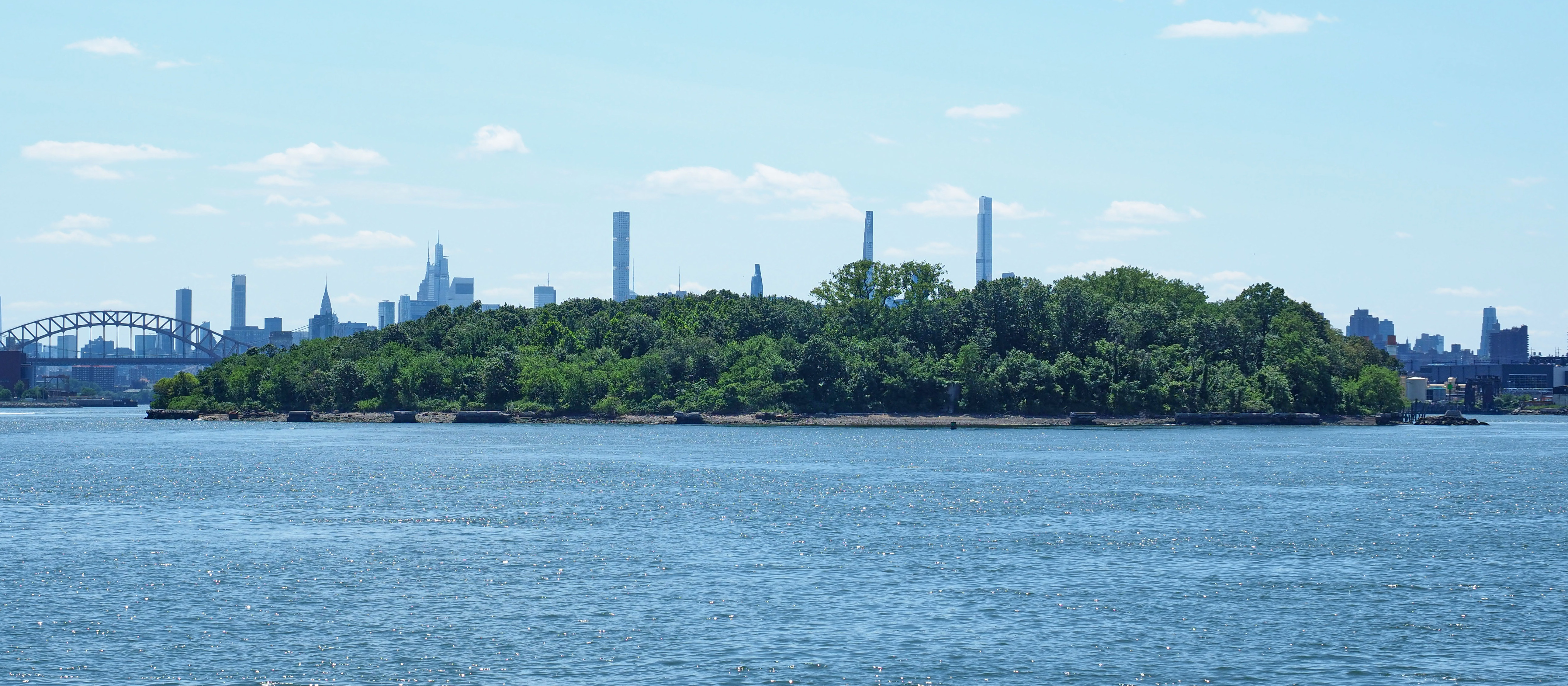
North and South Brother Islands
From the air, they look wrong -- two patches of dense forest floating in the East River between the Bronx and Rikers Island, surrounded by one of the most densely built environments on Earth. No roads lead to them. No bridges connect them. North Brother Island, about 20 acres, and its smaller companion South Brother Island, about 6 acres, are closed to the public, accessible only with special permission and a Parks Department escort. The Dutch West India Company claimed them in 1614 and named them De Gesellen -- 'the companions' -- but the currents surrounding them were so treacherous that for centuries no one bothered to build.
The Quarantine Shore
North Brother Island's isolation made it ideal for the work the mainland wanted to keep at a distance. In 1885, the city built Riverside Hospital here to house patients with contagious diseases -- smallpox, typhus, tuberculosis. The island became a place where the sick were sent and, if they were fortunate, eventually returned from. Its most famous involuntary resident was Mary Mallon, known to history as Typhoid Mary. An asymptomatic carrier of typhoid fever, Mallon was declared a public menace in 1915 and confined to North Brother Island for the rest of her life. She suffered a stroke in 1932 and spent six more years bedridden in the hospital before dying there in November 1938. Her confinement raises questions that public health officials still debate: where does the right to protect the community end and the right to personal liberty begin?
The Day the Slocum Burned
On June 15, 1904, the steamship General Slocum caught fire on the East River while carrying members of a German immigrant church community on their annual picnic excursion. The burning vessel beached on North Brother Island's shore. Of the approximately 1,300 passengers aboard, 1,021 died -- from the fire, from drowning in the treacherous currents, or pulled under by the weight of their woolen clothing. It remains one of the deadliest disasters in New York City history, and it devastated the Lower East Side's Little Germany neighborhood so completely that the community never recovered. Hospital staff on the island rushed to the shore to pull survivors from the water, but the scale of the catastrophe overwhelmed every resource available.
From Veterans to Addicts to Abandonment
By the 1930s, advances in public health had reduced the need to quarantine large numbers of people on a remote island. After World War II, North Brother Island found a new purpose housing veterans attending local colleges. When the housing shortage eased, the island was abandoned again -- until the 1950s, when a facility opened to treat adolescent drug addicts. Heroin users were confined here and locked in rooms until they were clean. Many believed they were being held against their will. Staff corruption and mounting costs forced the facility to close in 1963, and this time the island stayed empty. Since the mid-1960s, every proposed reuse -- selling the island, converting it to homeless housing, extending Rikers Island's jail -- has come to nothing.
Where the City Disappears
Nature moved in where humans moved out. Dense forest now conceals the ruined hospital buildings, their roofs collapsed, walls crumbling, hallways choked with vegetation. Poison ivy covers everything. The History Channel featured North Brother Island on Life After People as an example of what happens to structures after 45 years without maintenance -- and the real thing is more dramatic than any simulation. Journalists who have visited describe the island as "both eerie and beautiful," a place where New York City simply stops existing. Meanwhile, South Brother Island has become an officially designated wildlife sanctuary. Black-crowned night herons, great egrets, snowy egrets, and double-crested cormorants nest in its dense brush. The New York City Bird Alliance has monitored colonies here for over 20 years.
The Companions Endure
Jacob Ruppert, the brewery magnate who owned the New York Yankees, once kept a summer house on South Brother Island. It burned down in 1909. A city dump operated on the island in the mid-19th century until wealthy Bronx landowners and Queens villagers complained about the stench and a court shut it down. The islands have absorbed every use the city has thrown at them and outlasted each one. In 2007, South Brother Island was purchased with federal conservation funds and donated to the Parks Department as a wildlife sanctuary. North Brother remains in limbo, its future debated, its ruins slowly dissolving. From the air, these two green islands look almost peaceful -- like a secret the East River has been keeping from the eight million people who live around it.
From the Air
Located at 40.798N, 73.898W in the East River between the Bronx mainland and Rikers Island. The two islands appear as dense green patches amid the urban waterway -- North Brother Island is roughly 20 acres, South Brother about 6 acres. Both are uninhabited and heavily forested. Rikers Island is immediately to the southeast, LaGuardia Airport beyond. Nearest airports: KLGA (LaGuardia, 2nm east), KJFK (JFK, 12nm southeast), KEWR (Newark, 12nm southwest). Best viewed below 3,000 feet.