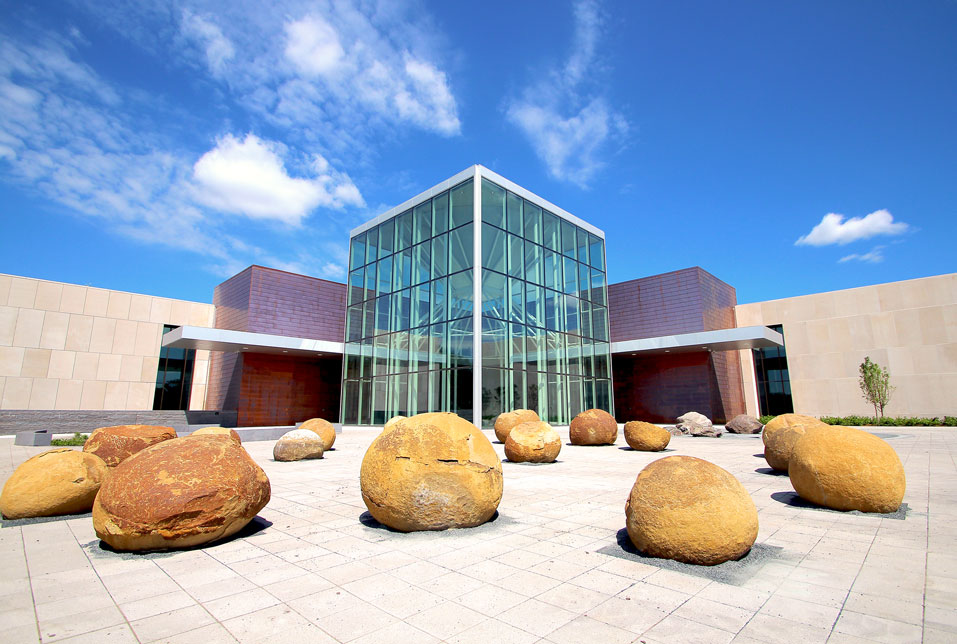
North Dakota Heritage Center
A high school student hiking near Marmarth, North Dakota, in 1999 stumbled upon something that would take paleontology by surprise: the mummified remains of an Edmontosaurus with roughly half its skin and soft tissue still intact after 67 million years. Today that specimen, known as Dakota the Dinomummy, anchors the North Dakota Heritage Center and State Museum in Bismarck, one of the most quietly impressive natural history collections in the Great Plains. Sitting on the grounds of the North Dakota State Capitol, the museum spans far more than dinosaur bones. Its galleries hold millions of artifacts covering 12,000 years of human habitation, from the earliest Paleo-Indian stone tools to the records of statehood itself.
A Dinosaur Preserved in Time
Dakota the Dinomummy is one of only about a dozen fossilized dinosaurs worldwide with fully mummified skin. Discovered in 1999 and excavated between 2004 and 2005, the duck-billed Edmontosaurus dates to the very end of the dinosaur era, approximately 66 to 67 million years ago. What makes the specimen extraordinary is that the animal was naturally mummified before fossilization, preserving skin texture, muscle impressions, and soft tissue in remarkable detail. The museum secured permanent custody of Dakota in 2008, and the specimen has been carefully cleaned and displayed in life position, with the right arm from elbow to fingertips fully visible. Alongside Dakota, the Adaptation Gallery features Triceratops and Tyrannosaurus skeletons, mosasaur specimens, and a gem, mineral, and rock collection drawn from the state fossil collection containing millions of individual specimens.
Twelve Millennia of Human Stories
The museum's archaeology and historic preservation collections contain millions of artifacts representing more than 12,000 years of human history across North Dakota. From the earliest nomadic hunters who tracked mammoths across post-glacial prairies to the Mandan, Hidatsa, and Arikara peoples who built permanent earth-lodge villages along the Missouri River, the galleries trace the long arc of habitation in a landscape most outsiders think of as empty. The State Archives housed within the Heritage Center serve as the official repository of state and local government records, preserving books, periodicals, maps, photographs, manuscripts, newspapers, oral histories, and film. A statewide network of 56 state historic sites is administered from this building, making the Heritage Center both a museum and the nerve center for North Dakota's entire historical preservation effort.
A Museum That Doubled
The original Heritage Center building opened in 1981, operated by the State Historical Society of North Dakota. But by the early 2000s, the collections had outgrown their home. A major expansion was completed with a grand opening on November 2, 2014, timed to coincide with the 125th anniversary of North Dakota statehood. The project added 127,000 square feet of collections storage, laboratories, and office space, effectively doubling the museum's total footprint. Today the facility features four galleries, two theaters, an outdoor amphitheater, a cafe, a children's play area called the Treehouse, and a museum store. The Heritage Center also houses the Johnsrud Paleontology Laboratory, where visitors can sometimes watch fossil preparation in progress, and publishes the North Dakota History Journal along with several other scholarly and public-interest publications.
The Capitol Grounds Experience
The Heritage Center sits on the North Dakota State Capitol grounds, making it part of a broader civic campus that includes the distinctive Art Deco capitol tower, one of the few skyscraper-style state capitols in the country. Admission to the museum is free, and it hosts year-round events, programming, and conferences that draw school groups, researchers, and travelers passing through Bismarck. For those exploring North Dakota's past, the museum serves as both introduction and deep dive. Its collections range in scale from microscopic shells to massive dinosaur skeletons, and its archives preserve the paper trail of statehood from territorial days to the present. Whether you came to see a mummified dinosaur or to trace a family genealogy through frontier-era records, the Heritage Center rewards the visit.
From the Air
The North Dakota Heritage Center is located at 46.82N, 100.78W on the grounds of the North Dakota State Capitol in Bismarck. From the air, the distinctive Art Deco capitol tower is the primary landmark, with the Heritage Center building adjacent on the capitol grounds. The nearest airport is Bismarck Municipal Airport (KBIS), approximately 3 miles to the southeast. The Missouri River runs just west of the city. Best viewed at 2,000-3,000 feet AGL to identify the capitol complex.