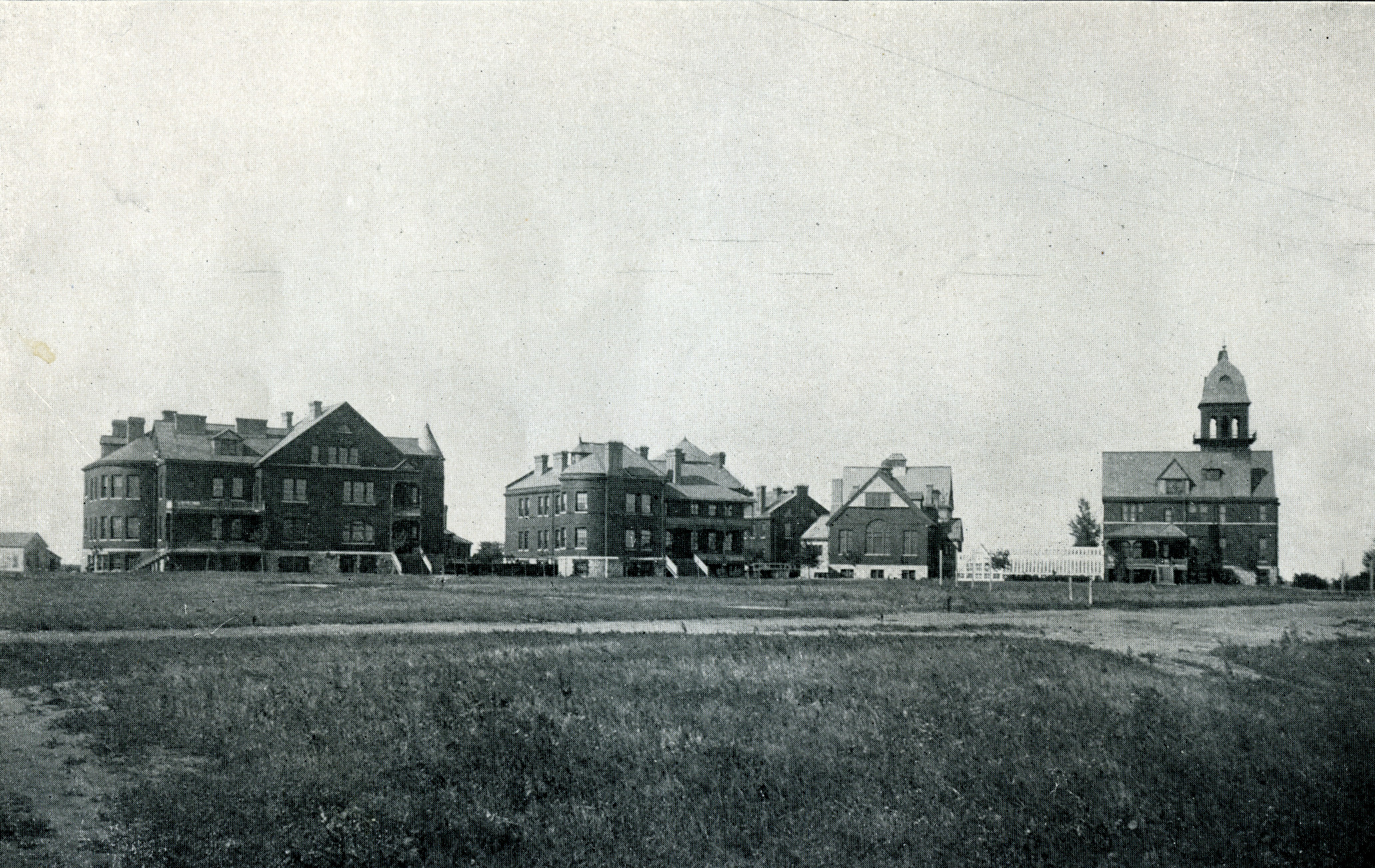
North Dakota State Hospital
The institution opened before the state did. On May 1, 1885, four years before North Dakota was granted statehood, the North Dakota State Hospital admitted its first patients on the southern rim of the James River valley overlooking Jamestown. The territorial legislature had authorized a "hospital for the insane" in 1883, making it one of only two public institutions in North Dakota to predate statehood -- the other being the University of North Dakota. Its first superintendent, Dr. O. Wellington Archibald, came from a posting with the U.S. Army at Fort Abraham Lincoln near Mandan, the same fort from which Custer had marched to the Little Bighorn nine years earlier. From its earliest days, the hospital carried the weight of a frontier territory's most difficult questions: what do we owe the most vulnerable among us, and what happens when the answer changes?
A Building That Could Not Stop Growing
Authorities initially praised the new institution, but the praise came with a catch that defined its first half-century: there were never enough beds. Patient numbers climbed relentlessly -- 106 in 1886, 819 by 1912, 1,288 by 1920. Each surge forced another round of expansion, another appropriation, another wing added to a complex that sprawled across the bluff above the James River. The hospital was not merely treating the mentally ill; it was confining those deemed criminally mentally ill, housing people that other institutions would not take, and absorbing the human cost of frontier isolation, poverty, and violence. By 1940, the patient population exceeded 2,000, and the institution had become a small city unto itself, perched on the valley rim with its own infrastructure, its own rhythms, and its own relationship to the town below.
The Stain of Forced Sterilization
Beginning in 1914, North Dakota joined dozens of other American states in practicing forced sterilization of patients deemed unfit to reproduce. The program continued into the 1950s. Patients at the State Hospital -- people already stripped of their liberty and often their legal standing -- were subjected to irreversible surgical procedures without meaningful consent. The practice reflected the eugenics movement that swept through American institutions in the early twentieth century, a movement that claimed scientific authority for what was, in reality, a program of social control directed at the poor, the disabled, and the marginalized. North Dakota's sterilization program was neither the largest nor the most notorious, but it was real, and its victims lived and suffered within the walls of this building on the bluff above the James River.
The Governor, the Purge, and the Fallout
In June 1937, Governor Bill Langer -- one of North Dakota's most controversial political figures -- fired Superintendent J.D. Carr and replaced him with Henry G. Owen. What followed was a wholesale gutting of the hospital's staff. Owen terminated 75 percent of the institution's employees, and a January 1939 report in the Fargo Forum alleged that the replacements were hired based on their contributions to the state's governing Non-Partisan League and other political connections. State special examiner Clyde Duffy investigated and found the costs were not merely financial. One hospital employee told Duffy: "The new employees didn't know how to treat the patients. They called them bad names, cussed and swore at them. Some said they would run away and some did run away." The corruption scandal laid bare a fundamental vulnerability: when a hospital for the most powerless people in the state becomes a patronage machine, the patients pay the price.
Rock Bottom and the Climb Back
By the late 1940s, the hospital had entered what observers called its "dark ages." A 1949 Fargo Forum article detailed a damning report from the American Psychiatric Association citing overcrowding, poorly qualified staff, and a general lack of organization. The legislature responded with increased funding and, beginning in 1953, an extended period of reform under Dr. R.O. Saxvik. Saxvik's reforms were comprehensive and patient-centered. He reorganized the hospital around specialized services: Adult Psychiatric Services for serious mental illnesses, Transitional Living as a psychiatric halfway house, and Chemical Dependency Services for addiction treatment. The transformation was slow, deliberate, and grounded in the emerging professional standards of postwar American psychiatry. The hospital that had once warehoused 2,000 patients began to function as a treatment facility.
A View from the Valley Rim
The North Dakota State Hospital still stands on its bluff above the James River, still serving as the state's primary psychiatric institution more than 140 years after it first opened its doors. Jamestown itself is a small city of roughly 15,000, and the hospital complex remains one of its most prominent features -- visible from the air as a cluster of institutional buildings on the southern edge of the river valley. The hospital now has its own museum, preserving artifacts and records from its long, complicated history. That history is not comfortable. It includes forced sterilization, political corruption, patient neglect, and decades of overcrowding. But it also includes reform, dedication, and the slow, imperfect work of building a humane institution in a place where the nearest help was always far away. The building on the bluff has outlasted every governor who tried to use it and every ideology that tried to define it.
From the Air
Located at 46.88N, 98.69W on the southern rim of the James River valley in Jamestown, North Dakota. The hospital complex is visible from the air as a cluster of institutional buildings on the bluff overlooking the river. Jamestown Regional Airport (KJMS) is approximately 3 nm north of the hospital. Bismarck Airport (KBIS) lies roughly 90 nm west. The James River valley is the dominant terrain feature, running roughly north-south through the area. Best viewed from 2,000-3,000 feet AGL on approach to KJMS from the south, where the hospital's position on the valley rim is most apparent. Jamestown is also known for the World's Largest Buffalo monument, visible nearby.
Sources
- North Dakota State Hospital
- State Hospital
- N.D. State Hospital's history marked by politics, reform
- North Dakota State Hospital Museum
- Wikipedia - North Dakota State Hospital
- UVM Eugenics - North Dakota
- Prairie Public Broadcasting - Eugenics and Sterilization in North Dakota