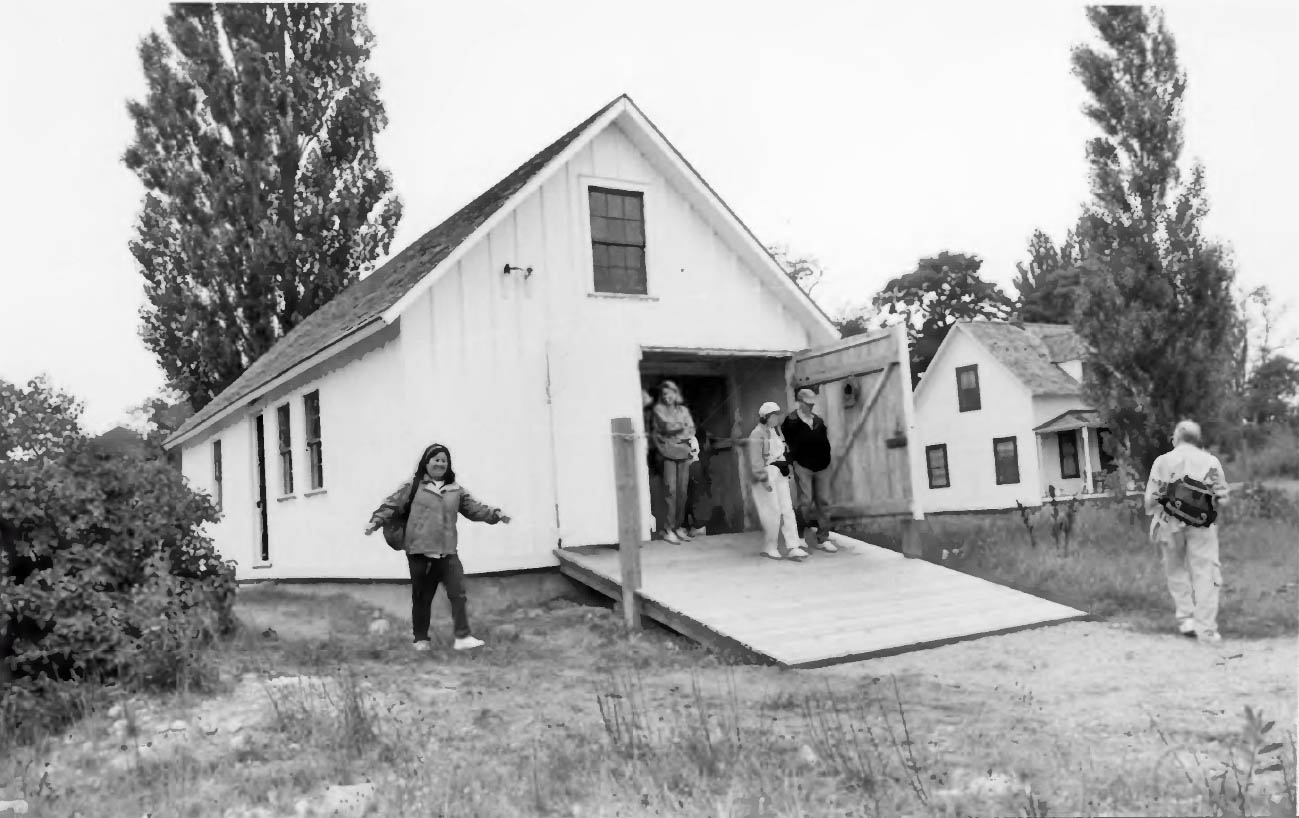
North Manitou Island Lifesaving Station
Nicholas Pickard was not a government man. He was a woodcutter who had settled on North Manitou Island in the 1840s, back when Lake Michigan's Manitou Passage was already earning its reputation as a graveyard for ships. Pickard had watched vessels founder in the churning water between his island and the mainland, and he decided to do something about it. He wrote to the federal government requesting a lifesaving boat and the standardized plans to build a station. The government obliged, and in 1854, Pickard and his neighbors constructed a cedar-clad boathouse on the island's northeast shore. That small volunteer act launched a lifesaving operation that would endure through every chapter of organized maritime rescue in American history -- the only station in the country to do so. In 1998, the complex was declared a National Historic Landmark.
Cedar Boards and Surfboats
The 1854 boathouse that Pickard built still stands -- a one-and-a-half-story frame structure clad in cedar boards, just wide enough to shelter a single surfboat with a storage loft above. It is the only surviving boathouse in the United States constructed from the government's 1854 standard plans. For two decades, volunteer crews from the island's small community of woodcutters and fishermen manned the station, rowing out into Lake Michigan's storms with nothing but muscle, courage, and a boat designed to punch through breaking waves. The work was dangerous and unpaid. When the United States Life-Saving Service was formally established in 1871, converting volunteer stations to professional operations across the Great Lakes, North Manitou Island's little boathouse was among the first to transition.
Three Eras Under One Roof
The station grew through each transformation of American lifesaving. In 1877, a proper two-story Life Boat Station rose beside the original boathouse, designed by architect Francis W. Chandler with a clipped gable end sheltering a lookout balcony where surfmen could scan the horizon for ships in distress. A paid crew arrived the following year, initially boarding with island families. By 1887, the crew had their own quarters -- a unique two-story dwelling designed by Life-Saving Service architect Albert B. Bibb, believed to be the only one of its kind ever built. The captain lived on the first floor; the crew bunked on the second. When the Life-Saving Service merged into the United States Coast Guard in 1915, the station simply changed flags and kept working. Over the decades, a pyramidal-roofed ready room, a fieldstone root cellar, a metal storm tower flying signal flags, and a generator building all joined the complex, each structure marking a new chapter in the station's long service.
The End of the Watch
By the 1930s, the station's Achilles heel had become impossible to ignore: it lacked a protected boat launch. Modern Coast Guard vessels needed harbor facilities that a sandy, exposed beach could not provide. In 1932, the Coast Guard reduced operations to a skeleton crew. Six years later, the station was decommissioned entirely and sold to the Manitou Island Association, a private corporation that converted the historic buildings into housing for employees managing the island as an exclusive hunting preserve. The surfmen's quarters became bedrooms for caretakers. The boathouse became a storehouse. The storm tower stopped flying its signal flags.
Rescue of the Rescuers
The National Park Service acquired the station in 1984 as part of the Sleeping Bear Dunes National Lakeshore. What they found was a remarkable time capsule -- buildings spanning over sixty years of construction, from Pickard's 1854 cedar boathouse to a 1916 generator shed, all clustered on a broad flat plain facing the same sandy beach where volunteer crews once dragged their surfboat to the water's edge. The Park Service carefully adapted the buildings for new use: the 1877 boathouse became a dormitory in 1990, the Bibb-designed crew quarters was renovated for staff housing in 1992, and the Hans Halseth House -- a crew member's private home originally built in the 1890s and relocated to the station grounds in 1912 -- was restored as employee housing. The complex sits on the northeast shoreline of North Manitou Island, separated from the island's former village by a grassy field, surrounded by the deep quiet of an island with no permanent residents and no wheeled vehicles.
Sentinel on the Shore
Today the station complex is accessible only by ferry from Leland, Michigan, followed by a hike along the island's trail system. The buildings stand in a row facing Lake Michigan, their varied rooflines -- cedar gables, cross-gables, hipped pyramids, the skeletal geometry of the storm tower -- telling the story of American maritime rescue in architecture. The waters offshore still hold their dangers; over fifty known shipwrecks surround the Manitou Islands, testaments to the same treacherous currents that compelled Nicholas Pickard to write his letter nearly two centuries ago. The station he built no longer launches surfboats, but the structures endure as the most complete physical record of lifesaving history on the Great Lakes.
From the Air
The North Manitou Island Lifesaving Station is located at 45.121N, 85.978W on the northeast shoreline of North Manitou Island in Lake Michigan. The complex of buildings sits on a broad flat plain facing a sandy beach, visible from the air as a cluster of structures separated from the island's former village by open grassy fields. North Manitou Island is roughly eight miles long and four miles wide, shaped like an inverted teardrop. Best viewed below 3,000 feet AGL. The island is part of Sleeping Bear Dunes National Lakeshore. Nearest airports: Traverse City Cherry Capital Airport (KTVC) approximately 25nm southeast, Empire Airport (Y87) approximately 15nm southeast on the mainland coast. The Manitou Passage between the island and the mainland is a prominent water feature.