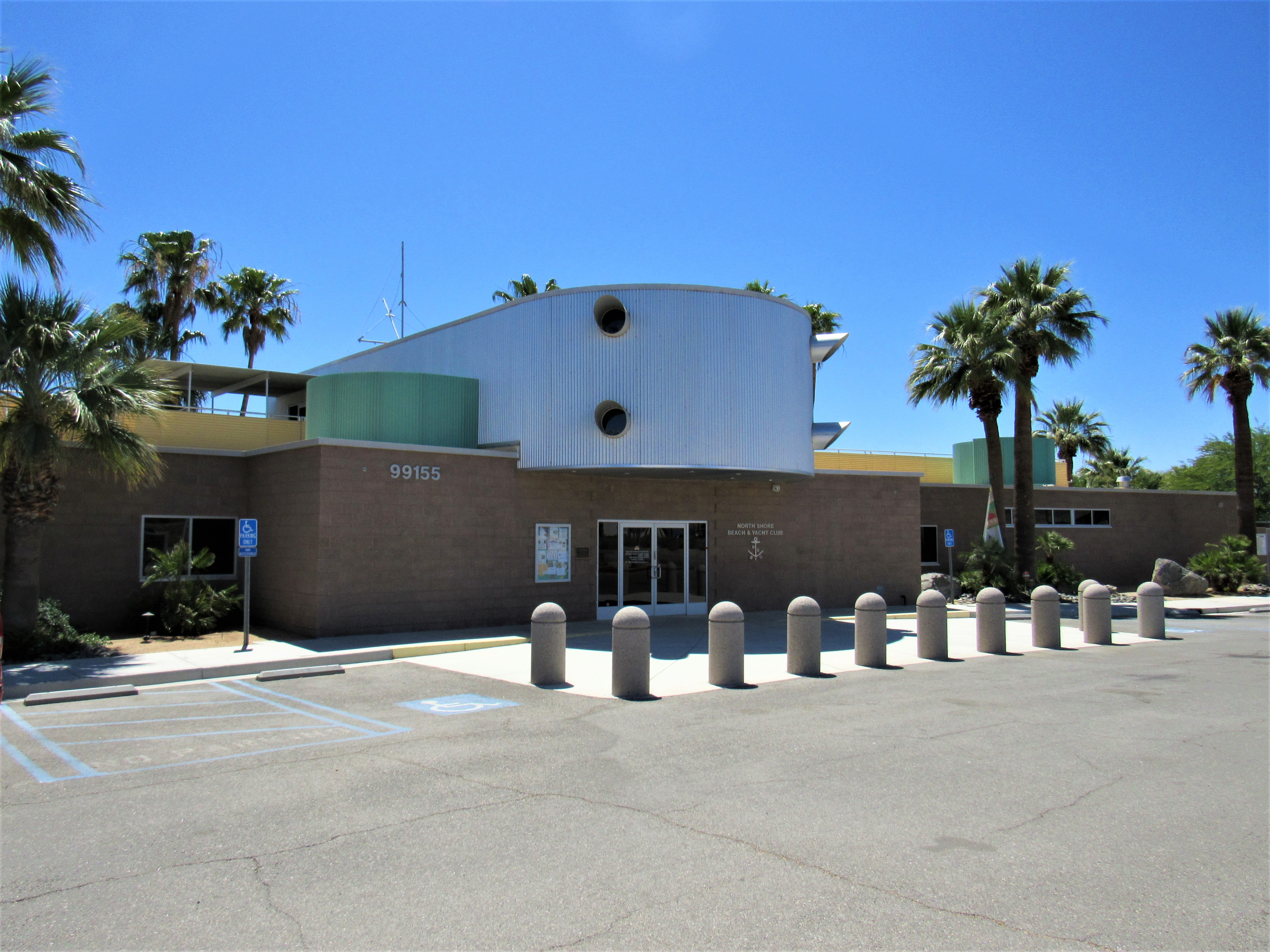
North Shore Beach and Yacht Club
There is a building on the northeastern shore of the Salton Sea that contains within its weathered concrete walls the complete biography of that strange inland lake: the optimism, the celebrities, the collapse, and the uncertain attempt at revival. The North Shore Beach and Yacht Club opened in 1962, designed by the Swiss modernist architect Albert Frey in a style that felt simultaneously futuristic and Californian. It cost two million dollars to build. At its peak, it drew more annual visitors than Yosemite. By 1984 it had been abandoned. By 2007 it was a ruin with a famous photograph. By 2010 it was a museum. The sea made all of this happen.
California's Largest Marina
When the North Shore Beach and Yacht Club opened, the Salton Sea was in its improbable golden age. The mid-century resort dream had found a home at the inland sea — boating, fishing, water skiing, and eventually a marina that was, briefly, the largest in California. The development was a two-million-dollar investment, remarkable for its time and place, and the Albert Frey design gave it an architectural distinction that matched the ambition. Frey, who had studied under Le Corbusier and made Palm Springs his adopted home, brought a desert modernism sensibility to the club that made it feel like something new rather than a copy of a coastal marina. At its peak, the club drew Frank Sinatra, Dean Martin, the Beach Boys, Marx Brothers, Bing Crosby, Desi Arnaz, and Rock Hudson — the kind of celebrity attendance that generated publicity and signaled legitimacy in the postwar entertainment economy.
The Turn
The decline of the North Shore Beach and Yacht Club followed the decline of the Salton Sea itself, and the sea's decline was written into California law. In 1968, Assembly Bill 461 declared that the primary use of the Salton Sea was to receive agricultural drainage — a legislative acknowledgment that the inland lake existed mainly as a disposal mechanism for the Imperial Valley's farm runoff, not as a recreational or ecological resource. The political and practical consequences of that framing accumulated over years. The sea's salinity climbed. Fish kills became regular events. The smell, on certain days, became impossible to ignore. Hurricane Kathleen struck in 1976, causing damage. A flood in 1981 destroyed the yacht club's jetty. The visitors stopped coming. The club closed in 1984.
Ruin and Recognition
The abandoned club sat deteriorating for more than two decades, visited mainly by people curious about decay and the photographers who follow them. In 2007, Linkin Park used the building's ruined interior for photographs associated with their Minutes to Midnight album — a choice that brought the building briefly back into public consciousness in a way that its original glamour had not managed in years. The images circulated, the building's history became part of its appeal, and by 2010 enough restoration work had been completed to reopen it as the Salton Sea History Museum. In 2015 the building was listed on the National Register of Historic Places, a designation that protected it and acknowledged what it represented: not just a building but a record of what happened when California built a resort around a lake that was already dying.
What It Means Now
The North Shore Beach and Yacht Club has a second life as a museum and as a destination for people who want to understand the Salton Sea's complicated history. The Frey design holds up — the lines are clean, the integration with the landscape is thoughtful, and the building reads as an artifact of a specific moment in California's postwar optimism that is worth preserving precisely because that moment passed. The sea outside continues its slow recession, the shoreline retreating and leaving behind salt-crusted playa. The building that once drew Hollywood's finest now draws visitors who want to understand what was lost and what might yet be saved. Grand Theft Auto V players who encountered the location know it as The Boat House, which is perhaps the most contemporary form of cultural recognition available.
From the Air
The North Shore Beach and Yacht Club is located at approximately 33.513°N, 115.927°W on the northeastern shore of the Salton Sea. From altitude the building is visible as a distinctive structure on the lakeshore, with the Salton Sea extending to the south and west. The Coachella Valley and Palm Springs area are visible roughly 30 miles to the northwest. Thermal Airport (TRM) is the nearest general aviation facility, approximately 25 miles to the northwest.