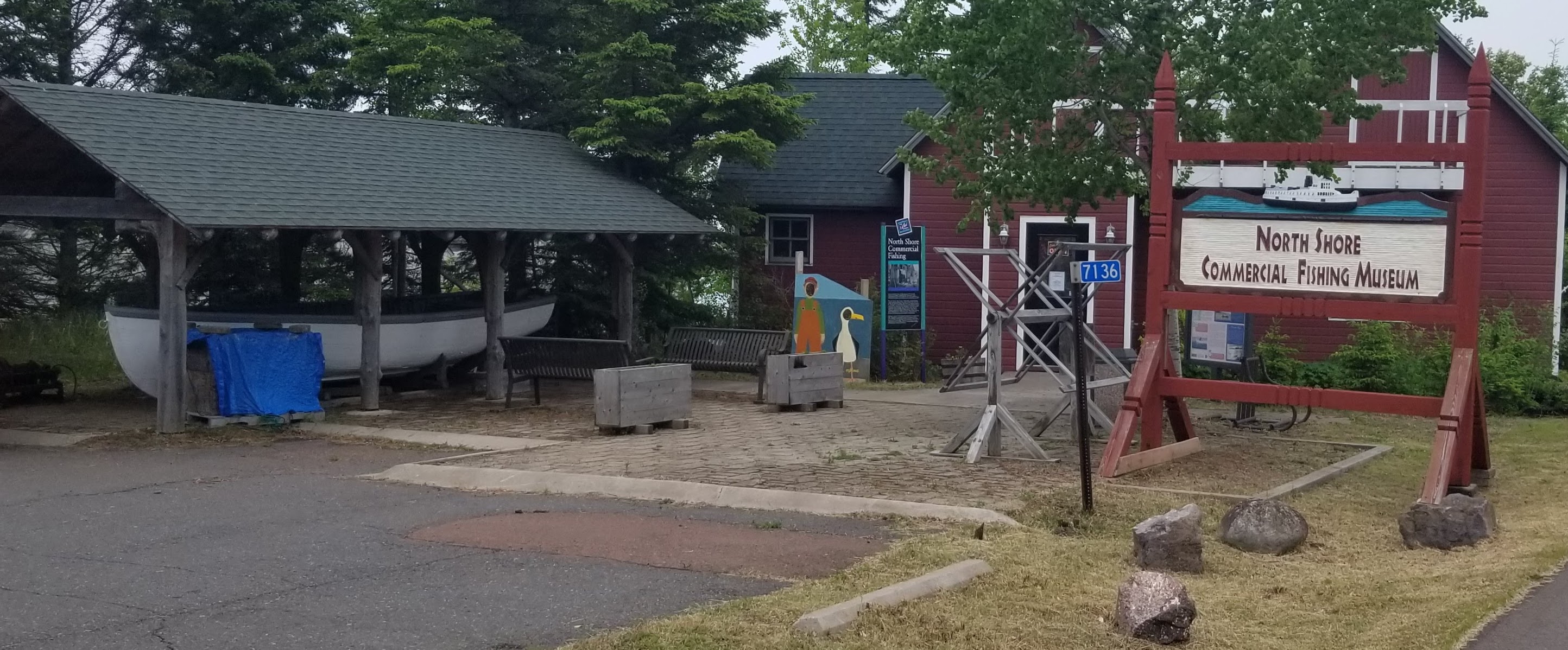
North Shore Commercial Fishing Museum
Helmer Aakvik went out to rescue a fellow fisherman lost in a late-November storm on Lake Superior. He never found the man. Instead, Aakvik himself became trapped on the icy lake, spending the night in 25-foot waves while chopping ice off his boat and his own body with an axe, fighting the disintegration of his vessel plank by plank. That story -- of courage that fell just short, of the lake's indifference to human determination -- is one of the exhibits at the North Shore Commercial Fishing Museum in Tofte, Minnesota. It is the kind of story this place was built to hold. Opened in September 1996, Minnesota's first museum dedicated to commercial fishing chronicles the Scandinavian immigrant families who turned Lake Superior's North Shore into a vital part of the national fishing industry from the 1880s through the mid-twentieth century.
Fish Houses on the Bay
The museum building itself is a replica of the 1905 fish houses built by the town's founders: Andrew and John Tofte and Hans Engelsen. The original structures once stood across the bay, wooden buildings where fishermen processed their catches and stored their gear. The replica shares space with the Lutsen-Tofte Tourism Association, a fitting partnership between the fishing heritage that built this coast and the tourism economy that sustains it now. The building's design anchors the museum in the physical culture it documents -- a reminder that the North Shore fishing industry was not an abstraction but a daily practice carried out in specific buildings, on specific boats, by families whose names still mark the landscape. Andrew and John Tofte gave their surname to the town itself.
The Scandinavian Shore
From the 1880s to the 1950s, commercial fishing was the primary livelihood along Lake Superior's North Shore, followed by logging and farming. The families who worked these waters were overwhelmingly Scandinavian immigrants, and the museum traces their journey from Norway, Sweden, and Finland to the cold shores of the largest freshwater lake by surface area in the world. The Norwegian American newspaper has called the museum "the region's most complete explanation of North Shore commercial fishing history." The museum collects photographs, equipment, and oral histories from fishermen and their families, building an archive of voices and objects that document how an immigrant community adapted Old World skills to New World waters. Fish from Lake Superior fed a growing nation during those decades, making these small North Shore communities participants in an industry of national significance.
The Viking and the Grindbygg
Among the museum's most striking exhibits is the Viking, a fishing boat owned by local fisherman Walter Sve. The boat is sheltered inside a grindbygg, a type of Norwegian boat shelter whose design dates back to the Bronze Age. This particular grindbygg was constructed by artisans from the North House Folk School in nearby Grand Marais, Minnesota, connecting modern craft traditions to centuries-old building practices. The structure protects the Viking from the elements while demonstrating how Norwegian fishing culture traveled intact across the Atlantic, adapting itself to Lake Superior's conditions while retaining forms that Scandinavian boat builders had perfected over thousands of years. Another notable exhibit features the steamship America, an important link between Duluth and North Shore communities, which sank near Isle Royale in 1928. The museum displays a scale model of the America and its bell, donated in 2001.
Stories the Lake Carries
The Schroeder Area Historical Society has published the North Shore Commercial Fishing Museum Journal quarterly since 1993 -- three years before the museum itself opened its doors. That detail says something about this place: the stories came first. The journal features articles on fishing families, lore, and the layered history of the North Shore, providing a written record that complements the museum's physical exhibits. Mike Whye of the Des Moines Register described the museum as "small, but it gives a fine account of the industry that drove this part of the state for decades." Nina Gadomski, author of the 2005 book Great Midwest Country Escapes, called it simply "a great little museum." Size is beside the point here. The museum holds something larger than its walls: the memory of families who made their living from a lake that could turn lethal without warning, and who went out on it anyway, morning after morning, generation after generation.
From the Air
Located at 47.576°N, 90.832°W in Tofte, Minnesota, on the North Shore of Lake Superior along Highway 61. Tofte sits on a small bay visible from altitude, with the museum building near the waterfront. Nearest airport is Grand Marais/Cook County Airport (KCKC) approximately 20 nm northeast. Duluth International Airport (KDLH) lies roughly 90 nm southwest along the shore. The Highway 61 corridor along the lake provides a strong visual reference. Isle Royale is visible to the northeast on clear days from higher altitudes. Best viewed from 2,000-3,000 feet AGL while following the North Shore coastline. The Tofte harbor area and small cluster of buildings along the bay distinguish the town from the surrounding boreal forest.