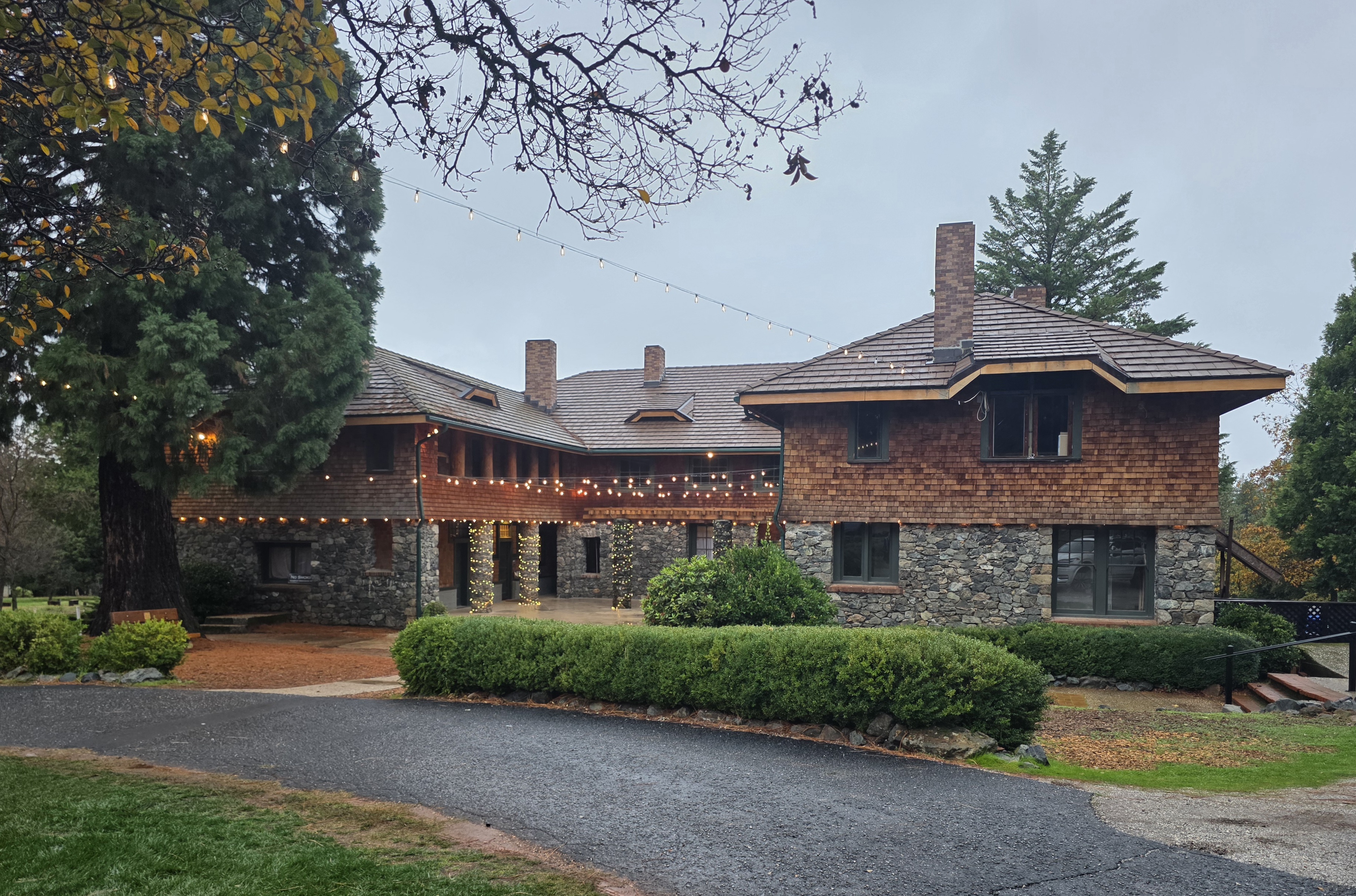
North Star House
Most architects wait years for the commission that defines their career. Julia Morgan waited exactly one month. In March 1904, she became the first woman to receive an architecture license in California. By April, she was designing an 11,000-square-foot mansion in the Sierra foothills for the president of the North Star Mine. The house she created south of Grass Valley would blend Arts and Crafts discipline with California hacienda warmth, establishing the architectural vocabulary Morgan would refine across hundreds of buildings, including her masterpiece at Hearst Castle two decades later. But North Star House belongs as much to the woman who lived in it as to the woman who designed it.
Gold, Water, and Ambition
James Duncan Hague was a mining consultant with a reputation built on science rather than luck. When he purchased the North Star Mine from William Bourne, he brought in Arthur De Wint Foote as superintendent, a decision that would transform the operation. Foote designed and installed the largest Pelton wheel turbine of its time, harnessing the power of falling water to generate compressed air for the mine's machinery. The North Star surged to become one of California's top gold producers. Success of that magnitude demanded a stage, and Hague wanted a mansion that could impress East Coast investors who might otherwise dismiss Grass Valley as a backwater mining camp. He had seen Morgan's drafting work at UC Berkeley under John Galen Howard and recognized her talent before anyone else gave her a chance.
The Architect's Signature
Morgan's design for North Star House revealed ambitions far beyond what a newly licensed architect might be expected to attempt. The California American Institute of Architects later identified three pioneering elements in the building: a blend of Classical European, First Bay Tradition Arts and Crafts, and California Hacienda styles; early use of reinforced concrete; and a multi-functional floor plan that allowed intimate conversations to flourish even during large gatherings. Twenty-two rooms spread across the mansion, connected by exposed beams, strong horizontal lines, and earth-toned shingles that made the building feel rooted in the landscape rather than imposed upon it. A courtyard divided the two wings, drawing the outdoors inside. Morgan would go on to design more than seven hundred buildings over her career, but North Star House remained a prototype for all that followed, including the 127 Hostess Houses she designed for military camps during World War I.
A New Woman in the Foothills
Mary Hallock Foote was already a celebrated author and illustrator when she moved into North Star House with her husband Arthur. But something shifted in the mansion's study after the birth of four granddaughters. Writing during the era of the New Woman, Foote produced two novels that startled literary critics. The Valley Road urged young women to postpone marriage, attend college, build careers, and only then marry the man they loved. In an age when parents chose their daughters' husbands and higher education remained a male privilege, the novel was radical enough to become a bestseller with five reprintings. Her second novel, Ground-Swell, went further still, portraying lesbian relationships with the same frankness. Critics marveled at these "western women" who stood up to men, voiced opinions, and spoke openly about their lives. Foote had lived the independence she described, and North Star House gave her the sanctuary to write it down.
From Devils' Mansion to Heritage Garden
When the mine closed in 1929, Arthur's son A.B. Foote and his wife Jeannette purchased the house and 170 surrounding acres. The family held it until 1968, when it was sold to a renegade preacher known only as Rev. Bill, who converted it into a boarding school for at-risk youth. By the late 1970s, rumors of misconduct circulated through the community, and locals began calling the property the Devils' Mansion. The school failed. Rev. Bill vanished. The house sat abandoned for years, deteriorating under the assault of weather, squatters, and teenagers. In 2002, Oregon developer Sandy Sanderson brokered the property's transfer to the Nevada County Land Trust, and a grant funded emergency roof repairs just before the structure would have collapsed. The North Star Historic Conservancy, formed in 2006, has been restoring the mansion with volunteer labor and community support ever since.
Roots That Endure
Arthur Foote was an engineer, but he was also a passionate horticulturist. He and his friend Luther Burbank shared plant specimens and competitive ambitions, once racing to see who could propagate a seedless plum. Neither succeeded -- the closest either came was a plum riddled with hundreds of tiny pits. Foote's Edwardian landscape surrounded the house with Washington hawthorn hedges, an orchard of persimmons, quince, hazelnuts, and cherries, and a vast vegetable garden where miners' families were invited to plant and harvest. His formal rose garden became a personal sanctuary. Today, remnants of the orchard still stand, and a Heritage Garden blooms year-round with specimens from the Foote era. The views from the terrace once stretched to the Buttes, but oaks and ponderosa pines have grown tall, trading panorama for privacy and leaving only magnificent sunsets visible through the canopy.
From the Air
North Star House is located at 39.194N, 121.076W, roughly a mile south of Grass Valley in Nevada County, California. The mansion sits in the Sierra Nevada foothills at approximately 2,500 feet elevation. Look for the historic estate along the corridor between Grass Valley and the Empire Mine State Historic Park. Nearby airports include Nevada County Airport (KGOO) approximately 4 miles north and Auburn Municipal Airport (KAUN) about 20 miles south. Best viewed at 2,000-3,000 feet AGL in clear conditions. The surrounding landscape of oaks and pines frames the property.