The Afternoon the Lights Went Out: The 2003 Northeast Blackout
At 4:10 p.m. on August 14, 2003, the lights went out. Not in one building, not in one city, but across a vast triangle stretching from Michigan to Ontario to New York. Within three minutes, 265 power plants had shut down. Fifty-five million people - 45 million Americans and 10 million Canadians - found themselves suddenly without electricity on one of the hottest days of summer. Subway trains stopped in tunnels. Traffic lights went dark during rush hour. The cascade started not with a storm or a sabotage, but with something far more mundane: a software bug in an Akron, Ohio control room and some trees that had been allowed to grow too tall.
An Alarm That Never Sounded
The root cause was almost absurdly small. A software defect known as a race condition lurked in General Electric's Unix-based XA/21 energy management system, used by FirstEnergy Corporation in their Cleveland-Akron area control room. When the bug triggered at 2:14 p.m., it silently disabled the alarm system. For over an hour, operators saw no warnings, heard no alerts. They had no idea that transmission lines in northeast Ohio were beginning to fail. At 1:31 p.m., the Eastlake generating plant had gone offline amid high demand. Power lines, heated by heavy current on the scorching day, began to sag. At 3:05 p.m., a 345-kilovolt transmission line drooped into an overgrown tree in Parma, south of Cleveland, and tripped offline. The operators never knew. By 3:32 p.m., a second major line had fallen into trees. Then a third.
Three Minutes to Darkness
The final cascade was breathtakingly fast. At 4:05 p.m., the last critical transmission line connecting the Cleveland-Akron area to the broader grid tripped from overload. In the next four minutes, the collapse spread like dominoes falling at the speed of electricity. At 4:10:34 p.m., lines between Michigan and Ohio failed. Three seconds later, eastern and western Michigan split apart. By 4:10:39, a 3.7-gigawatt surge of power was racing along the north shore of Lake Erie through Ontario - ten times the normal flow. One second later, 5.7 gigawatts reversed direction. At 4:10:46 p.m., New England severed its connection to New York to protect itself. By 4:13 p.m., it was over. More than 508 generating units at 265 power plants had gone dark, and an area stretching from Lansing, Michigan to Ottawa, Canada to New York City had lost all power.
55 Million People in the Dark
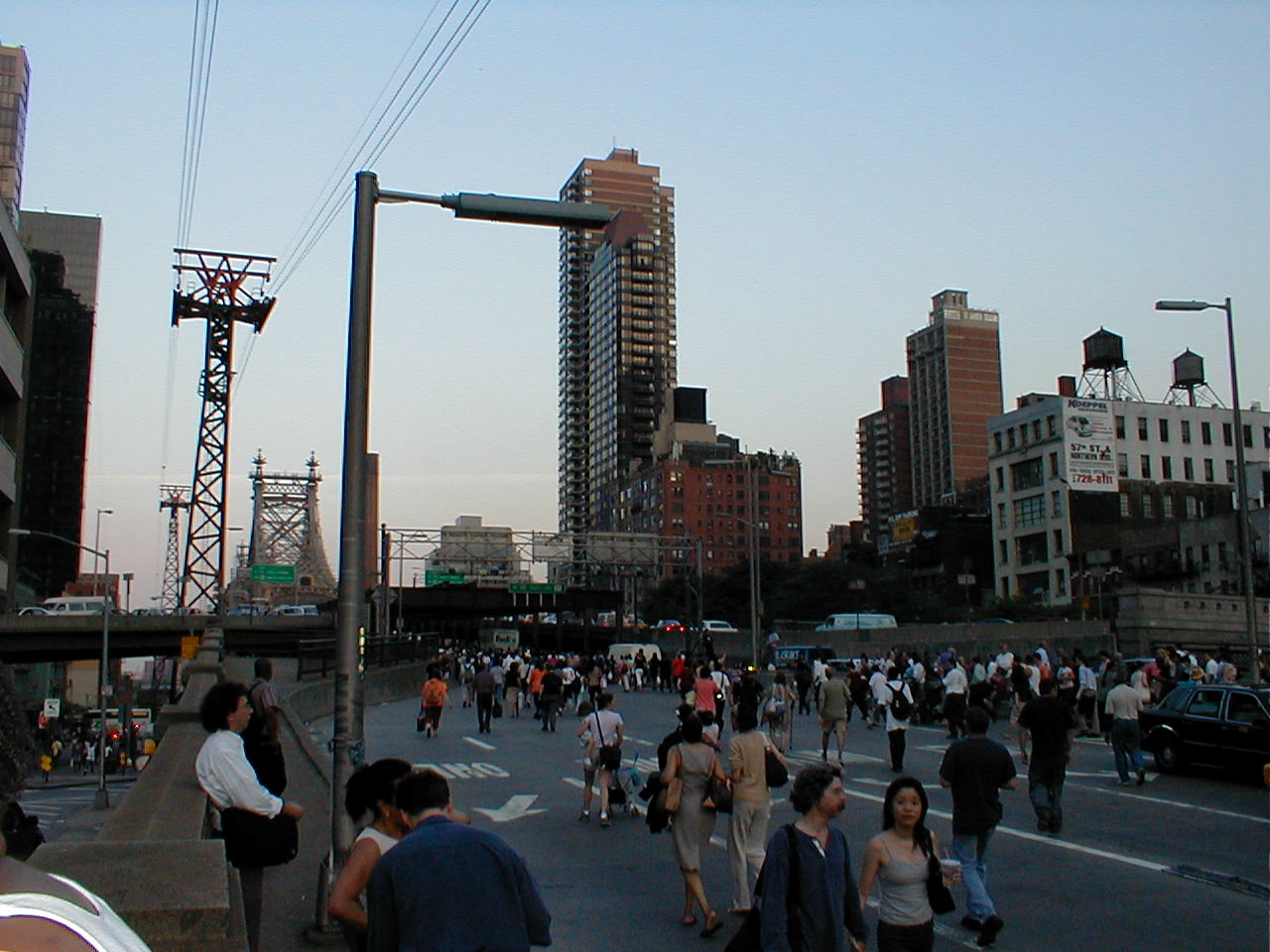
The effects rippled through every aspect of modern life. In New York City, more than 600 subway cars were stranded between stations; all passengers had to be evacuated through tunnels. Traffic lights failed across Toronto, and ordinary citizens stepped into intersections to direct cars, receiving fluorescent jackets from overwhelmed police officers. Cleveland lost water pressure entirely because its pumps ran on electricity. Detroit issued a boil-water advisory lasting four days. Gas stations could not pump fuel. At Cedar Point amusement park in Sandusky, Ohio, employees walked guests down the steps of the Magnum XL-200 roller coaster, which had frozen on its lift hill. Cell towers went dark as backup batteries died. The blackout contributed to nearly 100 deaths across the affected region.
Stars Over Toronto
Yet amid the disruption, something unexpected happened. In Toronto, residents poured into the streets, not in panic but in something closer to wonder. Florists arranged wedding flowers by candlelight. Convenience stores served customers in darkness. And for the first time in living memory, the stars appeared over the city - a dazzling canopy visible through the summer heat because every streetlight, billboard, and office tower had gone dark. The city later established an annual blackout anniversary party, held every August 14 since 2006, featuring bonfires, live music, and bike parades through darkened streets. For many Torontonians, the blackout became a treasured memory of community - neighbors helping neighbors when the grid that powered their isolation failed.
Legacy of a Bug
The joint U.S.-Canada investigation traced the entire catastrophe back to FirstEnergy's failures: inadequate tree trimming along transmission corridors, a broken alarm system no one knew was broken, and a control room flying blind during a crisis. The blackout directly inspired the Energy Policy Act of 2005, which made reliability standards from the North American Electric Reliability Corporation mandatory for American power providers for the first time. The event exposed the fragility of interconnected systems - how a single software bug in one Ohio control room could cascade through a web of interdependencies to paralyze a quarter of North America. Most areas had power restored by midnight, but some parts of New York and Ontario waited days. The total economic cost was estimated at six billion dollars. Toronto's subway did not resume service until August 18, four days later, as a precaution against further outages.
From the Air
The blackout's epicenter was the Cleveland-Akron area in northeast Ohio, centered near 41.36N, 81.57W. From altitude, the region appears as the dense urban sprawl of Greater Cleveland stretching inland from the south shore of Lake Erie. The Eastlake generating plant that initially went offline sits on the lakefront northeast of Cleveland. The transmission lines that sagged into trees ran through suburban communities south and southeast of the city. Cleveland Hopkins International Airport (KCLE) lies to the southwest. The affected area stretched from here across eight states and Ontario - an area roughly bounded by a triangle from Lansing, Michigan to Ottawa to New York City.